Sherpa

Documentaries and feature films about Mount Everest have become a dime a dozen over recent years. They all follow a pretty simplistic formula – a focus on some American or European climber chasing their dream, caught up un some terrifying existential disaster, tragedy and heroism abounding and all helpfully set against perhaps the most stunning backdrop in the world – and they all feel a little bit the same as a result. Jennifer Peedom’s Sherpa (2015) though feels totally different, and adds something new and important to the conversation.
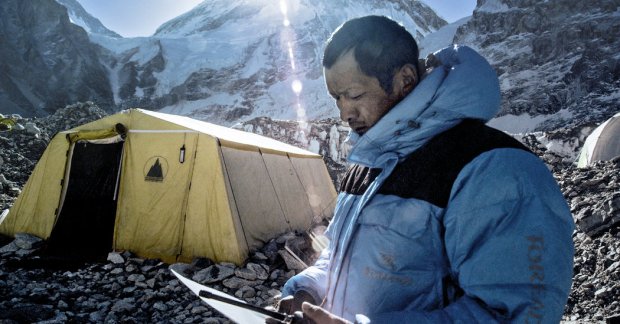
The film begins by laying out the perspective of a Sherpa, both in more societal terms and through an individual examination. From there, the film focuses on an intelligent analysis of the Everest industry, pivoting around the differing reactions to a day of major tragedy in 2014. Perhaps a better term for this western construction would be the Everest industrial complex. There is a form of racism or more accurately colonialism where westerners pay huge sums, sometimes six-figures, to climb the mountain. A mountain where they will traverse the most dangerous parts of once or twice, while the indigenous Sherpas will be required to climb the same area up to 30 times in a season. It also gets to the deep emotional connection that Sherpas have with the mountain, contrasted with the ugly, shallow pursuit of accolades apparent in those from the west. We see a man who has come to love the mountain more than his family, who has summited 21 times. An outlook built on obsession but also a very real, genuine spiritual connection to both the mountain and his continued ascent of it. As befits the location of the story, Sherpa is one of the most visually striking films I’ve seen this year, especially in the first half. Here creativity and excellent shot selection make the imagery both familiar and unique – slow-mo, snowflakes, close-ups, wide shots. There is some handheld, primary source material too, but it’s thankfully not overdone and Peedom selects when to use it, the shots to select and how long to run them for really well.

It is a surprise, a nice one though, that a film such as Sherpa has received such a wide cinema release. Eschewing expectation, ‘disaster-porn’ or putting the interest of western participants second makes the film far more interesting and intellectually stimulating, though less immediately marketable. It is the kind of film that does the festival circuit (which this one has to rave reviews), but that it would be nice to see more of in mainstream cinemas. Of course the shit does eventually hit the fan, and it is presented in a white knuckle terrifying way. This sequence is incredibly composed, the cutting together of radio chatter and footage brings to life the organisational chaos unfolding. But whilst respectfully acknowledging the tragedy, Peedom is more interested in the ramifications that it brings about. Initially there are arguments over who should go in the first chopper to the disaster site. And this divide is reflected again and again in understandably ever-broadening points of contention. Insurance, pay, respect and widespread anger toward inequity and the government’s role in it. It is here that the film’s only real failure is present. I’m not so sure that the complexity of Sherpa vs western dynamic after the avalanche is handled that well. Maybe that’s because it is just so damn complex and Peedom is not interested in giving glib niceties as the solution. But additional clarity around the root cause, specific demands and historical machinations between the two groups may have strengthened this part of the film slightly.
Verdict: Sherpa towers above similar films… like Everest if you will. Unwavering in its focus on the local connection and exploitation raging at the heart of the mountain, this is one of the best documentaries of the year so far. Pint of Kilkenny
Related beermovie.net articles for you to check out: Chasing Ice and CIFF 2014: The Salt of the Earth.
Like what you read? Then please like Beermovie.net on facebook here and follow me on twitter @beer_movie
Star Wars

Like everyone, Star Wars has been on my mind of late. So when I saw the original trilogy pretty cheap on VHS a while back I snapped them up, for a more faithful(ish) experience compared to the far too tinkered with blu-rays that are out there. These were never formative films for me in the way that they were for so many others, or the way the James Bond films or Jurassic Park (1993) were for me. I saw them as a kid, recalled liking them, but that was the extent of it.
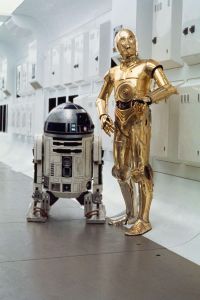 For me, Star Wars (1977) is miles away the best film in this franchise. It delivers a lean narrative, heavily influenced by classical adventure story tropes, with a sense of fun. It goes character intros (without labouring unnecessary mythology), a big action beat, regroup, bigger action beat. It really is as simple as that. But within that structure Lucas delivers a film that would spawn a legacy probably unmatched in some ways in film history. That the storytelling feels so informed by classical tales is not altogether a bad thing. Lucas is repackaging beats that have been go-tos for centuries, but making them feel at least a little inspired. It helps that with all the classical inspiration, the film is also happy to do a few unconventional things. For example, Darth Vader is revealed in no time flat. Most films would hold that back for an age, whereas this one sends him out front and centre within five minutes. The world-building of the film is an interesting aspect. We are exposed to different worlds early on and that is effective. But it’s based totally on design and physical details (or often a single physical detail) rather than any level of in-depth world-building.
Carrie Fisher gives the pick of the performances and gets reasonable screen time to go along with that, unlike Star Wars The Force Awakens (2015). Her badarse heroine s is perhaps the most original feeling character too. As good as the characters of Luke Skywalker and Han Solo are, they are very much archetypes. Lucas’ propensity for kiddie characters is apparent from the get-go too, though not overbearingly so. It’s one of the paradoxes of the Star Wars phenomenon I guess that those characters are pretty interminable in the movies, but also played a large part in driving the phenomenon that the series would become. This one is more of an ensemble piece than I recall, with Obi-Wan and the droids playing large parts, along with the three central figures. Given our current CGI saturation, the effects in Star Wars jar initially. But that fades quite quickly as the artistry, particularly in the model work, becomes apparent. That level of design artistry is so important, because let’s face it some of the character design could have gone so wrong. Designs like those of C3PO or Vader, could have looked totally silly if they were not executed so very well.

Of all the achievements of this film (and I think the original trilogy more broadly), it is John Williams’ score that may be the pinnacle. By now truly iconic, in the world of the film it is so lush and heightening. It’s not just that the score is so damn good, it’s that Lucas uses it so well. The introduction of the character of Luke, such an important moment for the entire franchise, is basically made by the soundtrack. The sound design is similarly exceptional, the whooshes of the dogfights obviously, as well as smaller flourishes like Vader’s laboured breathing. The editing though has the bemusing quality of a film student looking to impress. It is distracting and recalls Homer Simpson’s obsession with star wipes so much that I was almost a little bummed we didn’t see one here.
Verdict: Star Wars is a film of simple charms –clear adventure storytelling, a worthwhile set of sci-fi worlds, decent characters and great space-set dogfights. Here, George Lucas delivers those charms in a way that he, or anyone else, has never been able to replicate since. Pint of Kilkenny
Progress: 133/1001
Related beermovie.net articles for you to check out: Spoilertastic Star Wars The Force Awakens review and Guardians of the Galaxy.
Like what you read? Then please like Beermovie.net on facebook here and follow me on twitter @beer_movie
On Arrow, Daredevil, and how to tell a comic book story on TV

Comic book adaptations have been the rage for some time now. However oftentimes examples such as the MCU (which I love), do not feel like something with a comic book heart. Rather they feel like homogenous action/adventure stories taking vague inspiration from characters that started out in the form. Recently I’ve been delving into the first seasons of a couple of TV shows which manage to tell highly authentic comic book style stories, in two very different ways.
The heroes at the centre of both Arrow and Daredevil are what I would call ‘street level’ comic book characters. They are not gods, do not dress in super suits and are not from another planet. They don’t even have the bank balance of Bruce Wayne. Both of them start out in lo-fi costumes, unsure of what the hell they are really trying to do. Despite those character similarities, these shows feel totally different. Arrow is schlocky, it screams classic comic book tales in its telling. Daredevil is all gritty procedural, think the period comic creators realised people would still buy in if they went all grounded and dark. Daredevil is telling a very specific story, wrapped up in the mythos of the place it is occurring. On the other hand Arrow takes place in Starling City, a fictional place that functions essentially as Anytown USA, though there is also a separate plotline told in flashback form that takes place on island in the middle of the Pacific. The real-life issues of the former see Charlie Cox’s Matt Murdock/Daredevil fighting against gentrification and the evil of property developers. Oliver Queen’s is a more personal quest. He is attempting to right the wrongs that various individuals have wrought on his home-city, on an undertaking driven by a notepad his old man gave him before he died.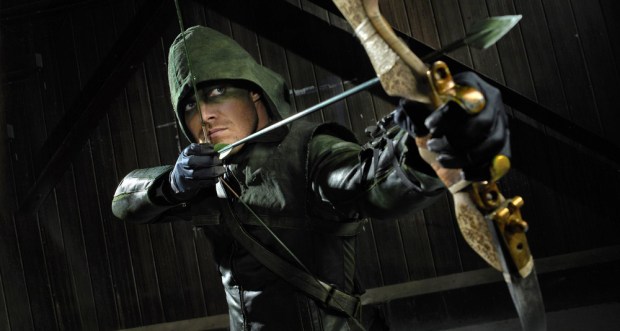
The overarching focus of Daredevil ison keeping everything grounded. The writing, whilst a little overscripted early on, wants this to feel dangerous and above all realistic. Even Daredevil’s pretty incredible sensory powers are presented in an artistic, reserved way, almost as if anything else would take the viewer out of the world of the show. The action is not like that you would see on a cinema screen. Can feel the blows and even better you can see everything that’s going on. Wish more film action was shot in a similar way, but I guess it is not showy enough. The whole show is harsh, tense, nerve shredding and oh-so violent. The action is reflective of the show’s thematic concern with the darkness and fallibility of individual humans. Perhaps the only letdown in how Daredevil is delivered is the writing on occasion. As mentioned above, it does feel overwritten at times and the dialogue is patchy, with Vincent D’Onofrio having to deliver the worst (and on occasions probably the best) of the lines as the villainous Wilson Fisk. However there is an extended sequence of a priest waxing lyrical on the nature of the devil that is the best written piece of TV I can recall seeing in ages. Arrow on the other hand brings the frivolity happily. There are people flying all over the place in their silly suits, using bow and arrows and even sillier weapons. Though there is a hell of a lot of death in this first season, Queen’s no holds barred approach coming off as quite conservative in a way. But that approach, and its ethical ramifications, evolves nicely over future seasons. Arrow brings that classical comic storytelling vibe. There are, often silly, self-contained episodes with a rollcall of villains and moustache twirling plans. But the entire story is also feeding into a larger arc that involves Oliver’s family and the most devious plan of them all. The flashbacks are really quite prominent in this first series. They serve an important function in developing the mythos of the Oliver character. But are perhaps not as interesting on a pure plot level.
Character wis e, Arrow sets itself up as a cool mini-team show (a trend that majorly continues in seasons 2 and 3) David Ramsey’s John Diggle and Stephen Amell’s Oliver have a great patter from the start that evolves from fun one-upmanship to shared commitment to a cause. Amell may have limited range, but he is great at action and able to set up a lot of the character through his physical presence. The writing of the character makes him surprisingly layered and majorly flawed. You would expect the more serious show to take this approach, but Oliver stuffs up and carries on like a bit of a jackass a fair bit in this show, much more than Murdock does in Daredevil. There is also a good family dynamic with Thea, drawing out the emotional beats and delivering some of the weight of the fact that Oliver really was marooned on an island, presumed dead, for five years. It is not easy for someone to simply return from that and have everything and everyone around him be normal. But the real star character of the supports is Felicity Smoak. Initially intended as a one episode character, Emily Bett Rickards’ winning performance obviously convinced the creators that she needed to be kept on board. Felicity is an awesome character, essentially a very capable, funny and sassy Miss Moneypenny or Lois Lane, though with more agency than either of those comparisons suggest. The fact that such high-schlock bothers with such complex characters is a major reason the show does not flame out after the original camp-fun has dissipated. On the other hand Daredevil essentially only bothers with the lead. Sure Foggy is a funny offsider, though an overblown and too comedic one. And their employee Karen actually has a fair bit to do as well as a good performance from Deborah Ann Woll that draws a whole lot of character out of the writing. But we are never that invested in what happens to these people. Perhaps the only other character we care that much about is Rosario Dawson’s Claire who functions as a really good counterpoint to Murdock. But that character appears far too little for some reason, popping up in only a handful of episodes. Even Murdock is a little thin at least in the present day action. Though like Arrow, the show delivers pretty successful flashbacks to progressively flesh out the character’s origin story.
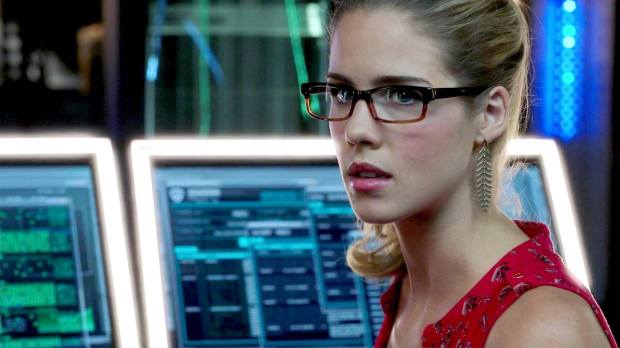
Verdict: Much has been made of an over-saturation of comic book properties and it is hard to disagree with that. But the first seasons of these two shows prove that there is scope to tell these stories in a way that is appealing to more hard-core comic book fans and broader audiences. These are the type of comics I like to read, smaller scale and for the most part contained. But they are still quite different. They both prowl the streets, but Daredevil takes an ultra-serious approach in the fight against gentrification whilst Arrow culminates in a desperate race against an earthquake machine levelling most of the city. The first will probably appeal more to those who are into this golden age of TV more broadly or general crime fans. Whilst the latter damn fun but also damn cheesy and geeky at times. If you’re like me, both of these are well worth your time (I’ve since plowed through seasons 2 & 3 of Arrow as well as The Flash season 1).
Arrow Season 1: Pint of Kilkenny
Daredevil Season 1: Pint of Kilkenny
Dirty Wars
“If they kill innocent children and call them al Qaeda,
then we are all al Qaeda.
If children are terrorists,
then we are all terrorists.”
The above is spoken by a Yemeni man, who arrived at the scene of a U.S. drone strike, and it encapsulates much of what makes the Rick Rowley directed, Jeremy Scahill driven Dirty Wars (2013) such an important film. It is a film that Scahill remarks at the beginning is “about the seen, and the unseen”. But most of what it is doing is bringing the unseen to the light where it should be viewed.

Dirty Wars focuses on how the U.S. led ‘War on Terror’ has spiralled out of control, into a worldwide style war. A war that America wages on many fronts, in many different countries. But war has not been declared in a vast majority of them. The film really sheds a light on the clinical coldness of American operations and the overwhelming secrecy in which they are allowed to be carried out. Aspects of the war that on the surface are so surreal they must be conspiracy theories – Obama calling the Yemeni President to ensure a journalist stays imprisoned – are easily shown to be true by Rowley and Scahill. Through some really horrific personal stories, the filmmakers very simply outline the horrors being perpetuated in the ongoing American War on Terror. They talk to people, initially at one site in Afghanistan far from Kabul, where the media rarely roams. The film picks the thread of this secretive American raid with a number of innocent victims, until the whole larger story falls wide open. This is the approach that the film takes in a number of different countries, gaining personal stories into the wrongheadedness of American undertakings.
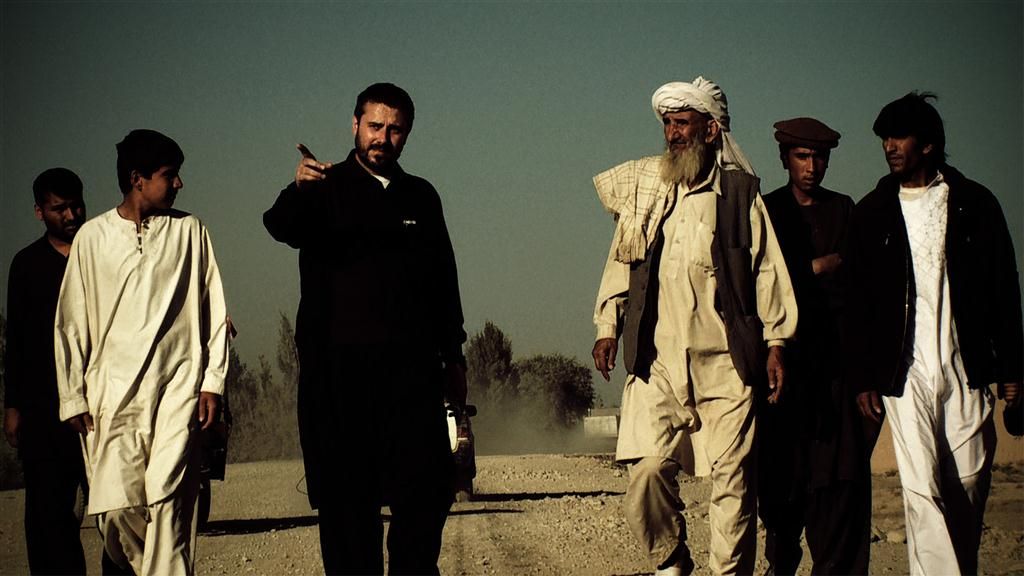
Scahill’s voiceover is pretty much ever-present and gets the balance right between providing a lot of information, without having it feel like a uni lecture. At times, the imagery onscreen is exceptionally confronting, we see dead children, the acceptable ‘collateral’ damage that the war is bringing. The filmmaking duo, combine to invoke a Michael Moore style approach in some ways, though without a lot of his gimmickry and histrionics (note: I love Michael Moore and his films). But the incendiary passion and determination is there. Rowley is unseen, guiding the film from behind the camera. He leaves the in front of camera work to the charismatic Scahill. Together, the two of them shine a harsh, often embarrassing light on the inadequacy of the American military approach – see for example the commander who can’t be bothered to learn how to pronounce the name of the tribe he is working with on a daily basis. Or the manner in which Scahill is totally fobbed off when he presents damning evidence to congress. Scahill is a great frontman for the material – captivating without ever threatening to overwhelm the material. It is not the most cinematic doco you will ever see. The editing is pretty good, but at times there is a struggle weave together the great info. To find interesting images to match the exceptional story being told through the voiceover. So we are occasionally left with pretty contrived imagery, poignant close-ups of nothing in particular, while Scahill lays down some truths.
Verdict: Jeremy Scahill is a fuckin brave badass, and the film kind of reflects that. It may not be all that cinematic. But it is informative, challenging and a ‘call to arms’ of sorts. Just not the sort depicted repeatedly in this film. Pint of Kilkenny
Related beermovie.net articles for you to check out: SUFF 2014: American Arab and The Act of Killing.
Like what you read? Then please like Beermovie.net on facebook here and follow me on twitter @beer_movie
Stranger by the Lake
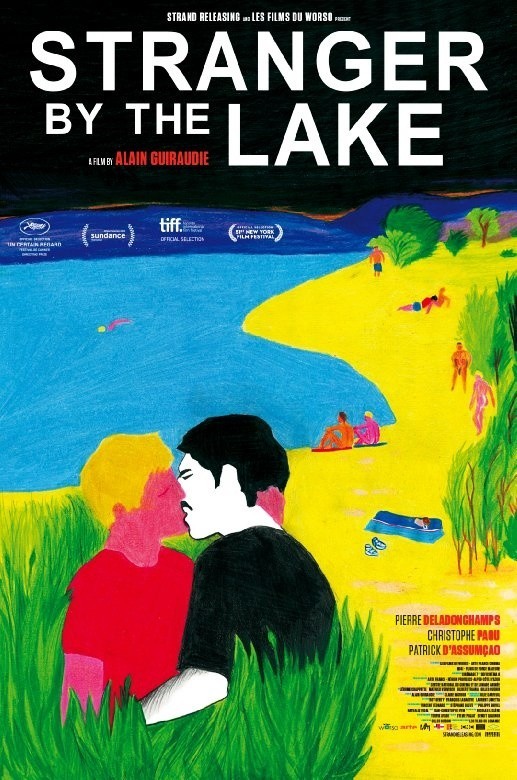
We still live in an age where sexually explicit films stand out firstly, and often only, on account of that explicitness. Think Gaspar Noe’s recent Love 3D (2015) and Lars von Trier’s wildly uneven Nymphomanic (2013). Alan Guiraudie’s Stranger by the Lake (2013) is certainly one of the most sexually explicit films I’ve ever seen, but the film’s style and economical storytelling linger a lot longer than the sex.
Stranger by the Lake opens with a slow first half, focused very much on the process of daily life. It begins with an almost silent sequence of a man arriving at a cruising spot, laying down the actions of being there – driving up, parking his car, walking to the beach through a forest, swimming and chatting to a couple of other men. The other predominant focus of the first part of the film is the establishment of character, which Guiraudie does in a very economic manner. In a way, what are being set up are archetypes, though that term does a disservice to the skill involved. Especially effective is the character of Henri, a man who sits apart from the rest of the cruising scene. This distance, his awkwardness and frumpy polo shirt, tell the audience everything they need to know about the character. It’s exposition through costume and placement of characters in space, rather than resorting to dialogue driven backstories. Similarly, with his moustache, tan and Adonis like body, we sense the alluring nature and dangerous physicality of Michel from the start, an element of that character that will haunt the main character Franck for the rest of the film.
Through the second half of Stranger by the Lake, two genres – thriller and crime – influence the film heavily. This part of the film begins with a murder, seen from a high angle, stationary shot, allowing the action to unfold just as it would be viewed in real life, but with the audience helpless to intervene. The crime aspects are the weaker of the two and perhaps some of the weakest parts of the film overall. The questioning of the various men at the lake by a lone detective is bland and laboured with no spark to the writing. The viewer never feels that the detective is serious about solving the case and there is no police-procedural style detail. The presence of the detective does help to provoke paranoia amongst some of the characters. But that could probably be generated in other ways. Thankfully though these sequences don’t take up much of the film and as a result do not affect its quality overall. In terms of the thriller aspects though, the film succeeds heartily, with an unconventional approach. Much of it is a creation of tension through omission. A body lies in the lake but doesn’t wash ashore or show up. The tension of if, and will it show up looms over the characters at the cruising spot. Similarly the simple fact of a character ceasing to show up creates tension as to their whereabouts and what they have done. The reflection of moments and interactions from the first half of the film, as well as the way Guiraudie strings those moments out, is another way in which major tension is elicited.

The widescreen shooting of the film looks totally spectacular. Much of the setting is established by a succession of glorious shots of the lake shimmering in the late evening light. The beautiful shots do not simply deliver on a visual level either, Guiraudie uses them as an integral part of his storytelling approach. The position, and especially the stationary nature of the camera, gives a sense of space and perspective. Late in the film, a shot mimics the set up when the murder was committed, building a serious amount of tension through this simple yet creative repetition, especially as it renders the audience feeling doubly powerless to intervene. Clouds rolling ever so slowly across the screen show the passing of time, as does the repeated shot of Franck’s car arriving each day, the only identifier that another day at the lake has begun. These shots are a structural tic that gives the film rhythm and progression. It’s not just time passing on a simple level, but also the advent of change – both change in a seismic life altering sense and also slow and infinitesimal change, which goes unnoticed until it is too late.
Verdict: Stranger by the Lake is a damn pretty thriller. One where the tension comes from very astute writing and the manner in which moments from the first half of the film are reflected and folded back on themselves. It all leads to an ending that, whilst a touch signposted, tears the emotional heart of the film asunder, albeit still in its understated way. Pint of Kilkenny
Related beermovie.net articles for you to check out: Locke and Tom at the Farm.
Like what you read? Then please like Beermovie.net on facebook here and follow me on twitter @beer_movie
The Terminator

No amount of derision for the late sequels can dim the love of folk for the first two Terminator films. The lacklustre reception to Terminator: Genysis (2015) reminded me that I had never really gotten around to seeing the classic entrants into the series, so it was time for Terminator (1984).

Gotta love the hair a young Bill Paxton is rocking here.
For a beloved sci-fi, the story is actually pretty stripped back. Taking place on separate timelines, 2029 and 1984, a lot of the early exposition is handled by a single screen of text explaining the rise of the machines. From there, a couple of mean dudes arrive in ’84 from the future, and the story is underway. It’s astutely written, setting up the goal of the plot (i.e. kill/protect Sarah Connor) without explaining why. It allows the action to fly from the very start, but maintains intrigue as to exactly where the plot will go. Even today, the violence in the film is quite bracing in its brutality. The body count is ultra high and with major characters possessing zero empathy, they mow numerous people down without a care. The Sarah Connor character, at least in this film, does not feel like a particularly strong one. It’s a traditionally matriarchal spot for her in a film. She has to be fought over by men, to preserve her abilities as a mother. Whilst that could be more modern, thematically the film remains resonant. You could easily patch drones onto this plot with no troubles at all. It’s a cautionary tale of the dangers of over-automation, particularly in the military sphere.

Linda Hamilton, who is so good as Sarah Connor
Arnold Schwarzenegger is a decidedly awful actor. But he does have an undeniable and unique presence to him. As such it is easy to see why the Terminator has become his most iconic role as it is designed for someone with his abilities. He doesn’t have to emote, in fact it’s better if he doesn’t. The film’s much lauded effects have undoubtedly dated to a degree. But they are yet another example of how you would take dated practical effects over dated CGI any day of the week.. It is impossible not to respect the level of craftsmanship and artistic creativity that went into the process. But there is no doubting that some of the effects work toward the film’s conclusion has a bit of a Harryhausen vibe, and not in a good way. Overall though, the design is one of the strengths of the film. Arnie’s body and the way it breaks down looks great, whilst the interaction and fuzzy borders between man and machine is rendered effectively. In addition to the lean writing, much of the tempo can be attributed to the soundtrack. Brad Fiedel’s score is electronic, but with a real authentic sounding beat, a combination that sets the pace of a lot of the action.
Verdict: Deserving of its place as an action/sci-fi classic, The Terminator still holds up despite some of its elements showing their age. It did strike me as not particularly setting up for a sequel, so I will be interested in how forced the storytelling of future films in the series feels to me. Pint of Kilkenny
Progress: 130/1001
Related beermovie.net articles for you to check out: Planet of the Apes and The Incredible Shrinking Man.
Like what you read? Then please like Beermovie.net on facebook here and follow me on twitter @beer_movie
The Thing
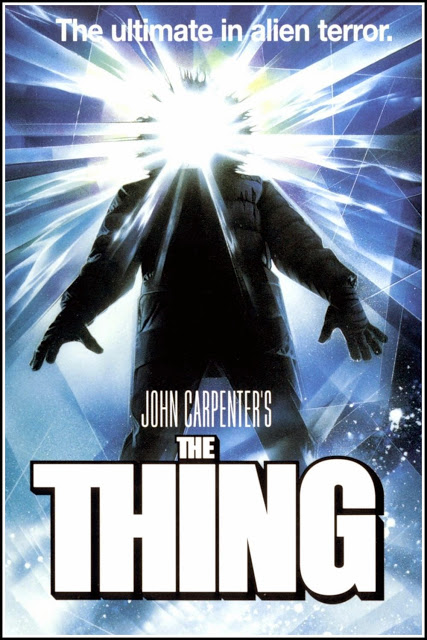
John Carpenter is one of the great genre filmmakers of all time with The Thing (1982) sitting alongside Halloween (1978), Big Trouble in Little China (1986), Assault on Precinct 13 (1976), Escape from New York (1981) and a bunch of others in his filmography. It is such a shame that he is not really working and as someone called for on Twitter we need a studio to give him a fat wad of money so he can pull a George Miller for us.
The set-up for The Thing is close to classic sci-fi 101, but in no bad way. Kurt Russel with one of cinema’s all time great beards and some other dudes are working in the harsh brutal isolation of the Arctic. Some ancient aliens get dug out of the ice and before you know it people are turning into slathering sorta alien things. But in the Animorphs/Body Snatcher style way where, at least initially, they look totally human. The plot is the classic sci-fi ‘aliens walk among us’ filtered through a proto-slasher structure. It trades nicely in that classical paranoia of who is human, and who is compromised. The lack of trust just totally eats away at people, all the while the audience is straining to guess who will be the next to die or to turn into some slathering bloody semi-human contraption. The opening shots, panning across the ice, establish the dual isolation and claustrophobia of the Arctic setting. As does a humourous early interaction between Russel’s R.J. Macready and a chess computer he derides as a “cheating bitch”. It’s a light and funny moment but it also captures the mental strain of where these men are working. The film does have some issues story-wise. The big bad is never established as well as it should have been and at one point the story seems to devolve into blokes just blowing shit up. However despite not possessing anything approaching the best horror narrative or even delivering the best horror ‘experience’, the film is still deserving of classic status, because the bits that are good are just so damn good.

Two technical aspects of the film elevate The Thing from assured genre film into the realm of classic – the practical effects by and Ennio Morricone’s work on the soundtrack. My notes for the film summed up this shift, with this extract capturing it: “oh yeah, once those effects started flying about, this got kinda awesome”. It did and it pretty much continues for the rest of the film. Indeed prior to the effects work raising up the film, it had been struggling to totally enrapture me. I was being kept at arm’s length by the assured, cool scientific feel to the story and script. The effects here are probably the best practical effects ever onscreen. But if not, then they are certainly the grossest, and yep I’m including The Fly (1986) in that discussion. My mouth literally dropped on a number of occasions, with moments like the autopsy scene or the dog metamorphosis being totally repulsive artistry. The effects are legitimately terrifying, even to this day. This is both on a visceral, gross level but also on an existential, body snatchin’, being absorbed level. As for the soundtrack, as great as Morricone is, I was a little bummed initially when I saw that he, and not Carpenter, was on scoring duties. I needn’t have worried though, because just as with the effects, Morricone’s work is quite simply about as good as it gets. From the very get-go the iconic composer brings gnarly atmospherics, plunging you into the isolated arctic freeze. The result of his score is that everything onscreen is amplified, the isolation or the visual beastly horror for example, without unnecessarily diverting the attention from the imagery at hand.

So beardy
Verdict: At times The Thing plays like an effects highlight reel scored by Ennio Morricone. Even just by itself that is no bad thing whatsoever, but throw in a little of Carpenter’s expert genre chops and Kurt Russel action leading man presence and beard, and you can easily see why this film is one of the 80s most beloved. A really fun genre experience. Pint of Kilkenny
Progress: 128/1001
Related beermovie.net articles for you to check out: Halloween Special: Halloween and A Fortnight of Terror Guest Post: The Evil Dead vs. The Thing.
Like what you read? Then please like Beermovie.net on facebook here and follow me on twitter @beer_movie
SFF 2015: Me and Earl and the Dying Girl
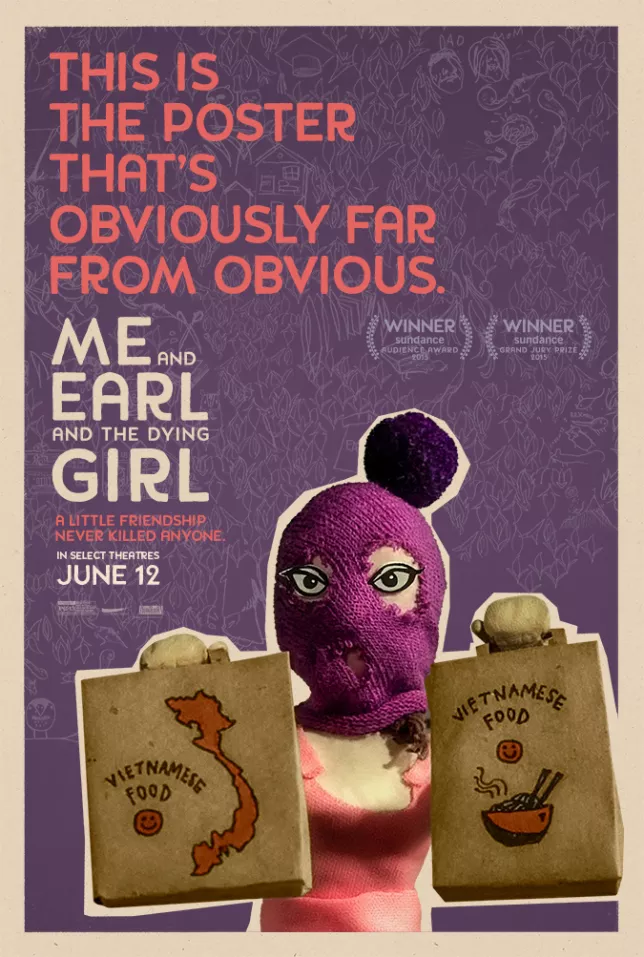
Me and Earl and the Dying Girl (2015) got an interesting reception at the Sydney Film Festival. The crowd around me were rapturous. Tears flowed and raucous laughter was commonplace. So it was not surprise that the film took out the audience award. But amongst some of the more ‘hardcore’ festival attendees, the film was pretty much dismissed as a poorly written hipster piece.
Whilst I really like the film, I can respect the latter point of view. Me and Earl and the Dying Girl did not particularly feel like a ‘festival’ film, particularly not a competition entrant, lacking the requisite toying with the form or serious exploration of theme that one expects. There is also little doubt that some aspects of the film scream indie charmer 101, especially early on. A voiceover, some claymation touches and Be Kind Rewind (2008) style remakes make the early sequences overly contrived. But the film quickly settles in and for the most part feels a lot less cloying. The film focuses on Greg and his friendship with the titular dying girl, Rachel. Greg’s mum (played by Connie Britten one half of the greatest cast parents in film history alongside Nick Offerman) forces Greg to reach out when Rachel contracts cancer. Their forced alliance gradually gives way to genuine friendship as Greg manages to provide Rachel with exactly what she needs. Earl is the main supporting character, played by RJ Cyler. Earl is Greg’s best mate who assists him to make a series of comedic, very low budget home movie remakes of arthouse classics. Perhaps more than anything it is this succession of amusingly titled remakes that make the film a good fit for the festival, putting the film’s love of cinema front and centre. The film was also a good fit for the 9:30am timeslot I saw it in. It is uproariously hilarious as well as emotionally resonant. The energy, whilst it shifted, was always there. Helped along by a score which I really dug, that turned out to be from the rather unlikely source of Brian Eno!
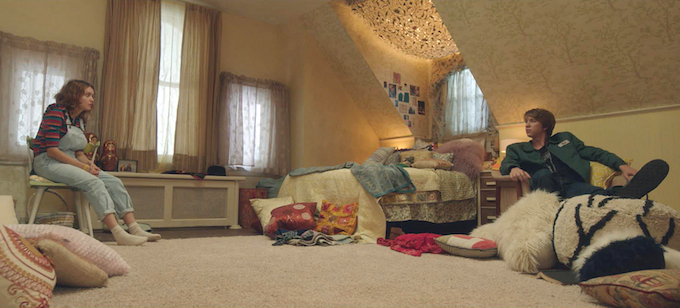
The film tells two stories, though both of them are from Greg’s point of view. The first is basically a teen film with him as the protagonist. He goes about trying to remain invisible and just survive the torrid high school years, whilst also attempting not to be too much of a self-centred asshole along the way. The second story is that of Rachel’s battle against illness, which contains the real emotional heart of the film, though still always seen from Greg’s perspective. Greg is a very sharply written character, the script and Thomas Mann’s performance combining to really nail the awkward jokiness of a teenager. The whole film is really well performed. The potential of Britten and Offerman as a couple is wasted a little, but they both do predictably very well with what they have. Cyler is really hilarious as Earl, one of the better best friend sidekicks for a while. But the real star is Olivia Cooke as Rachel. Hers is a really genuine performance, especially in the big emotional moments. Whilst the script occasionally veers toward the manipulative, the performance never feels that way and she is the real heart of the film. The plot suffers when her character disappears for a stretch through the middle of the film, which is one of the few failings of the script. Actually the script also delivered my major issue with the film. I can’t go into specifics without giving away spoilers (can discuss in the comments if you’ve seen the film) but basically I think the script betrays the audience in a very major way. In the immediate aftermath of seeing the film, it actually kind of ruined the experience for me, though that has faded quite a bit and I reflect a lot more positively now.
Verdict: Me and Earl and the Dying Girl is the kind of film to see in a big crowd. Get swept up in the love of cinema it has and the feelings it draws out of people. Occasionally its indie charm crosses over into insincerity, but when avoiding that the film is a real joy. Pint of Kilkenny
Related beermovie.net articles for you to check out: SFF 2015: The Look of Silence and SFF 2015: These are the Rules.
Like what you read? Then please like Beermovie.net on facebook here and follow me on twitter @beer_movie
SFF 2015: The Assassin
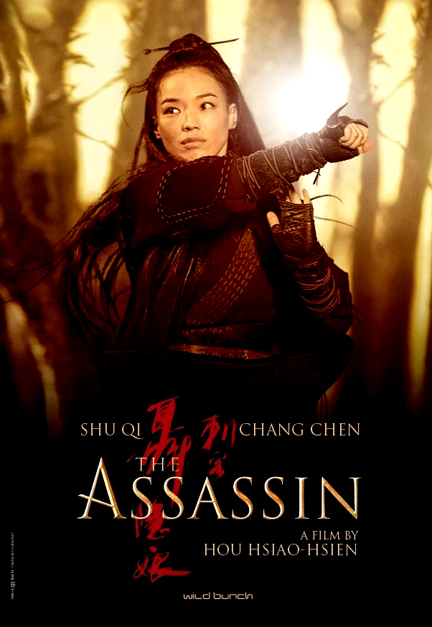
I saw the second screening of Hsiao-hsien Hou‘s The Assassin (2015) at the festival. The reaction to the first screening was not particularly appreciative. So much so I did give some vague thought to bailing on my screening.
 I hung tough though and was rewarded in my view. One major criticism of the film is that the plot is far too oblique. It is difficult to argue against that accusation, but it was just not a hindrance to my enjoyment of the film. Occasionally I just zoned out and enjoyed the experience of being at the festival and having these stunning images paraded in front of me, which was a joyful experience. This is certainly not traditional martial arts cinema. It has a slow and deliberate pace and the action sequences are relatively rare. When they do come, they are slower than the freneticism so emphasised by many of the biggest crossover stars of the genre. But there is such a deep level of thought in each one. The actions and moves of each character actually reflect the character and their predicament. The manner in which the combatants fiercely battle for control of the situation, desperation seeming to seep out of the screen, is something really rare. This approach to action plays into the tempo which is another major strength of the film. It takes its time to build both a strong visual sense and to tell the story, the long scenes strongly delineated from each other, causing the audience to pause and gather themselves before the film moves on.
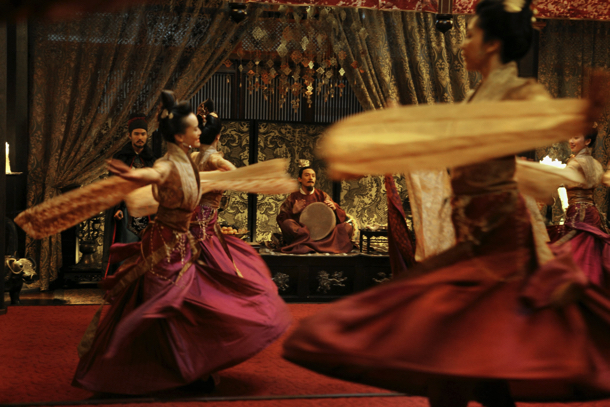
The Assassin is an utterly glorious looking film. There is a prologue shot in black and white, awash with shadow and contrast. It initially feels a shame when the film switches to colour. But Hou is able to elicit the same splendour from the new approach, with imagery popping off the screen. Even simply just sitting back and admiring the painting like composition of the shots is a treat. Seeing the brilliant choices of where to place the camera, admiring a shot from behind the camera, there is a lot to be gained from soaking in those scenes. There is a clean simplicity to the design which is maintained throughout the film. Even just simple costume touches, like the badass assassin being dressed all in black, making her instantly recognisable feel like they add a lot. There is a soundtrack that never feels intrusive but which adds to the feeling of being immersed in another time and place. Not to mention adding an exclamation mark where one is required – the swooshing of a blade as it slashes a throat for example. Conveying theme through action sequences is difficult, but here the role of human sentiments in warfare/martial arts is front and centre. Much of this comes from the fight scenes, though it is also prevalent in the plot and the evolution of the teacher-student relationship through the film as well.
Verdict: Plot-wise, there is no denying The Assassin is dense going, perhaps unnecessarily so. Having said that, it really didn’t bother me too much. Perhaps I was blinded by just how damn pretty the pictures were and the film containing some of my favourite martial arts scenes ever. Pint of Kilkenny
Related beermovie.net articles for you to check out: SFF 2015: Necktie Youth and SFF 2015: Goodnight Mommy.
Like what you read? Then please like Beermovie.net on facebook here and follow me on twitter @beer_movie
Ex Machina
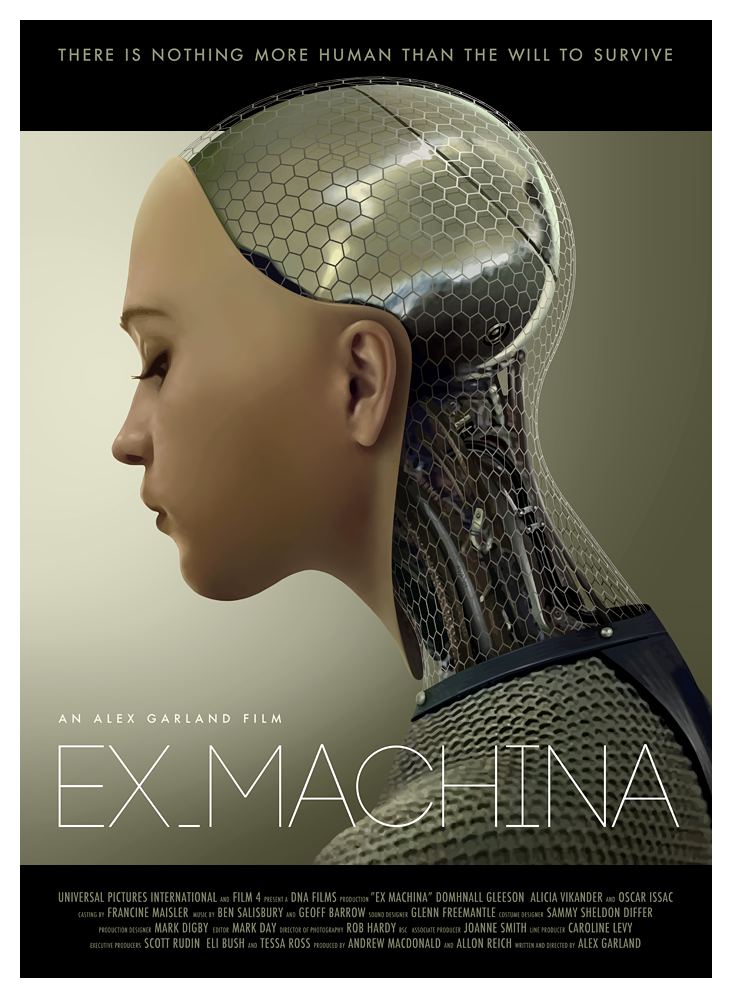
Ex Machina (2015) is the far less hyped of the two films currently doing the rounds about looming artificial intelligence. But what it lacks in hype, it makes up for in smarts and is a much more satisfying and thought provoking experience than Avengers: Age of Ultron (2015). Less explosions and witty banter though.
The film is the directorial debut of accomplished novelist and screenwriter Alex Garland, he of 28 Days Later (2002), Sunshine (2007) and Dredd (2012) fame. It sees timid boffin Caleb (Domhnall Gleeson) visiting the palatial home of the owner of the company he works for Nathan (Oscar Isaacs). Caleb is there to help the exceptionally clever and calculating Nathan test the proficiency of a new form of A.I. that he has developed. You can possibly hazard a guess at the intrigue that is to follow, thought that is not to say that it is predictable. There is a familiarity to it all coupled with an edge of intrigue as you can sense that perhaps you are not totally all over where this is headed. Garland’s script is chiefly responsible for this and it’s a very clever piece of work. There is a denseness to the scientific language that never feels too oblique or conversely jokey in its use of jargon. The script smartly guides the action and feels at times like a tightly crafted mystery almost rather than a sci-fi script. Its relatively talky, as most of the plot and themes come out in the conversations between Caleb and the feminine A.I. Ava. This includes the exploration of Ava as a sexual being, Caleb’s interest in that side of her as well as her fear of ‘death’. Interesting to see that last rather specific theme reappear so soon after Chappie (2015), which I thought (probably in the minority here), explored that pretty interestingly.
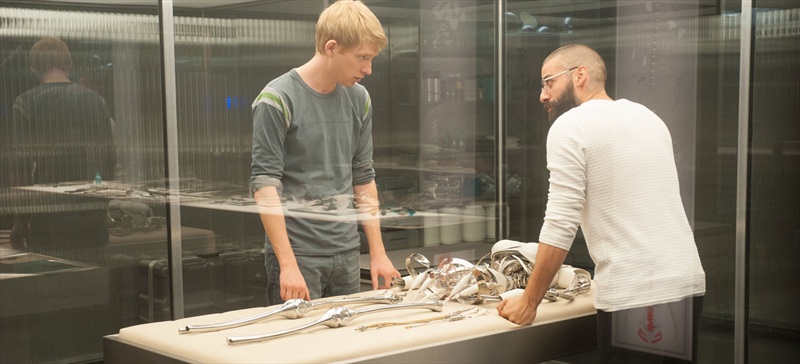
For a film by a first time director such as Garland, Ex Machina is remarkably assured. Perhaps it helps that he has been around sets so often and worked with so many maestros. It probably also helps that he wrote himself a darn good script. Despite the slow pace, there is an economy to the storytelling in the film. The first scene rapidly establishes the backstory to the film and quickly whisks the viewer off to the expansive ice covered and lush greenness of Nathan’s property. This economy never really leaves the film, with non-disclosure agreements, small chips in glass panels and much more conveying so much of the exposition that in the hands of a lesser filmmaker would be in the form of throwaway dialogue. Even the construction of the story is pretty bare bones. Alicia Vikander, as the A.I. Ava, joins Isaacs and Gleeson as the only three really key players in this story. Vikander is exceptional too, nailing that so close to human but not quite vibe that is so intrinsic to her character and the themes of the film. All three of the central performances are very good, Isaacs makes you believe in the brash, arrogant genius of Nathan whilst Gleeson, after initially overplaying the awkward overwhelmed geek aspect of Caleb, makes you really believe in the interactions between him and Ava. To see three skilled performers and have so much of the film’s success, both in terms of themes and buying into the plot, dependent on their skill is part of what makes Ex Machina so satisfying.
Verdict: If you like your sci-fi thoughtful and very smart, you will probably not be faced with a better choice at the cinema this year than Ex Machina. From what I’ve heard, Alex Garland is not all that keen to direct again after this one. Which is a shame, because if he keeps writing scripts with as much thematic depth and clarity as this one, he could have brought us a bunch more ace films. Pint of Kilkenny
Related beermovie.net articles for you to check out: Avengers: Age of Ultron and CIFF 2014: The Congress.
Like what you read? Then please like Beermovie.net on facebook here and follow me on twitter @beer_movie
 Beermovie.net