The Texas Chainsaw Massacre
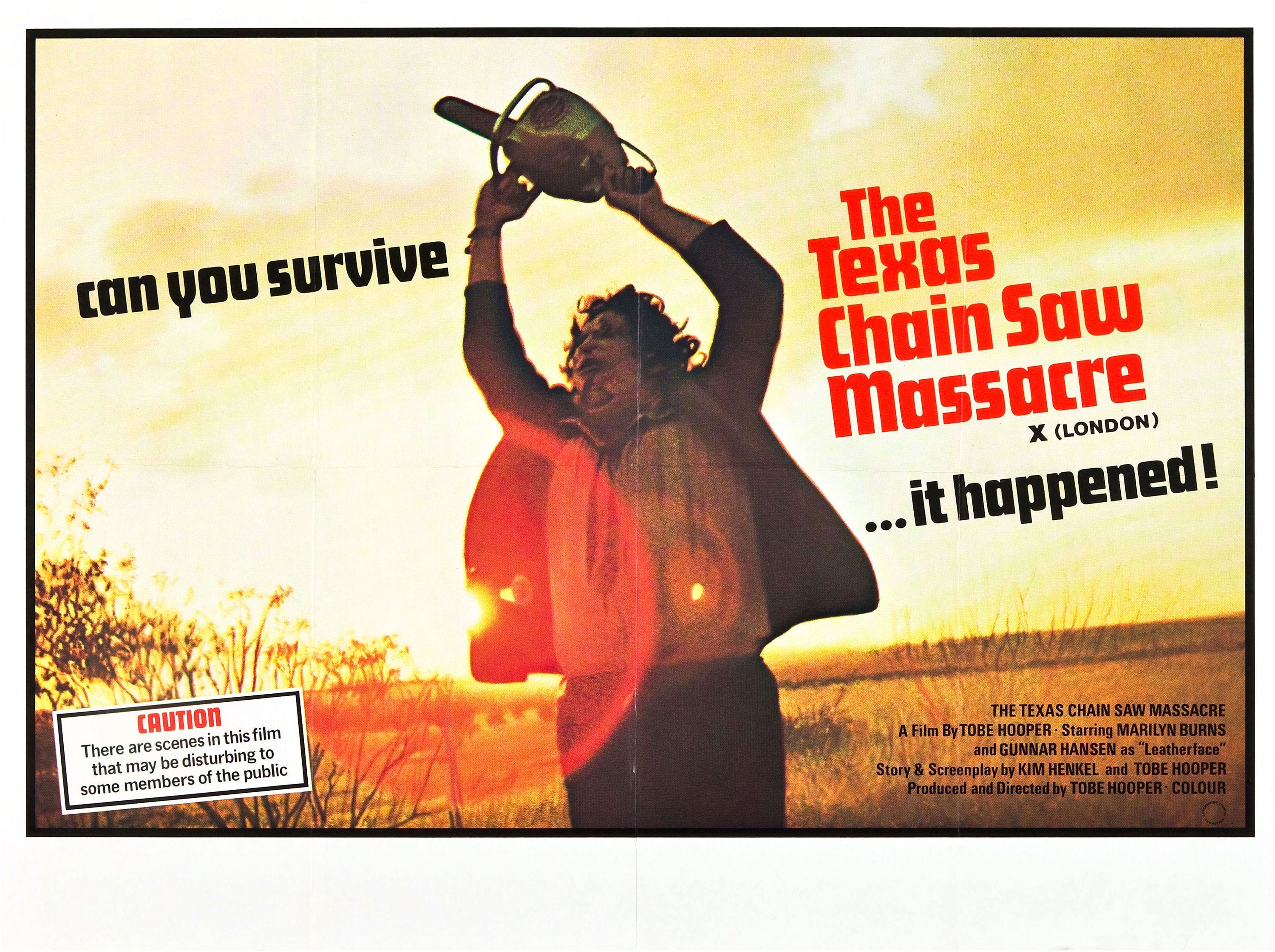
Amongst horror fiends, perhaps no film is more oft cited as a personal favourite or film that got people into the genre at a young age than The Texas Chainsaw Massacre (1974). Even if it perhaps does not hold up artistically as the absolute pinnacle of the genre, it is plain to see why the film has been so impactful for so many people.
If The Exorcist (1973) is one of the finest and most artistic films ever made that also happened to be a horror film, then The Texas Chainsaw Massacre is a short, sharp punch right in the face. Clocking in at 83 minutes, the film takes its time building up before unleashing a physically imposing villain upon a group of unsuspecting and essentially defenceless teens. The very last act slows down a little, trying to peel back the layers of motivation, and as a result the ferocious narrative force of the film tapers off a little. It also makes some silly, almost slapstick tonal choices that jar when juxtaposed with the intensity of the middle section. Though to its credit, the phenomenal final shot restores the feeling of terror that the middle section so chillingly creates. Right from the get-go of the film there is a feeling that something is not quite right, a disconcerting feeling that the world onscreen is off-kilter compared to the normality of our own. The voice-over that opens the film commenting on events to come and the utterly gross imagery that assault your eyes will immediately make you feel ill at ease. Thrown from there into a trip past a slaughterhouse and some detailed chat about the horrific ways cattle are slaughtered, it’s an atmosphere that never lets up, still underpinning events as they go from the eerie to the quick paced and shatteringly violent. It’s difficult to describe the feeling actually, occasionally it feels like you’re watching something whilst high, or that everyone in it is high. A gonzo horror film if you will, though that aspect of the storytelling does pass as the film progresses.
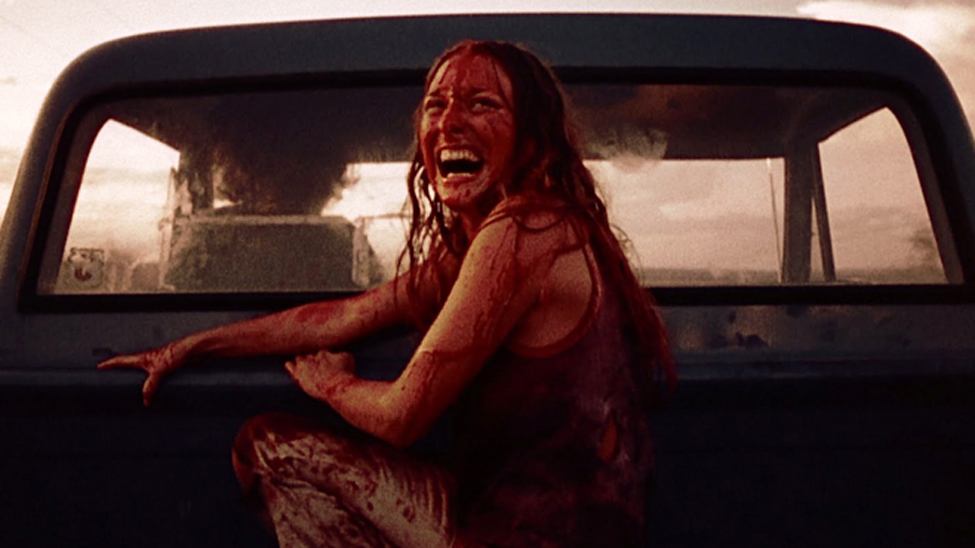
Contrary to some aspects of its reputation, The Texas Chainsaw Massacre is a very well made film. It is shot really nicely, with a pretty active camera, rather than a propensity for stationary shots favoured by many horror films. The camera is never frustratingly dynamic in its movements though, it always helps to add to the tension in the film, rather than aiming to cheaply build tension through obscuring parts of the action. The film relies a lot on fast paced editing to amp up the stakes as well as push the action pace-wise to a fever pitch. That editing is largely responsible for perhaps the best moment in the film, a chase scene which quickly flits between the fleeing heroine and Leatherface, culminating in a little chainsaw on door action. Thematically, the film makes some interesting connections between animal slaughter and the slaughter of the teen characters, which helps to hold interest through the first period before the murders start up. Once they do though, this theme is rife, reinforced by costuming, the method of the murders and how the bodies are disposed of. The brutality of the film takes on a new layer when considered in relation to the themes of animal slaughter, perhaps explaining why the film and some of the actions in it are so crushingly brutal and seemingly devoid of all purpose. Killing in the film feels wholly unnecessary. This aspect of the film is the one that has stayed with me since I saw the film and is one that I think is neglected in a lot of discussion of the film. As a villain, Leatherface is perhaps a little overshadowed by his reputation, in the fact that despite the violence he unleashes, he is plot-wise somewhat inconsequential. But he’s a terrifying physical presence and his jerky and inhuman movements are totally chilling.
Verdict: The Texas Chainsaw Massacre is as terrifying as its reputation promises. At one point after a particularly unexpected slaying I was peeking behind my couch to double check Leatherface wasn’t back there. There are some missteps for sure, but it’s a classic of the genre and feels a lot more modern than the mid-70s proto-slasher that it is. Pint of Kilkenny
Progress: 125/1001
Related beermovie.net articles for you to check out: Halloween Special… Halloween and The Exorcist.
Like what you read? Then please like Beermovie.net on facebook here and follow me on twitter @beer_movie
Secrets and Lies

Mike Leigh is known as one of the leading lights of British social realism and Secrets and Lies (1996) is generally considered to be his best film. The film was feted at Cannes upon release and continues to be discussed and revisited extensively inside film culture and criticism.
Secrets and Lies is a film of two totally separate halves, clearly delineated by a single scene. I’m not sure I’ve ever felt so differently about two halves of the same film. The first feels very domestic and at times like an episode of a soap opera, with a strange over-acting, mugging style of performances. This half of the film is almost totally without incident, setting up the three disparate storylines you know will cohere in the end, but seeming to take an interminable amount of time getting there. However just when you feel destined for a mind-numbing experience, Leigh, along with actors Brenda Blethyn and Marianne Jean-Baptiste deliver one of the better scenes of film history. I’ll avoid giving away too much detail for fear of spoilers, but it’s is a first meeting in a cafe, apparently mostly improvised in a single take. They meet and run the gamut of emotions – apprehension, awkwardness, comfort, relief and cautious affection. The two performers establish a great dynamic and blow everything up to this point away. This scene is perhaps the single greatest argument against the notion that realist films somehow equal boring. From there, the film seems to breeze by. Not because it has gotten ‘lighter’ in any sense. If anything the heavy themes are explored in more depth from this point on. But because the film has some much needed dynamism to it as new relationships are formed and impact on all of those built up so slowly in the first half of the film. This all culminates in a family BBQ that takes up most of the film’s last half hour. Just like the cafe scene, here is a sequence that is riveting on the surface level, but which also sits atop of untold depth both thematically and in terms of wrapping up the film’s plot.

The obvious thematic concern of Secrets and Lies is a focus on identity, but the concept of class and class relations is also prevalent. Notions of identity are examined through the prism of a family, like so many, straining at the seams or already broken. Part of this is an establishment by Leigh of an example of intense familial loneliness that is actually quite devastating to behold. From there it interrogates age old themes such as what defines a person and how that definition comes in opposition to those around them. Typical themes that are examined through what I think is a relatively atypical manner (again, I’m trying hard to avoid spoilers here). Similarly traditional notions of class are both parodied via exaggeration and inverted throughout the film, always reflecting and challenging those themes of identity. There is a third, very simple theme of the film too: families are totally fucked up. The film totally nails that one. Performance-wise, the film dispenses with much of the understatement so prevalent in realist film. Brenda Blethyn’s performance is a brilliant, if strange one. Through the first half, her over the top, dottering and mentally fragile mother is frequently distracting. But seeing that aspect of the performance in a new light after the rest of the film suggests it’s an effective approach as a whole. At times she is crushingly tough to watch as newfound emotions overtake that earlier dottering quality. Timothy Spall is equally good in what is perhaps a less-showy role, his photographer character provides a unique lens for the film to be seen through, as well as attempting to provide a sense of stability to the mess of a family swirling around him. And he slays an almost Shakespearean soliloquy toward the end of the film that in lesser hands would have been cringe worthy, but here it recounts the concerns of the film as well as provoking additional consideration about them.
Verdict: In the end, the achingly dull first half of Secrets and Lies is well worth enduring for the exceptional craft and heart of the second. Perhaps on a repeat viewing, the first will actually enhance what comes after it. For a thematically dense, but not tiresome drama you can do much, much worse than this. Pint of Kilkenny
Progress: 124/1001
Related beermovie.net articles for you to check out: MIFF 2014: Jimmy’s Hall and CIFF 2014: Eastern Boys.
Like what you read? Then please like Beermovie.net on facebook here and follow me on twitter @beer_movie
Groundhog Day
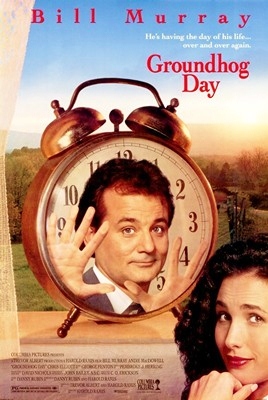
If there’s a film I see named by comedians as being influential more than any other, it’s Groundhog Day (1993). Similarly, the film’s director Harold Ramis and star Bill Murray, have an aura that seems to hold sway more in the comedian community compared to the broader public sentiment.
Often the exact reasons as to why these differences in standing preserve are intangible. But Groundhog Day also makes plain many of the reasons why. Whilst zany and offbeat, the film is impeccably and very tightly structured. The repeating structure is a framework from which Ramis and Murray can weave their magic. To achieve this, the script from Ramis and Danny Rubin cleverly builds slight layers on top of itself. It references and slightly tweaks aspects from the ‘day’ before. This is a major reason why the simple plot of Murray’s egotistical and rude TV weatherman Phil being stuck in a time loop, waking every day in a two-bit town that he despises, never becomes numbingly boring like so many of the film’s imitators. The script reflects the film as a whole. It is boisterous and thoughtful, as is the way the film is put together and progresses through musical choices and the editing. Not only that, what is such a tired plot structure actually feels very fresh here, with the script exploring all the nooks and crannies that the concept presents. The structure is used to novel ends, with the generic ‘arc’ or change of a character we expect in basically all films, technically compressed into a single day span.
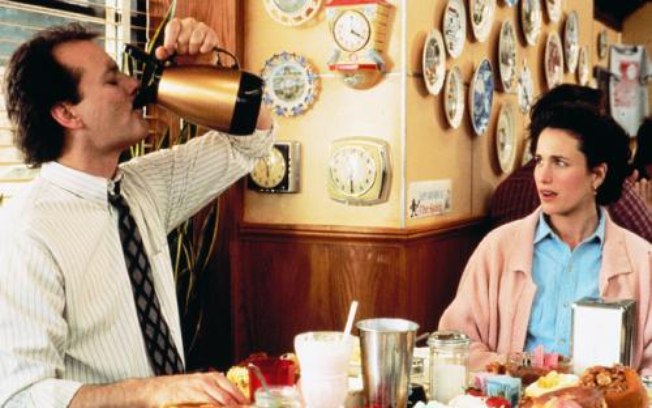
There is little doubt that a couple of the film’s plot points jar a contemporary sensibility (or perhaps just my contemporary sensibility). For a time that Murray’s character simply uses his predicament to bed women. At one point he practically tries to rape his love interest, and whilst he does in a way get his comeuppance for these acts, it is not as direct as it maybe could have been. Later on though, the manner in which Phil respectfully interacts with Andie MacDowell’s Rita and uses his ability to re-live the same day in their relationship, feeds into the core arc of the film. Those earlier moments, simply using his ‘skill’ to get into the pants of hot women around town, don’t serve the same narrative purpose. Murray’s reputation as one of the supreme comic performers is supported by this film. Right from the get-go, you can sense his comedic timing and rhythm. His whole body conveys that, his subtle movements and just the way he carries himself. These talents allow him to have the audience in the palm of his hand, whether he’s being the jerk you love to hate or the silly clown making you roar with laughter. Whilst she does not do much of the comedic heavy lifting in a ‘straight’ role, MacDowell has a really nice naiveté to her character that suits the plot and allows the audience to better appreciate the arc of Phil. The other standout performance is Michael Shannon in a wonderful two scene or so effort, mainly because it involves a Wrestlemania reference.
Verdict: This really is an exceptionally funny film and perhaps career best work from Ramis and Murray. Whilst there are occasional beats that are now a little dated, this is one of the smartest comedy scripts ever brought to life and is one of those classics that you need to track down if you’ve never seen. Pint of Kilkenny
Progress: 122/1001
Related beermovie.net articles for you to check out: The Trials of Muhammad Ali and Fightville.
Like what you read? Then please like Beermovie.net on facebook here and follow me on twitter@beer_movie
The Trials of Muhammad Ali

Nobody embodies the concept of a political sportsman more than Muhammad Ali. Dispensing with most of the sporting aspects of his life, The Trials of Muhammad Ali (2013) examines the political stances and impacts that this incredible athlete brought to bear on the twentieth century.

Ali’s brother, one of the great talking heads in the film
The Trials of Muhammad Ali is a very good example of cinema as biography, a subgenre of documentary that is generally pretty blandly done. The advantage that this film has is that it zeroes in on a very specific aspect of its subject. As such, the fact a minute approach brings so much new knowledge to the viewer (well it did for me in any case) that it is hard to keep up at some points. Ali’s early life and background are quickly sketched in. There is not a whole lot of detail, but there is more than enough to establish where he came from and how that influenced what was to follow. The optics for example of his early career, when Ali was ‘owned’ by 11 crusty old white dudes; or the fact that Cassius Clay was a white man who lived a couple of generations before Ali. The film chronicles Ali’s conversion from the “slave making religion” of Christianity to the “slave breaking religion” of Islam. Director Bill Siegel wisely digresses through this period to paint some really informative background of the history of the Nation of Islam as well as the splits that tear at it, most notably the one involving Malcolm X. This is then brought back to the focal point of the film by examining the huge impacts that Ali’s choice of religion had on his public perception in America. Just like the colour of Jack Johnson’s skin decades earlier, Ali’s allegiance to the Nation of Islam became something for the white American status quo to rail against. Though that is not to say that many in the African American community weren’t also perturbed by Ali’s choice and wished to see him fail because of it.
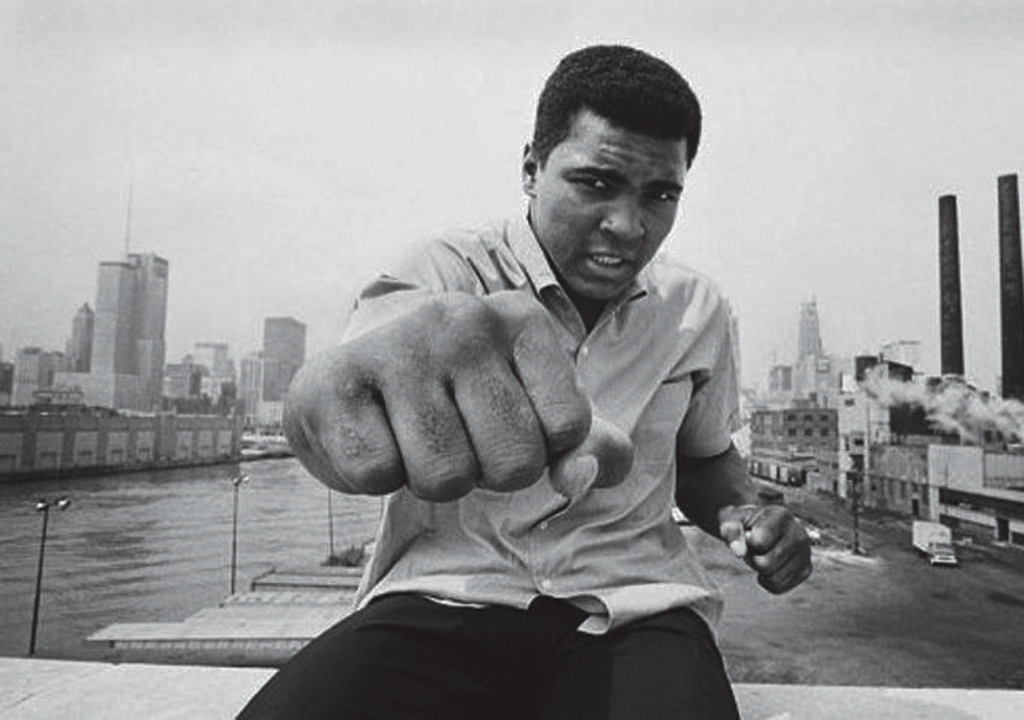
The other major focus of the film is on the refusal of Ali to join the war in Vietnam when drafted. It seems like a fairly defensible position now. But when it was made back then, by an African American Muslim no less, it was seen as a gross affront to the ‘American way of life’. The very fact that Ali was deemed unfit to continue as heavyweight champion of the world and banned from the ring, would actually partially feed into what made him so iconic in years to come. With a young family to support, Ali went on the road, speaking and honing his skills. Gradually over this time he developed the swagger and bravado that would characterise him as an athlete and which continues to inspire copycats, especially in combat sports, to this day. Again, it is impossible to not consider the lens this trash talk must be viewed through, coming from an electric African American athlete, a convert to Islam and a conscientious objector to the war in Vietnam.
Verdict: As an athlete, and a person, Ali was a revolutionary dude and incredibly ahead of his time. The Trials of Muhammad Ali effectively explains why Ali was so revolutionary by digging down into a lot of the detail around his allegiance to the Nation of Islam and refusal to fight in the Vietnam War. A must watch for and fans of sports and politics. Pint of Kilkenny
Related beermovie.net articles for you to check out: Fightville and SUFF 2014: American Arab.
Like what you read? Then please like Beermovie.net on facebook here and follow me on twitter @beer_movie
Only Lovers Left Alive

It is always so interesting to see an auteur take on subject matter generally considered the stuff of genre cinema. Stanley Kubrick pretty much made a career out of it, whilst Jim Jarmusch has shown he is not afraid to do it previously with films like Dead Man (1995). It is in that context that Only Lovers Left Alive (2013) hit last year, to some pretty universal critical love (I saw it pop up very high on a number of top 10s).
As you would expect given the director involved, this is a pretty unique take on the vampire film. It functions as an interesting reinterpretation of the vampire mythos, filtered through love story. The focus is on two vampires, Eve played by Tilda Swinton and Adam played by Tom Hiddleston. They live in Tangier and Detroit respectively, but maintain a grand love between the two of them, content to live apart so that they can explore their individual passions. These passions are initially set up a little too simply, one likes music the other books. But over time they inform and seep into their characterisation making it a much more satisfying aspect to their construction. From this base Jarmusch builds his narrative, weaving the two separate strands closer together. There are fleeting appearances by other characters, Mia Wasikowska as Eve’s sister, Jeffrey Wright as a good source of hospital blood and John Hurt as Christopher Marlowe (yes that Marlowe), though this is really all about Swinton and Hiddleston. All three of those supporting performances are unsurprisingly excellent, though with minimal to do, as the development of the supporting characters did not seem to be much of a focus of the film.
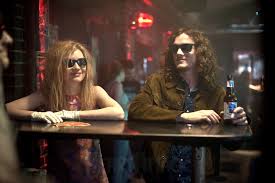 I mentioned Dead Man earlier and just as in that film, music is a major focus and accompaniment to the narrative of Only Lovers Left Alive. Adam is obsessed with music, his living space cluttered with vinyl, guitars and antique high level stereo equipment. His obsession gives an insight and genuineness to the character. This is a passion of course which has been developed and honed over centuries of living. The choice of tunes, a lot of fuzzed out style rock, shredding guitars over an almost abandoned Detroit and plenty more, is intensely creative as is its matching with the images on screen. It is hard to overstate how good the use of soundtrack is in the film. And it seems to align perfectly with Jarmusch’s manner of shooting, which situates the characters in really interesting places in the frame.
Verdict: For me, the film had some definite weaknesses in terms of narrative and minor character development. But the supreme use of music and soundtrack single-handedly makes this a film that deserves to be watched and re-watched. Pint of Kilkenny
Related beermovie.net articles for you to check out: Dracula Untold and 2013 in Review: The top 10 (Byzantium at #4).
Like what you read? Then please like Beermovie.net on facebook here and follow me on twitter @beer_movie
Locke
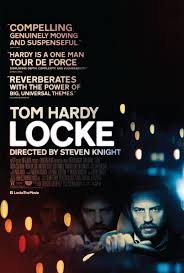
You probably know of Locke (2013) as the Tom Hardy driving around alone in a car film. In some ways that is pretty accurate. On a surface level that is what the film involves and if it was a different person in the driver’s seat it would be a very different and probably not as good film. But the film also goes beyond the gimmick it is based on to be something a little more satisfying.
Essentially, the film features Tom Hardy’s Ivan Locke driving in pretty much real time to attend the birth of his child. A child that is the result of an ill-advised affair he had whilst away from home on business. The story is driven forward by a raft of phone calls that Hardy has as he drives. He talks to his bosses who are infuriated that he will not be there for a high risk day of work, his kids, the woman having his child and perhaps most tellingly his wife. I have heard Locke described as a thriller which I don’t really think it is. But considering the film through the prism of thriller tropes is an interesting way to approach it. Especially as the ‘thrills’ come from much more domestic and relationship based places, rather than the guns and high stakes threats we generally expect. At times the film plays like a tribute to the purity and simplicity of filmmaking. When Ivan tells his wife why he is making an unexpected road trip is one such moment, with Hardy and the unseen Ruth Wilson conveying all of the emotion that the scene requires and then some. No explosions, no nothing else required.

Of course a huge amount of the success or otherwise of a film with a concept such as this is the strength of Tom Hardy’s performance. Luckily he seems close to incapable of being poor onscreen and this film is no different. He brings everything he has to this role, perhaps knowing that the whole film rests on his shoulders. There’s an awesome accent, delivery that emphasises the dry humour of the script and a face that conveys the emotional pitch of the narrative without ever feeling as though Hardy is reaching to get it across. The other aspect of the film that is so fundamental to it working is the script. One approach to a high concept film such as this is to just have it be a 120 minute. But rather than have the storytelling be as stand-alone as that, the script delivers an entire character arc for Ivan all whilst he is sitting in his car. We see him grow, see him reflect on his past and decide on his future in a very real, very satisfying way. The only aspect of the script that jars is the couple of instances where Ivan is talking to himself or his deceased father. There is nothing particularly terrible about these parts, but it seems like an unnecessary flash of melodrama when the standard approach is working so well.
Verdict: Locke is both a character study of a complex individual brought to life well by Hardy and a satisfying story. The fact that this tale told through mobile phone calls delivers full character arcs and never seems contrived is a testament to not only Hardy, but also to the work of director Steven Knight and the writers of the film as well. Pint of Kilkenny
Related beermovie.net articles for you to check out: Devil and Cheap Thrills.
Like what you read? Then please like Beermovie.net on facebook here and follow me on twitter @beer_movie
SUFF 2014: Freeload

As a fan of the works of people like Jack Kerouac and Woody Guthrie, especially his 1943 autobiography “Bound for Glory”, I was really keen to see Daniel Skaggs’ documentary Freeload (2014). With all of the popular accounts of riding the rails being at least 50 years old now, it is easy to imagine that the practice does not really exist anymore, but Skaggs brings us a window into this throwback lifestyle.
Even the best accounts of riding the rails are embellished with romanticism to a degree. Working with the immediacy of a pretty mobile camera and within the confines of the documentary structure, Freeload totally strips away any sense of this romanticism. That is not to say that the film is bleak, it just presents the good and the bad of the lifestyle without the need or desire for sentiment. Don’t expect to see a portrait of a bunch of down on their luck dudes, lamenting what life has brought them here. Most of those profiled by Skaggs have made this choice willingly, either for philosophical reasons or simply because they want no part of what the world has become. Who can blame them on that latter point? In fact the psychological insight that the film brings to the decision to ride the rails makes it feel like a pretty logical choice for the most part. The bad of their choice is not shirked from either and we see squalor, alcoholism and a griminess to the lifestyle in the film as well. They are also aware of the history of their lifestyle, of those who have made these choices in the past, whilst also being aware of the differences that separate them such as the fact that most of them are not looking for work, like many of those who were forced onto the rails used to.
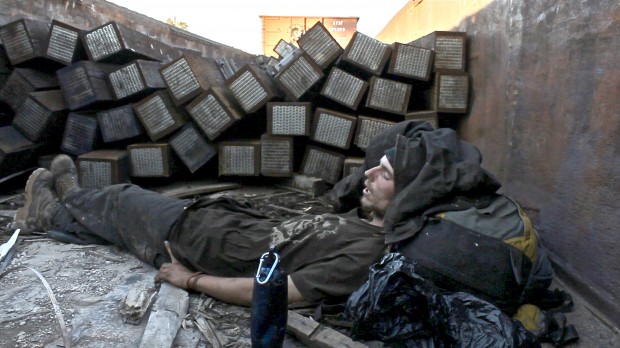
I would be amazed to see the practicalities of how Freeload was shot. Skaggs takes his camera into some really tight spots, spending long amounts of time in cramped and dangerous feeling places. So to do the rail riders’ dogs. They all seem to have one, and these generally (though unfortunately not always) well loved dogs are clearly used to sitting still for their own safety. Just like the shooting, the editing of the film is impressive as well. No doubt there were huge swathes of material shot and it is all condensed down into something coherent and broad ranging, without feeling slight. The way that the stories of the various people who are featured in the film are woven together to give a sense of an entire subculture does not feel forced at all and you still get a really good sense of who these people are as individuals.
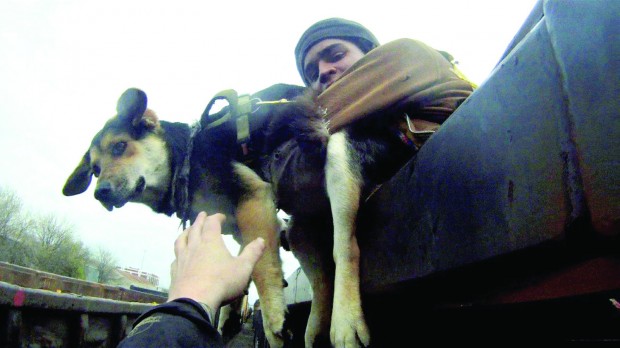
Verdict: Freeload brings to life a way of living that is probably totally foreign to a vast majority of us. In borderline verite style, Skaggs has done this with an impressive lack of intervention or judgement, allowing these really interesting people and their choice to live this lifestyle speak for itself, good or bad. It’s great to see a film not obsessed with painting a lifestyle as either the depth of despair or a grand philosophical journey either. The film simply shows their way of being. Pint of Kilkenny
Related beermovie.net articles for you to check out: SUFF 2014: Nova Express andSUFF 2014: Beckoning the Butcher.
Like what you read? Then please like Beermovie.net on facebook here and follow me on twitter @beer_movie
Live Tweet Review: Batman

Related beermovie.net articles for you to check out: Live Tweet Review: Independence Day and The Dark Knight.
Like what you read? Then please like Beermovie.net on facebook here and follow me on twitter@beer_movie
MIFF 2014: Come Worry with Us
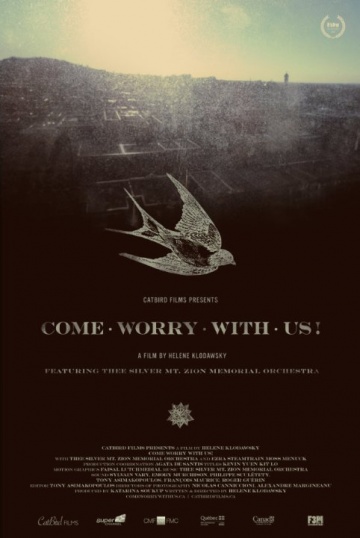
Rarely has a rock documentary looked like Come Worry with Us (2013), which provides a great insight into parenting psyche from a musician’s point of view. Jessica and Efrim are members of the band Silver Mt Zion who decide that when they have their first child they will take him on tour with them.
The band was founded along socialist and anarchist principles and as such have a very communal vibe. This is jeopardised in a way with the arrival of young Ezra when he is taken on tour. In particular, Ezra touring leads to Jessica being ostracised to a degree. This is not a conscious mean-spirited act of exclusion, but rather the practicalities of having a young child on tour make it inevitable. In other ways though there is much inclusion, as the members of the band have great interactions with Ezra and they even split the cost of a tour nanny and larger tour bus equally amongst all of them. Much of Come Worry with Us focuses on the attempts of the couple to re-adjust their lives when a new life is brought into it. As artistic people, the amount of time to create is heavily impacted by having a child and the two of them, especially Jessica, struggle to still find the time to have their creative outlets. That is the unfortunate side-affect of the time sacrifices that a mother, especially an artistic one, must struggle against.
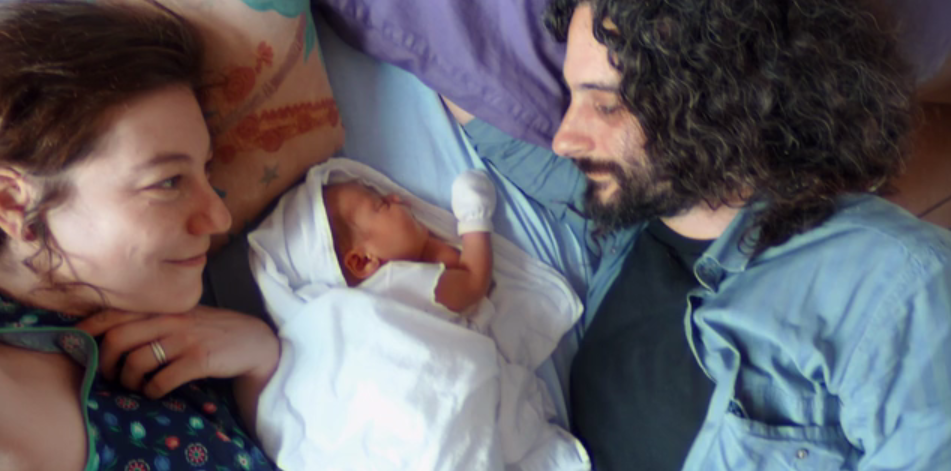
Traditional gender roles have definitely changed over time, though that is not to say traditionalism does not still thrive amongst some people. But there is a growing awareness that the roles traditionally thrust upon couples with a newborn child can be problematic. Jessica and Efrim from Silver Mt Zion, are highly aware of these issues through their general outlook on the world, highly influenced by socialism and anarchism. However practice is very different to theory and the couple find themselves struggling on tour as well as at home. Efrim is open about neglecting his parenting duties whilst on tour and Jessica is very aware of the fact she has slipped into a traditional matriarchal role. Given where they come from this is a real eye opener for the both of them. As someone who holds broadly similar views as the couple who is considering starting a family sometime soon, it was a definite eye opener for me too.
Come Worry with Us was definitely my favourite film of MIFF 2014. Part of that is probably because the film really spoke to where I am in life, as someone considering starting a family in the near future. It is also down to the fact that it is a really good concert tour film with an added level of interest by bringing a young kid guide along for the ride.
Verdict: Pint of Kilkenny
Related beermovie.net articles for you to check out: MIFF 2014: Cheatin and MIFF 2014: Human Capital
Like what you read? Then please like Beermovie.net on facebook here and follow me on twitter@beer_movie
Guardians of the Galaxy
Recently I had become concerned that Marvel seemed to be homogenising their approach to new films in the MCU. One of the great strengths of this, really quite remarkable, series of films has been that it is unafraid to make each film wildly different in genre and tone than the film that came before. The removal of Edgar Wright from the forthcoming Ant Man (2015), a film he had been driving for so long and the most recent Guardians of the Galaxy (2014) trailer looking like a generic male hero driven action film, had crystallised these concerns.
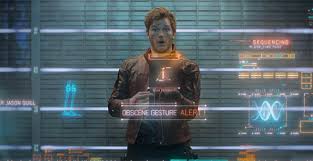 Thankfully though Guardians of the Galaxy shows that Marvel definitely have not lost their creative nerve, at least not yet. My fears were quelled right from the start actually as the film opens with a dark moment, but one totally grounded in human, earthbound concerns. This is interesting, because where this film takes the viewer is farther afield from ‘realistic’ human concerns than any other film in the series, including The Avengers (2012) and both Thor films. The film does struggle a little with pacing, which is always a challenge for any origin type story. Right at the start, what seem like huge plot points for how a young boy becomes a space-travelling thief (sort of) called Star Lord are just sort of plonked there. I would have liked a little more insight into that journey. But given the film has to essentially handle five origin stories, not just one, overall the film does a pretty great job of it all. Another thing the film does well is actually reside in the sci-fi genre. Sure it is not hard sci-fi by any stretch of the imagination, but it is also not simply a stock standard hero story dressed up in spaceships and green skinned beings. Especially towards the beginning, there is a willingness to set up relatively dense sci-fi mythology and political machinations. No other Marvel film has the level of worldbuilding that this one does and it is a major difference maker which greatly enhances the enjoyment of the film.

I think Guardians of the Galaxy manages to have the best ensemble of any Marvel film, which is saying something because I think both The Avengers and Captain America: The Winter Soldier (2014) do a pretty good job in that regard. All of the characters have decent motivations for what they are doing. Sure they are generally pretty simplistic – money or vengeance – but they make sense within the film and they also manifest themselves in the action of the film. The casting goes a major way to ensure that the ensemble does so well in telling the tale of the film. Just as it stays the absolute same on some fronts (the important ones mainly – female participation, racial and LGBT presentation), Hollywood seems increasingly willing to diversify its approach on some fronts. Indie directors like Gareth Edwards and Rian Johnson now get jobs spearheading franchises like Godzilla and Star Wars. And here we have Chris Pratt, the incredible Andy Dwyer from Parks and Recreation, as the star of a Marvel film. Pratt crushes it too, bringing a little of his earlier comedic charm with a whole lot of genuine leading man charisma and effectiveness as an action presence. Another left of centre casting choice that works far better than I would have imagined is the choice of wrestler Dave Bautista as Drax the Destroyer. Batista is not actually that charismatic as far as wrestlers go, so it was a genuine surprise that he really holds his own with his acting skills in this film. He brought a lot to his character. Zoe Saldana as Gamora is a little more of a straightforward choice. Her character as well mixes the unfortunately expected, with the refreshing. Gamora holds a really important part in the future direction of the MCU, as a result of a combination of who her old man is (sigh) coupled with the choices she makes throughout the film (yay). Similarly her character is a mixture of weapon like destructive fighting ability with the occasional need to be saved by far less skilled male counterparts.

Batista, who is so impressive as Drax.
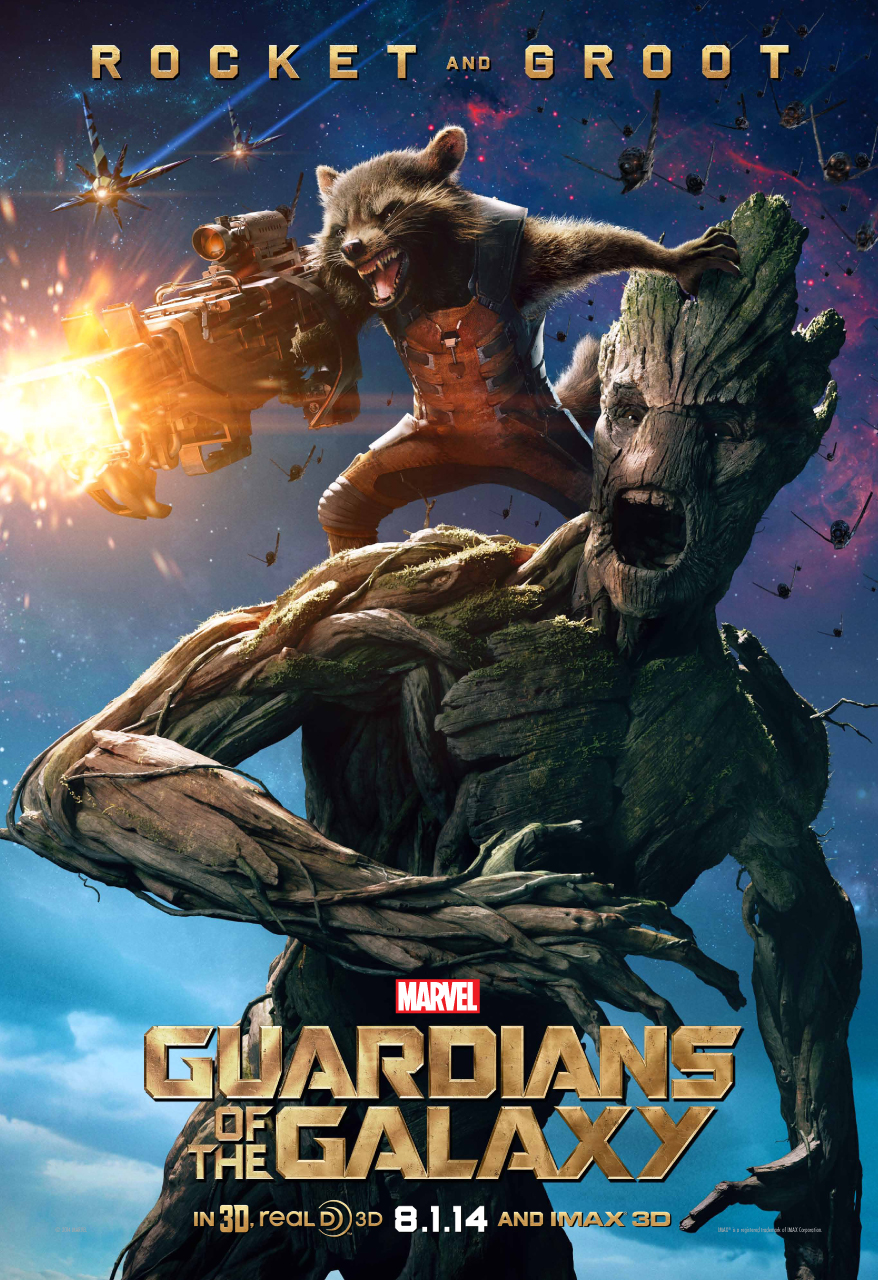
The two characters which had the potential to derail so much of what works in this film were Rocket Racoon, CGI voiced by Bradley Cooper, and Groot, huge tree sorta played by Vin Diesel. If they had of gone too comedic with them it could have wrecked the tone of the film and removed any real stakes from the narrative. But these characters end up being two of the biggest assets of the film. Rocket Raccoon will become an iconic character I feel, down in part to the exceptional one liners that the script gives him. The script also goes to the trouble of taking Rocket from what could have so easily been a CGI animal comedic relief sidekick into a fully formed and heartfelt presence. Part of that comes from the great relationship that he has with his best buddy, the hulking tree-like Groot. I’m not sure that Guardians of the Galaxy is my favourite Marvel film. But there is no doubt that I love the visuals of this one comfortably more than any other film in the series. It is in many ways a classical sci-fi aesthetic, Star Wars and Trek came to mind for me. However it is all rendered in a pretty bright and colourful kind of way, which is really refreshing given the tendency for gloom and grime that has reigned recently in any kind of superhero or blockbuster film. In addition to the visuals, I think this is also the best script we have seen in a Marvel film yet. It is definitely the hardest one they have had to nail and they do a great job, balancing the tone and the action very well.
Guardians of the Galaxy is pretty much unmissable if you have any interest in blockbuster filmmaking. To my mind it is the best blockbuster film of the year so far. It sees Marvel expand out, incorporating visually arresting sci-fi elements and plot points, whilst still having the film feel theoretically as though it could sit alongside the other films in the MCU. It also has a hell of a fun ensemble cast too, which makes the ride even more enjoyable.
Verdict: Pint of Kilkenny
Related beermovie.net articles for you to check out: Captain America: The Winter Soldier and Worth Watching April 2012 (includes review of The Avengers).
Like what you read? Then please like Beermovie.net on facebook here and follow me on twitter @beer_movie
 Beermovie.net