Memento

Christopher Nolan is an exceptionally divisive cinematic figure. But before The Dark Knight Rises (2012) and Interstellar (2014) split opinion of him, he was beloved. And perhaps no film was more responsible for his adulation by cinephiles than the non-linear murder mystery Memento (2000).
At its simplest level, Memento is the story of Leonard, a man trying to solve the mystery of who killed his wife. The film is perhaps most famous for the manner in which its non-linear narrative literally unfolds. Leonard, who has amnesia, slowly pieces together what happened to his beloved and records the memories he needs to hold on to in tattoos. This structure, along with the performances, are the chief joys of the film. One issue for me is that both the structure of the film, and the establishment of Leonard as a character, means the success or otherwise of the film is predicated totally on the twist that is obviously coming. In the end it fell slightly flat for me, perhaps because I had seen similar before (though admittedly, they may have been made after this film). Having said that though, whilst the main twist has been seen plenty of times before, there is plenty of embellishment around that which satisfies here.

Coming relatively close to L.A. Confidential (1997), Memento represents the golden age of Guy Pearce as a Hollywood leading man. He continues to ply his craft in a range of really good supporting roles, but in terms of carrying a film, he is seemingly not held in the same regard these days. Here, Pearce conveys a man obsessed with routine and structure, two things he considers to be his salvation from the existential weight of his condition. Along with the excellent Carrie-Anne Moss, Pearce also brings a strong emotional core to his character which drives the narrative along and pushes it in different directions. I always like it when a film approaches a genre in a totally different way. Memento is a police procedural encased in a structure you would more associate with sci-fi. It’s a combo that works really well, even making the tired Groundhog Day (1993) style structure feel ingenious. Nolan chooses to start the film with the central mystery (seemingly) being solved and unfolding back from there, which to any fan of crime fiction, immediately invokes our favourite reveals at the end of crime stories. But the director toys with those expectations throughout, always a step or two ahead of us.
Verdict: Perhaps seeing it for the first time in 2014 has diminished the impact of Memento for me. On one level, I don’t quite see the hype. But on another level, this is a very good film, which feels nicely quirky and small in comparison to much of Nolan’s later work. Stubby of Reschs
Progress: 119/1001
Related beermovie.net articles for you to check out: House of Caine: The Dark Knight and The Rover.
Like what you read? Then please like Beermovie.net on facebook here and follow me on twitter@beer_movie
Rope
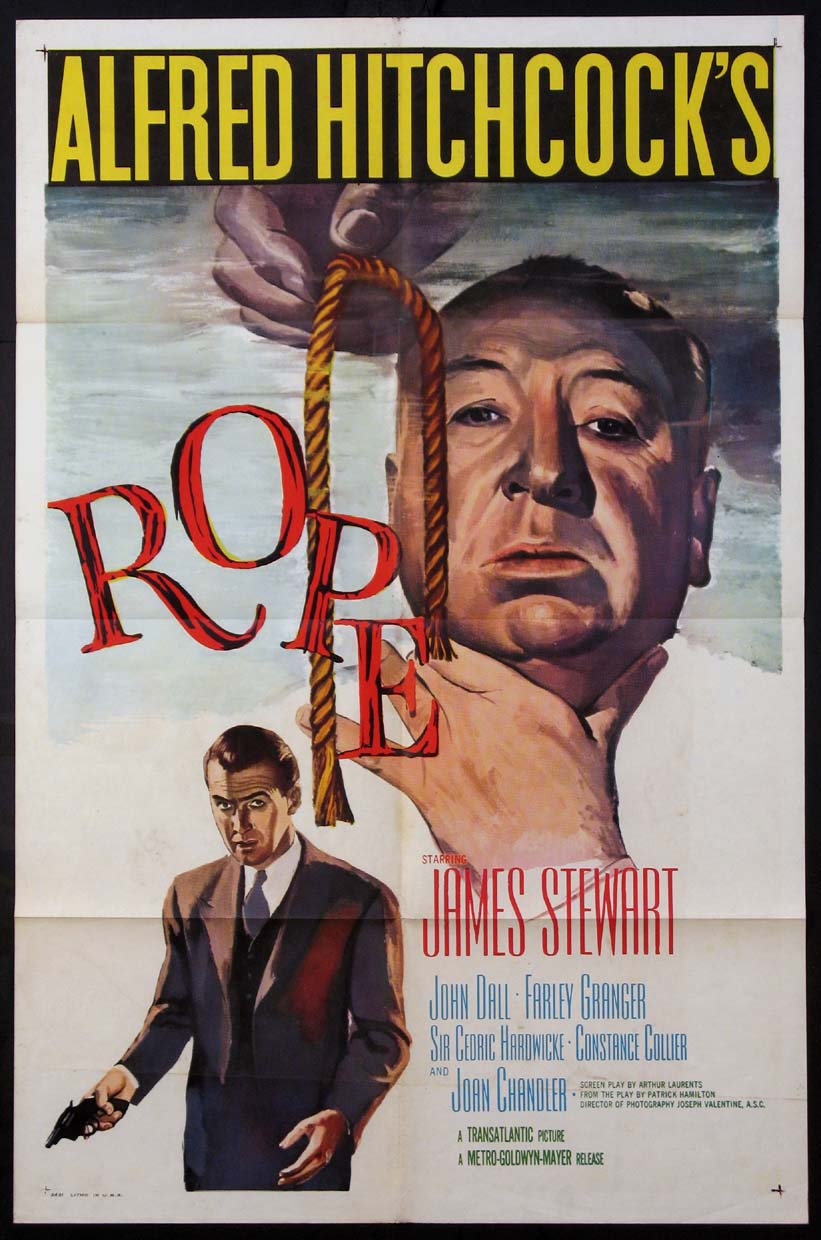
What a poster! Can see who the real attraction here is.
You have to give it to Alfred Hitchcock. He could have comfortably kept making the same type of movie over and over again if he chose to, and in the process made a lot of money and a lot of really fantastic films. But what set him apart and made him perhaps the greatest director of all time was his constant desire to push the envelope. He famously had to fight exceptionally hard to get Psycho (1960) made, blew the budget on a Salvador Dali dream sequence in Spellbound (1945) and got all high concept with Lifeboat (1944). Another film quite similar in premise to that is the baby-faced Jimmy Stewart starring Rope (1948).
The high concept Rope all takes place in a single small apartment. It sees two young men Brandon and Phillip covering up a murder (which they carried our using the titular weapon) whilst hosting a dinner party, with the body hidden away in the apartment as friends and family mingle. Amongst those friends is Rupert, played by a pretty young Jimmy Stewart. This mentor figure is the audience’s way into the film, reacting as we may to the events as they unfold. Rupert is brought to life by Stewart’s remarkable humorous sensibility, which shines through even in roles such as this which are not particularly comedic. The body literally sitting in the middle of the room whilst characters linger around it casts a pall on proceedings, from the perspective of the audience at least, though not the unsuspecting characters. The body also influences what is a very smart script, resulting in everything taking on different meaning if you have the knowledge of what is really going on. It is a wordy script too which is quite bold, the characters expounding a lot of ideas aloud, in a way which never ends up feeling like the unnecessary regurgitation of the plot and bringing the audience up to speed, rather adding complexity to the film’s thematic focus. The film is shot in 4:3 aspect ratio, which is an interesting stylistic choice. It works though, boxing in the action on screen and intensifying the claustrophobia that the audience and especially the under pressure characters onscreen are feeling.
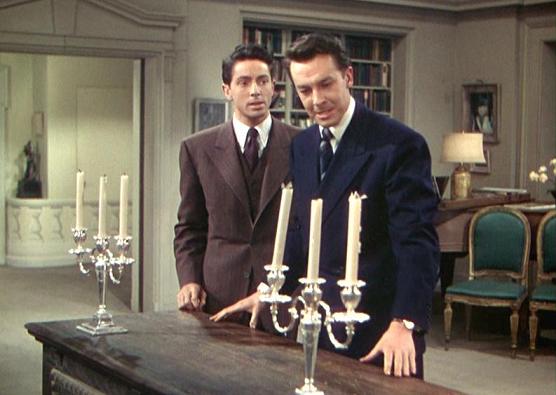
Given the premise, it is in themes not plot that Rope has the most weight. Right from the start, you can tell that Hitchcock’s primary concern with the film is psychology. Brandon and Phillip go through a range of feelings in terms of the crime they have committed, from contentment, to guilt, to horror. This is all informed by the distinct hint of homoeroticism in their relationship and the way that one seems to be able to control and guide the other. Also feeding into the psychology of the participants is their class, which has imbued the perpetrators, Brandon in particular, with a sense of entitlement and smug satisfaction in what he has done. The manner in which Brandon and Philip revel in their intellectual game is also connected to their class. It is as if they are bored by the leisure activities that society offers them, so instead of polo they resort to a sick game of cat and mouse, as if that is the right that their class affords them. The experiment of pulling of the perfect crime, killing for the sake of danger and sake of killing, also serves to stoke the ego of the perpetrators, reinforcing what they have always been told – they are special and they are better than those around them.
Verdict: Rope always feels a little too small a film to be counted amongst the very best of Hitchcock. But there is no shame in that and the psychological aspects of the film are unique, intense and expertly written and performed. Stubby of Reschs
Progress: 118/1001
Related beermovie.net articles for you to check out: Live Tweet Review: The Birds and Psycho.
Like what you read? Then please like Beermovie.net on facebook here and follow me on twitter @beer_movie
The Great Escape
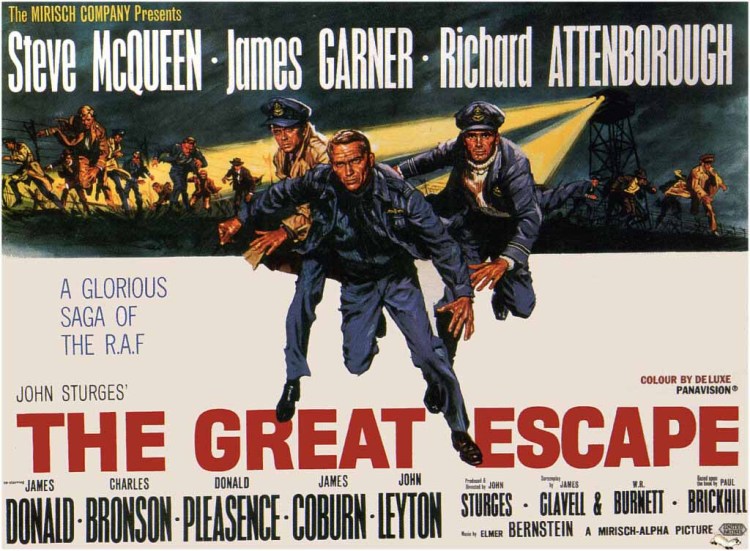
Growing up, I am pretty sure The Great Escape (1963) was one of the films my Nan was forever watching. That and Escape to Victory (1981), or I have just confused the two and she actually only re-watched one of them over and over. In any case, if it was The Great Escape she loved, I must applaud her exemplary taste, because it is one hell of a film.
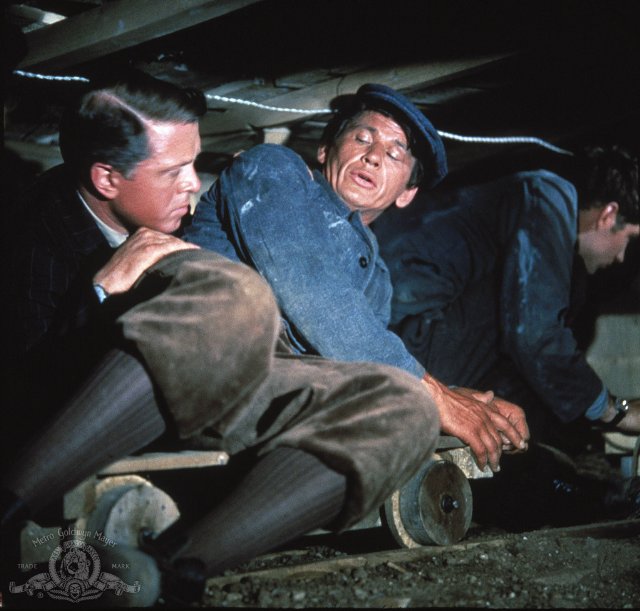 The film is set in a German POW camp from where, I am sure you will be shocked to discover given the title, a group of Allied soldiers are attempting to escape. An interesting counterpoint to the portrayal of camps in most WWII films is that in this one, the inmates can actually live a relatively comfortable life. So the fact they are so desperate to escape, taps into their duty as soldiers. It is considered cowardice to sit out the war comfortably when you should be doing everything in your power to escape. Structurally, the film is a little more innovative than what you would expect from a classic, mainstream war film. Rather than just building a core narrative, we are gradually introduced to the small escape efforts made by the crack band of escape artists. The focus on this merry band of inmates, with their distinct fields of expertise, means the film functions as an inverted heist film, as the crew do their absolute best to get out rather than in. One criticism levelled at many contemporary mainstream films is the lack of stakes or tension. There are no such issues here, as the tension at the end absolutely killed me. Not to mention the fact that the film eschews the ending you were expecting, but gives you one that is a lot more true to the rest of the film and the war it is depicting a small part of.
The theme song for The Great Escape is one of the best recognised in cinema history. It is firmly lodged in my head as I write this, even though I watched the film a while ago now. The song is a perfect storm of catchiness, simplicity and more than anything else fits in perfectly with the action on screen. It is employed as a refrain, popping up intermittently throughout the film and it works well in that role. Along with the theme song, the aspect of The Great Escape which has probably lasted the longest in the public consciousness is the incredibly talented ensemble cast, led by Steve McQueen. McQueen is one of those dudes who is just instant charisma, he exudes it just walking around. Alongside McQueen is a whole host of the era’s finest actors. The late, great Richard Attenborough as the inmates’ leader, Charles Bronson whose magnetism is equally as strong yet totally different to McQueen’s and a whole bunch of other iconic stars. The characters function for the most part as ciphers or caricatures. But that is fine because the characterisation of the script is so good that even though they are slight, they still deeply involve the audience in the goings on of the film. They are almost caricatures with nuance if that is a thing.

Verdict: It is not easy to respectfully turn WWII events into non-warmongering popular entertainment. The Great Escape does it better than probably anything else, driven by the funny script populated by a crew of characters which is bought to life by one of the best male ensembles that has ever appeared together. Longneck of Melbourne Bitter
2014 Progress: 21/101
Progress: 117/1001
Related beermovie.net articles for you to check out: High Plains Drifter and Ben-Hur.
Like what you read? Then please like Beermovie.net on facebook here and follow me on twitter @beer_movie
Live Tweet Review: Batman

Related beermovie.net articles for you to check out: Live Tweet Review: Independence Day and The Dark Knight.
Like what you read? Then please like Beermovie.net on facebook here and follow me on twitter@beer_movie
Toy Story

Iconic for many reasons, Toy Story (1995) sticks in most people’s minds as the real birth of computer animation on the big screen. Not only that, it really kicked off a second golden era of American mainstream animation, with Pixar going on a decade or so stretch where they could do no wrong and matching any run of Disney’s in terms of sheer brilliance.
 On paper, there is nothing to suggest that Toy Story had the potential to be a hit with such a broad audience. It is basically just an adventure tale involving two jealous toys, namely a cowboy and an astronaut. Maybe if it was done well the kids would dig it, but surely there is nothing there for adults. Even after re-watching the film recently, it is hard to logically tease out what makes it so appealing for an adult audience. The short answer is that it is just an exceptionally well written and made film. So are plenty of flicks that adults don’t want a bar of too. There is a certain nostalgia about the plot, everyone has dreamt about their toys coming alive when they are not around. It was a clever ploy by Pixar to combine such a classical plot with the groundbreaking new technology and it makes the film so much easier to jump right into.
Not only is the plot very traditional but the film is structured like an old school comedy. There is an odd couple and the jokes come a whole lot faster than I recall. The joke rate is quite incredible actually. Plus the film was a real innovator in putting jokes in for adults, without kids feeling like they were missing out – “Hey look, I’m Picasso” etc. You could argue that Pixar have not made another film with characters as good as this one. Indeed there are three layers of great characters, the leads Buzz & Woody, the beloved supporting cast such as Slinky Dog & Rex, and finally the peripheral characters such as the toy soldiers and the etch a sketch which add so much colour. What I don’t think is arguable is that the menacing Sid is Pixar’s best villain. Wow he is still such a foreboding and flat-out evil presence even today. I would have thought the studio would have dialled that character back a bit, but the film is better for their decision not to do so.

Everything about Toy Story is borderline perfect. The dialogue (Buzz’s deluded early patter a particular highlight), the huge cast of characters and Randy Newman’s tunes that complement the action so well. There is something more though aside from the sheen. Some form of filmmaking magic that characterises all the greatest classics of cinema and which help to make this film one of the true classics of my generation.
Verdict: Longneck of Melbourne Bitter
2014 Progress: 19/101
Progress: 115/1001
Related beermovie.net articles for you to check out: This poster has me excited about Pixar again and Two Very Different Animations (featuring reviews of The Jungle Book and Akira).
Like what you read? Then please like Beermovie.net on facebook here and follow me on twitter@beer_movie
A Hard Day’s Night

Whilst in London recently I was lucky enough to catch a screening of the famous Beatles film A Hard Day’s Night (1964) at the BFI at Southbank. I didn’t take extensive notes like I usually do, but thought I would share some thoughts in this quick review.
First up, the BFI in Southbank is a fantastic facility. With the Arc Cinema here in Canberra, an institution with ostensibly similar goals being gutted, it is great to see an archive cinema that is clearly booming and exceptionally popular. It was slightly disappointing to see that there was no real exhibition space at the facility, but in a city like London there are always other places to catch quality glimpses at film history.

The Beatles are of course an exceptional band. I have not explored their music as much as I probably should have, but even so I would say that “Revolver” is probably the most perfect album in pop music history and a work of art to stand against any created in the 20th century. Their work veered from the heartfelt, to the experimentalism of “Sgt Pepper’s Lonely Hearts Club” to the silly. It is the latter where the film A Hard Day’s Night comes in as the fab four rollick about onscreen in what is essentially a slapstick farce. It is far from the perfection that some of their music approaches, but that probably makes it all the more fun. It takes a certain level of charm for four not great actors dicking around onscreen to be acceptable cinema entertainment. Those four guys definitely had that charisma. The film also takes some wryly amusing pokes at the frustrations that the band must have felt with the stifling fever pitch of fame that surrounded their every move. As fun as the story – which is essentially a succession of skits – is, the songs when they come along absolutely stand out and are probably reason enough to watch the film alone.
Not everyone will get much out of this. I enjoyed it and if you have even the slightest interest in the band or even slapstick comedy then you probably will too. If you are Beatles nuts like my parents who went with me to see this, you will probably absolutely adore it.
Verdict: Stubby of Reschs
2014 Progress: 18/101 (wow, I am going to fall miserably short of this goal)
Progress: 114/1001
Related beermovie.net articles for you to check out: Steamboat Bill Jr and Singin’ in the Rain.
Like what you read? Then please like Beermovie.net on facebook here and follow me on twitter @beer_movie
Fitzcarraldo

“The land where God did not finish creation” – Fitzcarraldo.
Recently when I reviewed The Omen (1976) I mentioned the cursed production that film endured. The production of Fitzcarraldo (1982) whilst not cursed in the same way was probably a more tortured production, one which spawned the infamous making of doco Burden of Dreams (1982). Of course that old cliché that there is a fine line between genius and insanity probably holds more truth than many of us would care to admit. Director Werner Herzog and his leading man Klaus Kinski straddled that line through their whole careers and in reality probably spent large swathes of time on either side of it, which is certainly a recipe for on-set fireworks.

Molly, played by Claudia Cardinale
In reality though, little of Herzog and Kinski’s on-set warring permeates the film on screen which is assuredly made with none of the raggedness you would expect from such a production. The story focuses on the character of Brian Sweeney ‘Fitzcarraldo’ Fitzgerald, played by Kinski, a man who desires above all else to build an opera house deep in the Amazon. He wants it with such a manic fervour that his desire has in a way broken him and sent him over the edge. For Fitzgerald, opera “gives expression to our deepest feelings” and that is something he is desperate to be able to share with all those he comes into contact with. In a get rich quick scheme he decides to travel up the Amazon in order to claim a patch of rubber trees. It is an arduous journey which culminates in transporting his huge ship straight over a huge mountain. So much of Fitzcarraldo feels like a Western. Iquitos is referred to as a frontier town. Brian and his lover Molly, who runs a bordello are very much the new outsiders in this slightly lawless place. Not only because they are not locals, but because they also do not fit in with the other blow-ins who are mostly ultra-rich rubber barons. Then there is the long perilous journey into the unknown where the ‘natives’ pose a serious threat. Not only that, the journey is for territory that can hopefully be exploited for wealth.
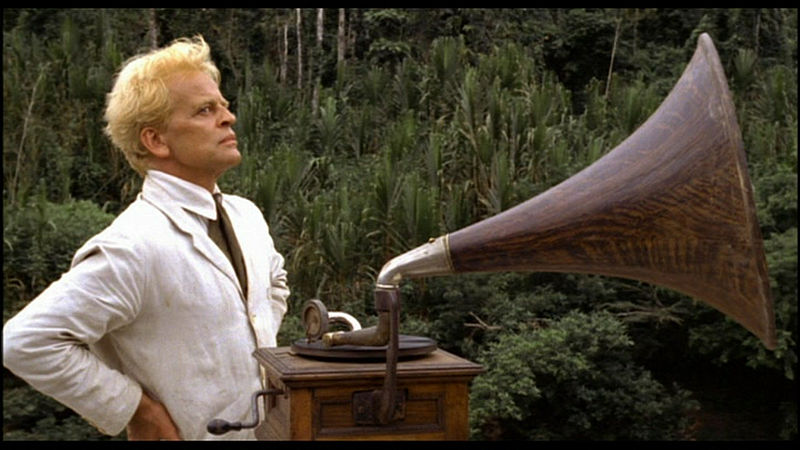
Having said all of that though, there is no doubting that the psychological side of this film is like no Western that has ever been made and in a good way, it is kind of hard to work out exactly what Fitzcarraldo is truly about. Going into it, I thought it was about a dude trying to carry a boat over towering mountains. That is part of it, but it takes over an hour and a half to get to that part of the story. It is also I guess a film about opera, a form I know next to nothing about. Or perhaps it is more-so about the transformative power of art. Sometimes I feel a similar fervour for film that Fitzgerald feels for opera. The quote above is one from right near the start of the film and accompanies a wide shot of the jungle, which is immediately contrasted with a palatial house. This is also in part what the film is about, the clash of cultures and the exploitation of cultures by Western influences. There is for so long in the film a forcing of ideas on the indigenous population of the Amazon. But in a crushing sequence, probably not in the way you would expect, the locals have their stark revenge when both the viewer, and the characters in the film, perhaps least expect it. In the end though, the film is a nigh on indescribable fever dream simultaneously serious, psychological, weird, absurdist and bold whilst all these elements crash into and tear at one another.
Fitzcarraldo is essential viewing for any fan of Herzog and is one of his best fictional features. The film is complete with stunning visuals as the massive, battered vessel travels first along the river and then over a mountain. These visuals are the backdrop for a psychologically challenging journey that will make you think, ponder and puzzle.
Verdict: Pint of Kilkenny
2014 Progress: 17/101
Progress 113/1001
Related beermovie.net articles for you to check out: Jack Reacher and POV: The Loneliest Planet.
Like what you read? Then please like Beermovie.net on facebook here and follow me on twitter @beer_movie
The Omen
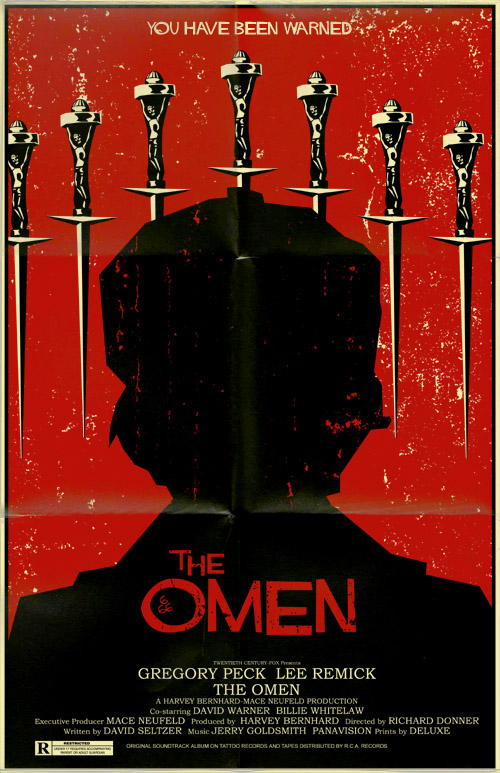
There is something distinctly 70s about The Omen (1976). That is not to say it has dated, but it has a sort of aura about it that only films from that decade such as Don’t Look Now (1973) seem to share. Just as many of our most beloved slasher films are distinctly and fundamentally 80s as well.

One hallmark of the 70s horror film, and indeed great horror films of other decades, that The Omen nails is the genuinely creepy opening credits sequence. Church chanting and singing as well as aggressive music form the backdrop to a kid casting a crucifix shadow. From there, the early parts of the film focus on the successful American diplomat Robert Thorn played by Gregory Peck and his wife Katherine played by Lee Remick. Desperate for a baby, Katherine devastatingly delivers a stillborn child. A dodgy priest in the Italian hospital where this is taking place convinces Robert to adopt a replacement kid, without her ever knowing. Especially through the first half of this film there are a number of really atmospheric set pieces that are genuinely shocking. The most confronting of all, in one of the most shocking moments I think I have seen in a film, takes place at a child’s birthday and really sets up the course of the film. A large black dog appears to one of the party guests shortly before a truly outrageous death. In a chilling finale to the sequence the same large dog appears to Damien, the child of Robert and Katherine. There are other similarly wonderful sequences that take place in a zoo and then later in a cemetery. The latter lifts the film from a bit of a second half funk, as it had run out of some of the steam of the first half, before finishing strongly.
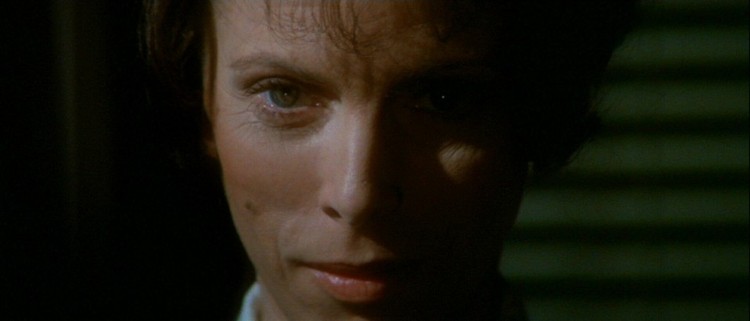 I have already mentioned Nicholas Roeg’s Don’t Look Now and it is a film my mind kept returning to as I was watching this one. They both share a very washed out colour palette, a dank fogginess that seems to permeate the furthest reaches of the plot and characters. I think that is the intent behind the palette as well, to convey a definite mood, not just a British locale that rarely sees the sun. Biblical symbolism and elements are the other elements that permeate the entire film. Much of the core of the film’s plot comes from a contemporary interpretation of the bible and the antichrist, whilst priests, crucifixes, Satan and even a little of the redemptive power of Christ make their way into the film. And whilst I did not find the second half of the film as engaging as the first, I quite liked how it shifted into an almost Indiana Jones-esque adventure flick for a time even rocking a little globetrotting and archaeology. Also, if you are into reading behind the scenes accounts of films, do some snooping around on The Omen. It was one of those creepy cursed productions where the cast and crew had planes they were in hit by lightning, there were near misses with IRA bombings, creepy car crashes with links to the plot of the film and plenty more horrid luck afflicting those who worked on the film and their loved ones. A real life curse on a horror film can only improve it in my estimation.
The Omen is a hell of an atmospheric horror film but it also brings a fair bit more than that to the screen, with a whole bunch of quite shocking scenes. Grounding the plot in much symbolism, Christian and otherwise, means there is plenty there to mull over if you so desire. If not, a dude gets his head sheared straight off by a massive piece of plate glass in a slasher kill par excellence that comes a decade before its time, so there is always that.
Verdict: Pint of Kilkenny
2014 Progress: 16/101
Progress 112/1001
Related beermovie.net articles for you to check out: The Black Cat and The Masque of the Red Death.
Like what you read? Then please like Beermovie.net on facebook here and follow me on twitter @beer_movie
The Incredible Shrinking Man
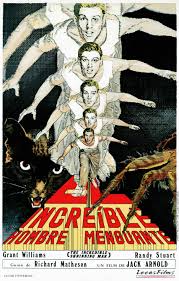
The title The Incredible Shrinking Man (1957) screams awesome B-movie schlock. However the reality of this Richard Matheson penned, Jack Arnold directed film is a little more contemplative and thought provoking than that.
 Don’t get me wrong, there are still awesome battles between our shrunken hero and a ‘giant’ spider, but this is a fair way from Honey I Shrunk the Kids (1989) territory. The film wastes no time breaking with the convention you might be expecting, as a borderline meta voiceover is revealed to be the Shrinking Man himself, speaking in the past tense, so I guess we can presume that he survives the ordeal. We see the main character Scott Carey exposed to a kind of mist whilst lounging around on a boat and then the action shifts to six months later. There is a subtlety to the start of his change as initially his clothes do not fit right, he loses his appetite and then his wife no longer has to get on tip toes to kiss him. From there Carey endeavours to find a medical cure for his predicament, with mixed results. The film has that 50s sense of a great emotional scene. At one point as Scott is down about things and concerned his wife should leave him and she responds ‘as long as you’ve got that wedding ring, you’ve got me. Then right at that moment Scott’s wedding ring clatters off his shrinking finger. The second part of the film morphs into more of an adventure film as Scott becomes trapped in the basement, facing many tense dangers, not the least of which is a spider which resides in the same room. I like this latter section of the film, it is a nice change-up from the almost domestic drama feel to the first half. The entire film, even this more adventurous later period is played very straight. So what could have been a very light hearted look at a man shrinking becomes a cerebral look at the terror that would surely invade your psyche if you were literally shrinking. Where would it end?

The Incredible Shrinking Man comes from that era of film where such care was taken with each aspect of production before a film was released. This is evident right from the opening credits, which have a distinct James Bond feel to them, as a silhouette of a man gradually shrinks as a song plays. Perhaps not as common for the time was the presentation of the main character. His physical condition really affects him emotionally (in a very realistic way) which leads to him lashing out increasingly at his ever-loving wife Louise. So great is the strain on Scott, that he explicitly contemplates suicide which is pretty forward and shocking for a film of this vintage and is part of a seriousness that makes the film so original. The effects are a mixed bag watching them today. The parts where Scott is onscreen by himself, dwarfed by his former everyday surroundings, look great and were presumably achieved through practical and set dressing techniques. Also impressive, but more dated, are those instances where the shrinking man is onscreen with another person or an animal. There is a ghosting on many of these effects, with Carey appearing see-through at times. It is not particularly distracting, but I guess in an age where CGI would make that sort of thing exceptionally simple, it does stand out. Without a doubt the boldest and most shocking part of this film, one which bucks convention throughout, is the ending. The tension through the second part of the film builds and all the while I was expecting a conventional Hollywood ending. Instead, without giving too much away, the film delivers possibly the most un-Hollywood ending ever. Rather, it is an introspective and philosophical end that leaves you thinking about it in the days after the film finishes. I loved it, would have to be one of my favourite endings ever actually.
This is well worth checking out for any sci-fi fan or hell, even any fan of philosophical and thought provoking films. Didn’t think I would be writing that. It has some minor issues, but overall it is easy to see why it is considered such an all time classic.
Verdict: Pint of Kilkenny
2014 Progress: 15/101
Progress: 111/1001
Related beermovie.net articles for you to check out: King Kong and A Very Different Idiot (featuring reviews of The Forbidden Planet and The Naked Gun).
Like what you read? Then please like Beermovie.net on facebook here and follow me on twitter @beer_movie
Un Chien Andalou

Oh yeah, you know Un Chien Andalou (1929). Rather, you probably just know that one shot, the iconic eyeball slicing scene. It is surprising how many people are so aware of that one shot, without ever having checked out the 16 minute entirety of Luis Bunuel’s surreal and absurd avant-garde classic.
As for the eye slicing, it is rightly iconic. It is also uncompromising. Even if you are well conditioned to contemporary gore it is an almost unwatchable shot. Aside from that, the film also features the weirdest maguffin you are ever likely to come across, ants flowing out of stigmata, too many dead animals for my liking and a wonderful choice of soundtrack that is both bawdy and drives the film along. I like avant-garde cinema, but for me, 16 minutes is a little long. I prefer a good 2 minute blast of Man Ray imagery. Stretching the form over this kind of length leaves me searching for meaning a little too much. Having said that, the images do link together so well in this film through plentiful match shots and other editing techniques, that for the most part you will not find yourself too bogged down.
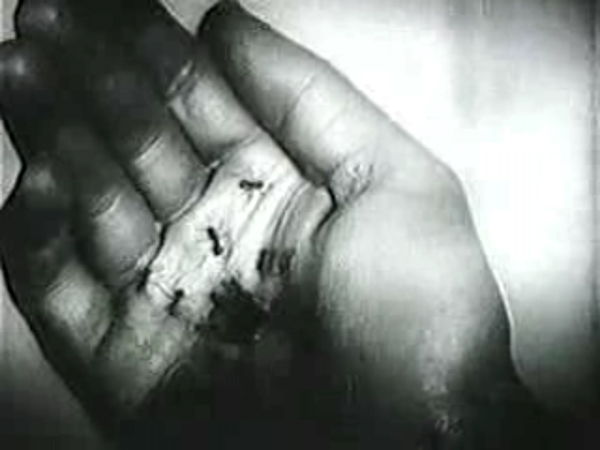
Obviously with a surrealist, avant-garde film like this, you are never really going to know what in the world is going on. But for a film in this subgenre to be effective, at least for me personally, it must first look cool, and secondly have some sort of binding theme. This film nails it on the first. The repeated image of the ants festering around a stigmata is exceptional and probably deserves to be just as iconic as the eyeball slice and there are numerous moments when you have no idea what you are watching, but you know it looks very cool. On the second measure, Un Chien Andalou succeeds for the most part I guess. Well there are a lot of themes there. They may not be cohesive as such, but Bunuel and Dali are throwing some interesting ideas out there. Not that they all stick or even that I picked up on them all. For me though, the film was concerned with a huge amount of things including male/female relations, religion (the folly thereof?), the act of writing and creation of any art (and the investment of one’s person in doing so), the nature of time as there are temporal folds and creases and reincarnation. So basically, plenty to assault you over the course of 16 minutes.
It is easy to see why Un Chien Andalou is perhaps the most famous avant-garde film of all time. It’s pretty challenging to sit through its short running time, but for the most part is a worthwhile and rewarding experience, especially for anyone who wishes to be a student of film history. You can check the film out here:
Verdict: Stubby of Reschs
2014 Progress: 14/101
Progress: 110/1001
Related beermovie.net articles for you to check out: Hold Me While I’m Naked and Worth Watching June 2011 (featuring a review of Man Ray’s A Return to Reason).
Like what you read? Then please like Beermovie.net on facebook here and follow me on twitter @beer_movie
 Beermovie.net