Edward Scissorhands
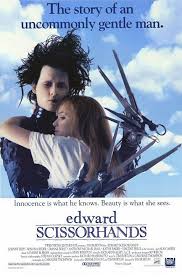
Tim Burton and Johnny Depp have becoming increasingly known as the filmmaking team of unintentional nightmares. However that is certainly not the case when the highly influential cult classic Edward Scissorhands (1990) is involved.
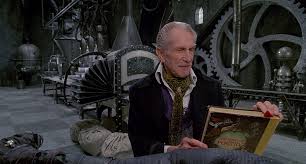
Influences haunt the film throughout, the first straight off the bat as the creation by the The Inventor (awesomely Vincent Price) of Edward openly suggests Frankenstein, both in Mary Shelley and numerous other iterations. The grandmother relating the kid the film in the form of a bedtime story recalls The Princess Bride (noting that is a trope with origins far longer than that book/film). There is a Blue Velvet (1986) era Lynchian sheen to the hyper-suburbia settings. It takes a lot of storytelling skill to be so openly influenced by greats that have come before, but to never feel derivative or lesser as a result. Like a great musical cover, homage such as this, whilst not necessarily surpassing the source, can provide something different and equally worthwhile. This even extends to the central character of Edward, who evokes the character of Pinocchio, with his exaggerated boyishness and the sense that while close, he’s not quite human.
 Living in an age of films with exhausting, lengthy set-ups (hell, that’s the entire function of some films), this sort of floors you with how quick it gets rolling. Edward is on his way home with his adoptive family within about the first 15 minutes. From there, a lot of the early joy of the film comes from the domestic minutiae, such as Edward attempting to put his pants on. Throughout the entire film, but especially in these parts, Johnny Depp gives a performance with a physicality that borders on slapstick. Happily, going back 25-odd years means that the performance is not weighed down by his atmosphere sucking shtick. The other lead, Winona Ryder gives what is also probably the best performance of her career. She brings a whimsy and teenage hard-headedness to her role and quickly accelerates the strong bond between her Kim and Edward, which does not really get going til a fair way through the film.
For a relatively modern film, Edward Scissorhands has exceptional reach. The film is a big (borderline obsessive) touchstone for the goth and emo subcultures, as well as being a formative film for a huge range of people outside of that. Given I don’t and never have belonged to either of those subcultures, I won’t presume to know the entire connection. Part of it would be the presentation of notions of ‘right’ and how that does not always represent the nicest or most humane thing to do. But I would also guess the fact that the film is something of a portrait of an outsider plays a major role. The film both works and doesn’t on this front, with Edward’s difference accepted and feeling slightly exploited throughout. Though what it does capture very well is how if you’re different, any mistake will have you judged completely, through the prism of magnifying and demonising one’s quirks.
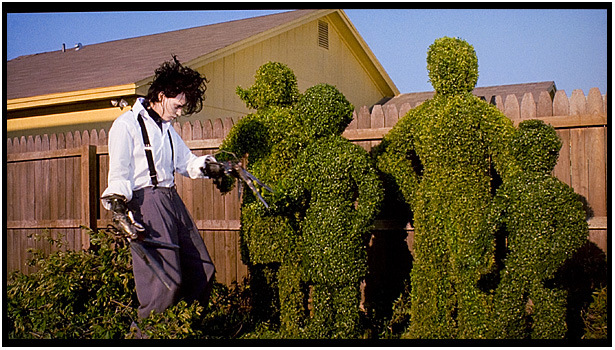
There is something distinctive about the aesthetic design of the film. Sure there is a dash of the Lynchian as I mentioned earlier, but Burton possesses that and turns it into something of his own. Predominately this is achieved by splashing light gothic elements and tone throughout the visual look, providing an old fashioned contrast to the sheen. This combination suits the character of Edward perfectly. Even the casting seems to tap into this vibe, especially that of Vincent Price, who cooped up in that scary house on the hill, channelling Dr Frankenstein, functions as both an aesthetic choice and smart piece of casting. Throughout, the filmmakers seem to be toying with the look of it all, the house on the hill for example looks intentionally fake. This toying with form, across a range of the aspects of the film, is something Burton seems far beyond now. On some rare occasions, the film does feel a little over-stylised. But unlike Burton’s later films it never feels as though the showy style has become the point of the film, the attention to story and emotion is never overwhelmed. Danny Elfman is a composer indelibly linked to Burton’s work. I can’t say I have seen all of the films they collaborated on, but I struggle to imagine any of the scores being better than this one. Like so much else in the film, there is a playful interaction with something of the past, in this case classical music. The result simultaneously evokes the suburban and just as importantly deftly emphases that light gothic sensibility which makes the film so unique.
Verdict: Tim Burton is so often a maligned filmmaker that it is genuinely illuminating to go back and see what made him a visionary in the past. As far as film fables go, Edward Scissorhands is a genuinely great piece of cinema, whimsical yet laden with meaning. As strange as it is on some levels the film has such a huge following, it makes a whole lot of sense on plenty of others. Longneck of Melbourne Bitter
Progress: 121/1001
Related beermovie.net articles for you to check out: A Tribute to Dennis Hopper: David Lynch’s Blue Velvet and Live Tweet Review: Batman.
Like what you read? Then please like Beermovie.net on facebook here and follow me on twitter @beer_movie
The Hunger Games: Mockingjay – Part 1

Depending on where in the world you live, The Hunger Games: Mockingjay – Part 1 (2014) has either opened or is just about to. It feels like the film has crept up a little, with less hype than one would expect. Not sure if this is just my imagination or if they are perhaps holding a little something back for the closing bonanza that will be with us next year.

The first two films in the series were for all intents and purposes high concept action films. Both of them were good, though the second one was a marked improvement. The usual course of action for the next film in an uber-successful series with a ready made audience would be of course to turn in more of the same, just a little bigger with a few more bells and whistles. Quite incredibly and refreshingly though, The Hunger Games: Mockingjay – Part 1 eschews the action film structures and brings us a war film. Not only that, it’s a really good and very smart war film. It is a bold move on the part of the studio and the filmmakers involved as it risks alienating people who loved the first two films. Especially since even for a war film it is not a particularly action packed one. The focus here is on the propaganda war being raged in Panem. As such much of the film is deliberately paced, as Katniss and her new allies film clips to help win over the masses. There are a couple of big set pieces, one exceptionally tense toward the end, but the real focus is on the hearts and minds of the everyday people in the districts.
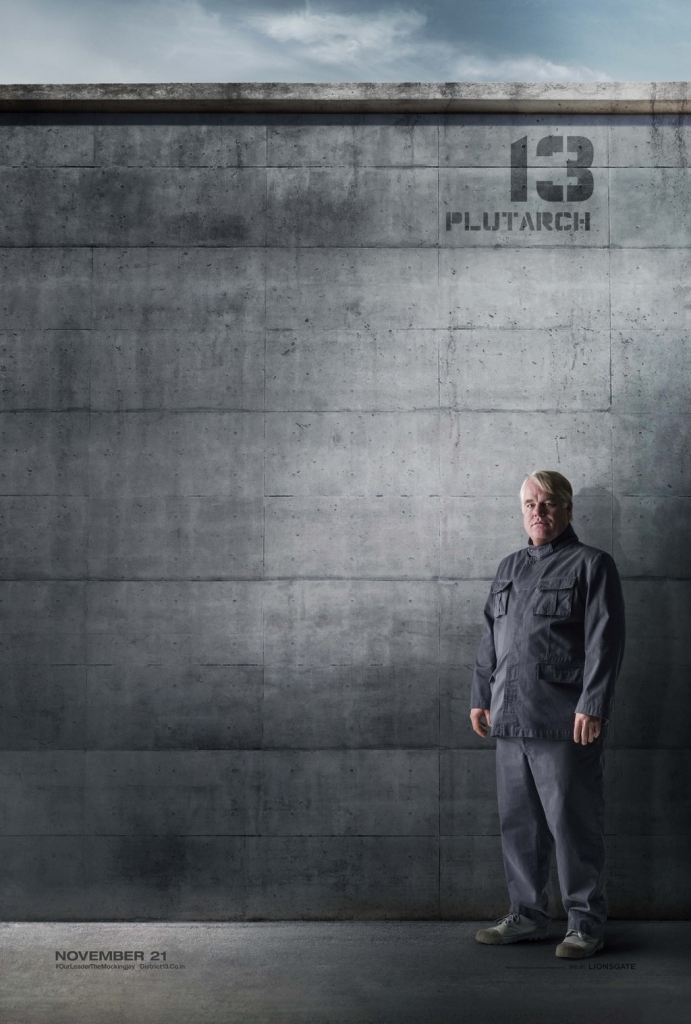 One major criticism that has been levelled at the film is that it is in fact only half the film. It is a little strange that people are so shocked by it given the title. But I can understand the frustration, the story is left unfinished. Having said that, the ending to this film is not actually any more abrupt in terms of the overall storyline than how The Hunger Games: Catching Fire (2013) finished up. It is interesting that although this is a YA adaptation and most of the audience would be expected to be teens, this is a really dark film and is also more adult than probably 90% of films that will be released this year. As for the cast, Jennifer Lawrence is once again exceptional at conveying the inner turmoil and at times vagueness of Katniss. The character is written so well, being simultaneously heroic yet exceptionally torn about her place in the revolution that it needs a performance as good as hers to bring that to life. The film is touchingly dedicated to the late Philip Seymour Hoffman and he, along with Woody Harrelson and Julianne Moore lead the wonderful supporting cast. If anything they feel a little underutilised, though only because they are so enjoyable onscreen rather than any particular narrative deficiencies.
Verdict: Successfully shattering the formulas of the first two films, this is one hell of a smart war film and a truly bold direction for the series to be taken in. It’s the best of the three films in the series so far and will have me lining up at midnight next year to see the conclusion. Longneck of Melbourne Bitter
Related beermovie.net articles for you to check out: Worth Watching March 2012 (includes review of The Hunger Games) and Worth Watching December 2013 (includes review of The Hunger Games: Catching Fire).
Like what you read? Then please like Beermovie.net on facebook here and follow me on twitter @beer_movie
Toy Story

Iconic for many reasons, Toy Story (1995) sticks in most people’s minds as the real birth of computer animation on the big screen. Not only that, it really kicked off a second golden era of American mainstream animation, with Pixar going on a decade or so stretch where they could do no wrong and matching any run of Disney’s in terms of sheer brilliance.
 On paper, there is nothing to suggest that Toy Story had the potential to be a hit with such a broad audience. It is basically just an adventure tale involving two jealous toys, namely a cowboy and an astronaut. Maybe if it was done well the kids would dig it, but surely there is nothing there for adults. Even after re-watching the film recently, it is hard to logically tease out what makes it so appealing for an adult audience. The short answer is that it is just an exceptionally well written and made film. So are plenty of flicks that adults don’t want a bar of too. There is a certain nostalgia about the plot, everyone has dreamt about their toys coming alive when they are not around. It was a clever ploy by Pixar to combine such a classical plot with the groundbreaking new technology and it makes the film so much easier to jump right into.
Not only is the plot very traditional but the film is structured like an old school comedy. There is an odd couple and the jokes come a whole lot faster than I recall. The joke rate is quite incredible actually. Plus the film was a real innovator in putting jokes in for adults, without kids feeling like they were missing out – “Hey look, I’m Picasso” etc. You could argue that Pixar have not made another film with characters as good as this one. Indeed there are three layers of great characters, the leads Buzz & Woody, the beloved supporting cast such as Slinky Dog & Rex, and finally the peripheral characters such as the toy soldiers and the etch a sketch which add so much colour. What I don’t think is arguable is that the menacing Sid is Pixar’s best villain. Wow he is still such a foreboding and flat-out evil presence even today. I would have thought the studio would have dialled that character back a bit, but the film is better for their decision not to do so.

Everything about Toy Story is borderline perfect. The dialogue (Buzz’s deluded early patter a particular highlight), the huge cast of characters and Randy Newman’s tunes that complement the action so well. There is something more though aside from the sheen. Some form of filmmaking magic that characterises all the greatest classics of cinema and which help to make this film one of the true classics of my generation.
Verdict: Longneck of Melbourne Bitter
2014 Progress: 19/101
Progress: 115/1001
Related beermovie.net articles for you to check out: This poster has me excited about Pixar again and Two Very Different Animations (featuring reviews of The Jungle Book and Akira).
Like what you read? Then please like Beermovie.net on facebook here and follow me on twitter@beer_movie
The Raid 2

The Raid (2011) was the biggest breakout action flick for quite some time, probably since the not quite as good Ong Bak (2003). Whilst the quality of that film’s sequels were apparently not too crash hot, thankfully The Raid 2 (2014) not only matches the first film, it totally blows it out of the water.
 The film picks up basically from where the first ended. Rama, keen to expose the corrupt police forces that betrayed him in the first film, is recruited to a top secret police unit devoted to weeding out corrupt elements. Where better to drop an undercover cop in an action film than within the confines of the city’s foremost high-flying gangsters, with a side-trip to prison beforehand. There is a really good tempo to the film throughout the whole running time. The action builds to peaks and then lets you back down again, and the beats are spot on in setting up the intrigue. And the fight scenes, oh my the fight scenes. The first one, taking place in a toilet cubicle of all places, feels so good you wonder if there is anywhere to go from there. But there definitely is. I cannot recall fight scenes in a film that are so slickly choreographed, but without feeling overly rehearsed. The creativity and escalating of them is not just about bigger, faster and bloodier. Each scene has a real distinctiveness, from the confining effect of a toilet cubicle to a scene which is sluggish due to the deep mud that the combatants are battling in. Everything in the film has a certain weight to it. The sequence of Rama punching the prison wall which featured in the trailer for example just feels like those lightning fast punches are thudding into your body. Maybe realism is what I mean by weight as refreshingly our hero even gets his arse kicked on a couple of occasions, as he should when he takes on 30-odd highly trained martial arts killers. Even later, when villains are given (awesome) James Bond-ish tics like a walking stick or a propensity for mashing face with hammers, the sensibility of the film never spills over from the realm of hyper-real to fantastical.

Where the first film was basically a straight up, high concept, action flick, The Raid 2 adds complexity, rather than just switching up the situation. The plot weaves in more police and political machinations, though thankfully it never becomes the focus and the general thrust of the narrative is always pretty clear. The film has been rightly lauded and marketed as something as an action film masterpiece. It also rests well within the gangster genre, a fact I have not seen discussed too much. All the gangster tropes are there – warring families, greed, unbridled ambition, sons trying to eclipse the father, dirty cops and more. The success of the film as a gangster piece is elevated by the novelty of having it punctuated, or rather dominated, by huge amounts of hand to hand combat sequences. Caught up in all of this action and him flat out murdering dudes, the narrative does at one point lose sight of the fact that Rama is an undercover cop with a very specific job to do. Just as it feels like it is going too far down that track though, the story re-sets and refocuses on the overarching plot which had become a little clouded. Led by Iko Uwais as Rama and Arifin Putra as the ambitious Uco, all the performances in the film are excellent, not just in the arse-kicking aspects, yet another reason why this film stands so far above the genre film norm. Gareth Evans knows when to show restraint with his direction as well. The fight scenes are wisely under-directed which means you can see what is happening a whole lot more easily. The flourishes are left for coolly shooting streetscapes or to highlight a particular death.

Basically you should just believe the hype on The Raid 2. As advertised, it is one of the best action films ever made, featuring creative and bloody fight scenes galore. But it is also one of the best post-2000 gangster films, perhaps even the best. See it now. If you don’t have time to see the first as well, then Wikipedia the ending and get your hands on this one.
Verdict: Longneck of Melbourne Bitter
Related beermovie.net articles for you to check out: Run Lola Run and Worth Watching January 2013.
Like what you read? Then please like Beermovie.net on facebook here and follow me on twitter @beer_movie
The Cat Returns

Twitter was abuzz over the weekend at (mainly erroneous) reports that the iconic Studio Ghibli was ceasing production. Whilst the outlook for the studio remains pretty grim, it is also clear that at this stage the studio is not pulling out of making animated films. My heart was even more particularly warmed by this news than it would have normally been because the night before I had watched what is my new favourite Studio Ghibli film – The Cat Returns (2002).
Blu-ray is a bit of a forgotten medium I think, with many assuming it is just the last dead duck physical format before everyone moves to some sort of cloud based subscription service (nooooooo!). Personally, I love blu-ray and this film is a perfect example of why. It is remarkable just how much the colour and animation pops when this film is viewed on blu-ray and it enhances the look of a film which is rendered in an even finer and more painting like style than is the norm for the studio. The story begins with a remarkable act of kindness as a young girl Haru bravely saves a rather remarkable cat. It turns out that this cat is a prince from the Cat Kingdom, and as such the young girl is showered with attempted acts of kindness and repayment from the kingdom. It starts out innocent, though misguided enough, with Haru being followed everywhere by cats and receiving far too many gift boxed mice. However the stakes of the film are escalated when it is demanded that Haru wed the cat prince, something she is rather keen to avoid. Ghibli films always intrigue and The Cat Returns, with the whimsy of cat’s wandering about on hind legs engaging with each other and humans, definitely intrigues a lot. Not to mention the fact that all of the cats have such different personalities, a stark difference from the standard Disney animal sidekick. There is also a sense of more pure adventure in this film than most of the studio’s output that I have viewed. There are thrills and tension galore and if that’s not enough, there’s a freakin maze!
I am not sure if The Cat Returns is an adaptation of a single fairytale, but at the very least there are a lot of classical influences on the story. It feels like it an amalgam of a bunchy of delightful moments from classic tales. And as the tweet above from Dave Crewe of http://www.ccpopculture.com pointed out when we were discussing the film, there is a subtle inversion of fairy tale tropes going on in the film as well. Both visually and narratively, the film recalls Alice in Wonderland, with a young girl adrift in a strange fantastical land slowly gathering a cohort of colleagues to hopefully help her navigate it. In a similar way to Wonderland, the Cat Kingdom is an incredibly built place, one where there is an underlying sense of threat and malice, continually bubbling under the somewhat bright and cheerful surface. In fact that is a hallmark of classical fairy tales, as brightness is always accompanied by darkness or even evil. The tone of the film is whimsical, breezy and light occasionally going as far as bordering on the absurdist. Having said that though, the narrative is essentially linear, so there is no narrative confusion posing as absurdism lurking in the film. Which is great and different to both the more serious environmental old school fantasy novel vibe of Princess Mononoke (1997) or the vibrant assaulting of the senses weirdness and danger of Spirited Away (2001). In fact coming out of the same studio, those two films are an interesting counterpoint to this film, even though broadly speaking all three films reside in the same genre.

The maze! Geeks like me love mazes… almost as much as we love dinosaurs.
The Cat Returns is chiefly an exercise in tone. It is a film that is whimsical and playful, especially when interacting with and subverting fairy tale norms. Funny, adventurous and thrilling, this is definitely one to add to your Ghibli ‘to watch’ list if you have never managed to catch it.
Verdict: Longneck of Melbourne Bitter
Related beermovie.net articles for you to check out: Princess Mononoke and Worth Watching September 2012 (includes review of Arriety).
Like what you read? Then please like Beermovie.net on facebook here and follow me on twitter @beer_movie
Little Miss Sunshine

Revisiting Little Miss Sunshine (2006) I was struck by how much, just like Juno (2007), the reception of the film has cooled in light of the pale imitations that studios started pumping out to cash in on its success. This is a shame, because as a crowd-pleaser of a film, with something for pretty much everyone, it is bloody hard to beat.
The film is a simple, but not sentimental, long distance journey taken so that the youngest member of a family can compete in a beauty pageant. The family is a bunch of misfits, from a foul mouthed grandad, a prick of a father through to a teenager who has taken a vow of silence. The car is a bright yellow, mechanically questionable kombi van which adds to the misfit feel of it all. The results of the film, like any great team, are far superior to the constituent parts that it is made up of. Along the way, there are little moments that give the film such charm – a homophobic old dude spotting a suicidal gay Proust scholar for a porno, and a note advising ‘go hug mum’. It’s a comedy that does credit to its road film roots, having the characters overcome a range of barriers, from the comical to the heartfelt. It also does not shy away from the fact, actually it totally embraces it, that kid’s beauty pageants are the weirdest thing in the history of the world. And the whole film is topped off by a dance sequence that may be the greatest and certainly most incisive in cinema history.
 You know why both Little Miss Sunshine and Juno are really good films and all the shitty pale imitations are shitty pale imitations? Both of them have really exceptional and most importantly original scripts. This one is a weird script in some ways. It is simultaneously really artistic, no one would ever say a lot of these things, but despite that it also manages to be incredibly true to life. The film is also boosted massively by the fact that the cast is exceptional, and many of the cast are giving if not career best performances, then pretty close to it – Toni Collette, Abigail Bresnan, Steve Carrell (he has never been in the same ballpark of awesomeness as he is in this film), Paul Dano and Greg Kinnear for example. Carrel’s character is an interesting one to consider the film, and its merits through. There is a lot going on there, but really his character is a peripheral figure. It says a lot about the film and the script that a fringe character is so three dimensional and well written. That is also true of Dano’s character, who aside from one big (and crushing moment) is really in the background with Carrell, adding so much colour and surprising depth to the film. Even caricature characters like that of Alan Arkin are not only expertly written, they also manage to some how sit with the tone of the film with no jarring.
Little Miss Sunshine is hilarious filmmaking that also manages to make you both care and feel. If you think about it, there are not that many films you can say that about. If you have never seen this, then you are missing one of the truly great post 2000 films. And if like me you have not checked this out since its release, then it is well and truly time to take another look.
Verdict: Longneck of Melbourne Bitter
2014 Progress: 12/101
Progress: 108/1001
Related beermovie.net articles for you to check out: Hey Hey It’s Esther Blueburger and Computer Chess.
Like what you read? Then please like Beermovie.net on facebook here and follow me on twitter @beer_movie
Mea Maxima Culpa: Silence in the House of God
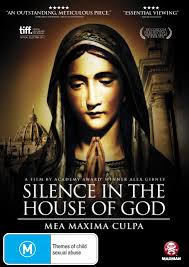
Everyone who read my top ten of 2013 list will know that I think Alex Gibney’s Mea Maxima Culpa: Silence in the House of God (2012) is a fantastic although deeply disturbing film. Even though it has already featured on this site in brief, I thought that it was time to expand upon my thoughts on the film with this in-depth review.
Given the film is about the sexual abuse of deaf children in the care of the church, it is no surprising that it is so disturbing. Indeed any film on the subject should be. Many exceptional documentaries will make your blood boil. This one was no different and within two minutes that is how I was feeling. But importantly Gibney never feels the need to resort to cheapness to build this rage inside his viewer. He coaxes it out by simply giving thorough information, from which anyone who sees it could never be anything but pissed off. The fact that the Catholic Church for so long hid behind what were on the on the surface good deeds they were doing, in order to sexually molest young deaf men in their care is such a horrid deceit. Those with the power of the priesthood seemingly had no qualms about using that power in this shameful way. This point is reinforced by Gibney’s choice of experts to speak as well. A former bishop explains how there is a connection between the absurd imposition of celibacy upon Catholic priests and the acting out of abuse. Even more chilling is the fact that many priests who carry out these abuses believe that their inherent goodness or ‘holiness’ outweighs their heinous actins.

Similarly, the basic structures of the Church apparently felt no qualms about covering up the shameful abuses carried out by their supposed brothers in Christ. All these revelations just serve to make the individual instances even more horrifying, if that is even possible. The fact that it is all so systematic, with the covering up of abuse, paying off of victims and absurd attempts to ‘rehabilitate’ offenders through spiritual therapy. If there is a God, that god fucking hates child abuse. It is startling just how far up the chain this all goes. Gibney reveals that former Pope Benedict and the beloved John Paul II were both far from perfect in regards to dealing with paedophilia inside the church. The latter ignored complaints made against one of his most trusted confidants. The film shows the horrors perpetuated by both individuals and systems inside the Catholic Church, but wisely avoids bashing the concept of organised religion wholesale. Don’t get me wrong, there are no punches pulled, but Gibney does not dilute the message of the film by extrapolating the horrors he presents as being symptomatic of a belief in God. He does however attack the systematic covering up of abuses by the Catholic Church and connect that to how the church operates worldwide.

Director Alex Gibney
The ‘talking heads’ and infuriating subject matter go a long way to making Mea Maxima Culpa: Silence in the House of God as great a film as it is. However it is also an auteur piece, another example of why Alex Gibney is if not the best cinema documentarian working today, then very close to the top of that list. Probably his most astute decision with this film is to have four of the deaf adult victims of abuse function as talking heads. They sign their testimony, which allows you to feel the raw emotion and lasting effect that the abuse has brought to their lives. Voiceover is used to translate for those of us who don’t read sign and to complement the nuanced signed testimony of the victims. A lesser director would have opted to have the voiceover the focus, perhaps in tandem with re-enactments, but Gibney knows that his approach will deliver the most powerful statement. Another one of the small yet masterful decisions that Gibney makes is with the film’s structure. It starts out specific, opens out to the systematic nature of things and then comes back to the specifics again. This return to specifics at the end is notable, because it is so important that the story of the four men who open up for the film have their entire story told.
Mea Maxima Culpa: Silence in the House of God is a chilling film about the evil that people commit in the world. Detailed, informative, clear, insightful and artistic, as well as an utterly bleak watch that is depressing for your view of the human race, this is not a film that is easy to recommend. But it is a film that everyone should see once.
Verdict: Longneck of Melbourne Bitter
Related beermovie.net articles for you to check out: 2013 in Review: The Top Ten and Worth Watching January 2014 (includes a review of We Steal Secrets).
Like what you read? Then please like Beermovie.net on facebook here and follow me on twitter @beer_movie
Searching for Sugarman
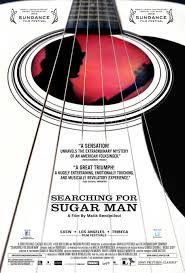
It is a golden period for cinematic documentaries, but it is hard to think of one that has been better received over the last five years than Searching for Sugar Man (2012). It is a hard film to write about and avoid spoilers, but I will attempt do so. However if the review seems to be skimping on details, then that is my excuse as to why. I will put it right up front here though. Pretty much everyone should rush out and see this film.
The film focuses on American singer songwriter Rodriguez. He was an undeniable talent and released a couple of albums in the early 70s. Rodriguez found very little success in the States and was more or less totally unknown in his home country. His music found an audience elsewhere though. I was aware of him, as I knew a couple of people who had his albums and were really into his tunes. But more notably, the singer became a massive star in apartheid South Africa. That huge South African following is the focus of the film. More specifically it is the story of how in the late 90s, a couple of big Rodriguez fans attempted to discover the story of whatever happened to their favourite singer and work out how he died. Rumours swirled of an on-stage suicide and similar macabre ends for the icon. That is about all I will say about the story that the film brings as I do not want to give too much away. The film is very much a product of the time in which the events were taking place. Nowadays, if you wanted to know what had happened to a singer you were into, you would just google it. But in the late 90s it was not necessarily as easy as that, and I think that is a cool notion. Fifteen years ago if you were really into something, you had to work a whole lot harder to indulge that passion, which had its benefits (don’t get me wrong, so does having everything just a click away).
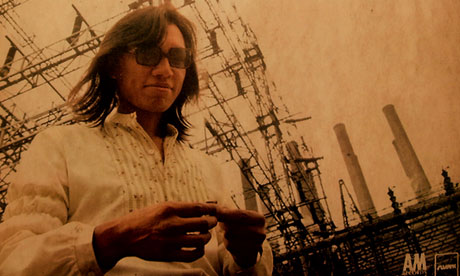
The great Rodriguez
The film is excellently shot and whilst it is not a doco that relies on pretty imagery to wow you, there is no doubting that the filmmakers wisely invested time in photographing it all as nicely as possible. Design is another example of the attention to detail, with sharp titles on screen and creative flourishes such as drawings to show the passage of time all adding a level of sheen to the film. The film mixes up its documentary techniques nicely too. There are standard, but interesting talking head interviews, with people such as the producers of his albums, and then the more cinematic focus on the quest to find out more about Rodriguez. Searching for Sugar Man also examines the broader notions around the success of the singer, especially why he had so much resonance for the inhabitants of South Africa during apartheid. His records were some of the most famous in the entire country and took on a very anti-establishment role for South Africans. The two albums he released, especially “Cold Fact”, inspired people to rise up, at the very least in their own minds. Rodriguez comes across as a great character in the interviews with those who worked with him. An almost ethereal presence who touched all of those around him, their recollections will make you feel something for the singer songwriter on a deep level.
Searching for Sugar Man is one hell of a documentary and deserves all of the hype it has gotten. Emotional, surreal and touching, this portrait of a most incredible man is pretty close to perfect as far as docos go. No doubt many of you have already seen it, but if not then get on it.
Verdict: Longneck of Melbourne Bitter
Related beermovie.net articles for you to check out: Marina Abramovic: The Artist is Present and Hunter: For the Record.
Like what you read? Then please like Beermovie.net on facebook here and follow me on twitter @beer_movie.
Utopia
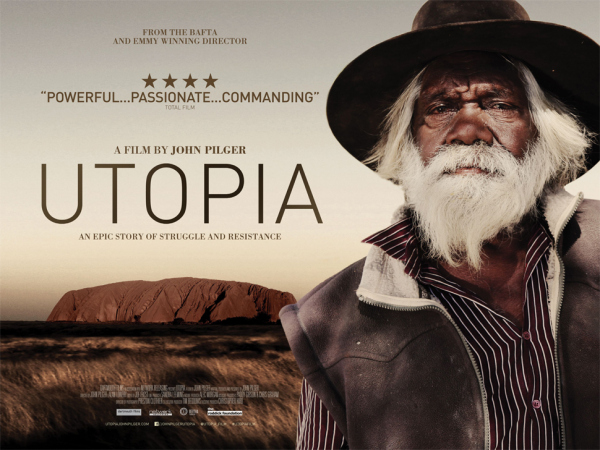
Filmmaker John Pilger is a very important Australian institution. The National Film and Sound Archive once again proved it is the same last week, when it hosted Pilger in Canberra for a screening of his latest film Utopia (2013).
Pilger, an incendiary expat, has been making films about the wrongs of this country, and many others, for around 35 years. I haven’t seen enough of them to say Utopia is the best or most important. But it is one of the best and definitely most important Australian films I have seen for quite some time. Australia has long been a deeply racist country and indeed nothing has changed. This racism manifests itself in many different ways. The horrific deaths in custody and police brutality (normalised and made easier by their new favourite toy the taser). The continued celebration of Australia Day on the offensive date of 26 January, when the British invaded this country (not to mention the widespread incomprehension of why this date is offensive). Also on a much more localised, personal level, the sharing of racist jokes and the like is still far too commonplace, again something only getting worse with the proliferation of social media.

John Pilger
The film opens with one of the all-time great fatcat scumbags of this country Lang Hancock waxing lyrical on what he terms “the Aborigine problem”. His solution is extermination, except for those who have assimilated and taken on ‘white’ values. Yes this is historic footage, but unfortunately the views that Hancock espouses are not too far removed from the views of many today. Before getting into his focus on the plight of Indigenous Australians in remote areas today, Pilger does a good job of sketching out the historical precursors. In particular the continual systematic reduction of Indigenous Australians to sub-human status and the forgotten history of extermination in our past, continued and exacerbated by the continual lack of acknowledgement of the Frontier Wars which were a feature of early European settlement. These wars claimed more indigenous lives in Australia than Native American ones were lost in North America, but which still have no place in our National War Memorial. The title of the film comes from a settlement named (ironically?) Utopia, which is statistically the least advantaged place in all of Australia. Pilger brings us images from Utopia and similar places that are repeated all over central and northern Australia. Remote communities that are neglected by authorities to the point that they are now pockets of third-world poverty in this very first-world country. These regions represent the spiritual and physical home of so many of Australia’s Indigenous population which is why it is imperative that those who wish to, should always be able to live there. Authorities must do more to ensure that this can take place in something other than squalor. Squalor that doctors in the film compare to 19th Century Dickensian England. Squalor that results in one-third of Indigenous Australians dying before the age of 45. Squalor that results in epidemic levels of trachoma, a disease which is entirely preventable and has been eradicated in every single other developed country in the world and of course amongst white Australians. What is termed “the punishing of the Indigenous different” in the film is not restricted to living conditions in remote areas. With around 3% indigenous population, the rate of indigenous incarceration in the country is startling. So much so that Western Australia has just built an Indigenous only prison. So much so that in some parts of the country, Indigenous incarceration rates are up to eight times greater than what they were in apartheid South Africa. As in America today, there are two sets of laws and law enforcement in our country.
Utopia also examines ‘The Intervention’ which was unleashed in 2007 by the conservative Howard government. This involved the use of our military to seize control of remote communities and their rights. It also involved the extraordinary step of Australia temporarily suspending the Racial Discrimination Act. There is only one reason that you suspend a Racial Discrimination Act and that is in order to do something racist. Howard and his cronies (chiefly Mal Brough) justified this by painting horror stories of child sexual abuse in these remote communities. The only problem is that these were based on a lie. A former worked in these remote communities appeared on the ABC Lateline program spinning these tales. As a matter of fact, he was no former worker in the community (he had never spent a night in the community he was apparently an expert in), but rather a worker in Brough’s Department. On another note, the silhouette that his shaded features on Lateline project is the spitting image of Freddy Krueger’s silhouette. Unfortunately apt.
One of the devices Pilger uses in the film is to compare the footage he shot of same of the same communities that he shot 28 years ago with that he shot in 2012. The contrast is startling, mainly because there is actually very little difference at all. The interviews that Pilger undertook with many of the politicians that oversaw much of this total lack of change, including Brough, Warwick Snowden and Kevin Rudd, are equally startling. Each of them bumbles through, in fear of Pilger’s questions. Not because of the interviewer’s aggression (though his questions are rightfully forceful) but because of the knowledge they all have that they did a great disservice to the country in their treatment of these issues, and their unwillingness to be brave enough to let that show.

Pilger’s focus in Utopia is to not to exhaustively detail the solutions that should be brought about by those in power in this country. As he so rightly pointed out during the Q & A, the solutions have been well known for decades, there is just a refusal to actively engage with the problem. The reasoning behind this is twofold. Firstly, with a racist electorate to placate, there is little political traction to be gained by investing time and resources into actually fixing the issues. Secondly, there is a focus on creating the utterly false perception that Australia is a poor country. We are a very rich country. Any country that can afford to sign a contract for $1.2 billion to jail and oppress people legally seeking asylum (as our Government did this past week) is in no way poor. Imagine the great work that could be done on the issues that Pilger presents for $1.2 billion (or for that matter, the work that could be done re-settling those fleeing oppression in their homelands in Australia).
I initially began this closing paragraph by stating Utopia was a film that all Australians must see. But I think it is important to say that this is a film that I would encourage every single one of you to see, no matter where you live. Australia is my country, but it is one with a shameful past and an equally shameful future. I hope that you can all manage to see this film to learn a little more about that.
Verdict: Longneck of Melbourne Bitter
Canberra folk, Utopia screens one more time at Arc Cinema at the National Film and Sound Archives on 16 March and also opened at Palace Electric Cinemas in New Acton today.
Like what you read? Then please like Beermovie.net on facebook here and follow me on twitter @beer_movie.
Hunter: For the Record

It is nice for me that my final review for 2013, a year I intended to focus more on Aussie film, is indeed an Australian film. It is even nicer because Hunter: For the Record (2012) is a low budget independent music documentary that hopefully I can do a little to publicise.
However to simply refer to the film as a music doco is to do it a fair disservice. It is that, the film focuses on Robert Hunter, a pioneer of the pre-Triple J hip-hop scene in Australia and more specifically in Perth. I would consider myself to be a fairly big fan of Australian hip-hop, and I learnt a lot from the early parts of this film about the scene back in the early to mid 90s that I never knew about. After about half an hour of the film though, Hunter reveals that he has been diagnosed with cancer, and that is where the film really begins. It remains a portrait of hip-hop culture, but more importantly becomes a portrait of a man suffering from cancer. The film shows the physical and mental evolution of someone who is dying and who is well aware of that fact, at least for the most part. It is a massive credit to the filmmakers and all those who agreed to participate in the film that they never attempt to gloss over the man that Hunter truly was. It is refreshing to see a portrait of an artist who is not utterly perfect and gifted. Neither does the film stretch to manufacture him into some kind of tortured soul artist as is so often the case. Hunter was an artist like no other really. I have never seem someone who is such an incredible mix of bogan and refined artist. This is a guy who can write fantastic hip-hop songs about being a proud dole bludger, but also the most heart wrenching love song (in hip-hop form) to his father, that will bring a tear to your eye. I think that this tribute to Hunter from a couple of his crew, sums up a lot of him beautifully:
The filmmakers were blessed with a bevy of great material from the video diaries that Hunter began to make for himself and his young son after his cancer diagnosis. Beyond that though Hunter: For the Record has been really well put together by first time director Sam Bodhi Field. Some of the visual touches are nice, especially when a couple of tracks play with the lyrics popping up on the screen graphically. There is something distinctly poetic about the film. Not just from the rhymes of the music, but the film moves and ebbs in a way that for me is reminiscent of poetry. I think that Hunter imbues the film with so much of that as well. As well made as it is and as good as the interview participants involved are, without Robert Hunter telling so much of his story so beautifully, this is not half the film that it ends up being. There is a poetry that emerges from this complicated dude confronting his cancer diagnosis head on as he does and being so open in sharing his struggles. As Hunter’s life winds down, he comes to a place of very insightful awareness of his failings as a man and as a father. Not only that, he also evolves as an artist right to the end, seeing a growing refinement to his work especially lyrically, as his health declined.
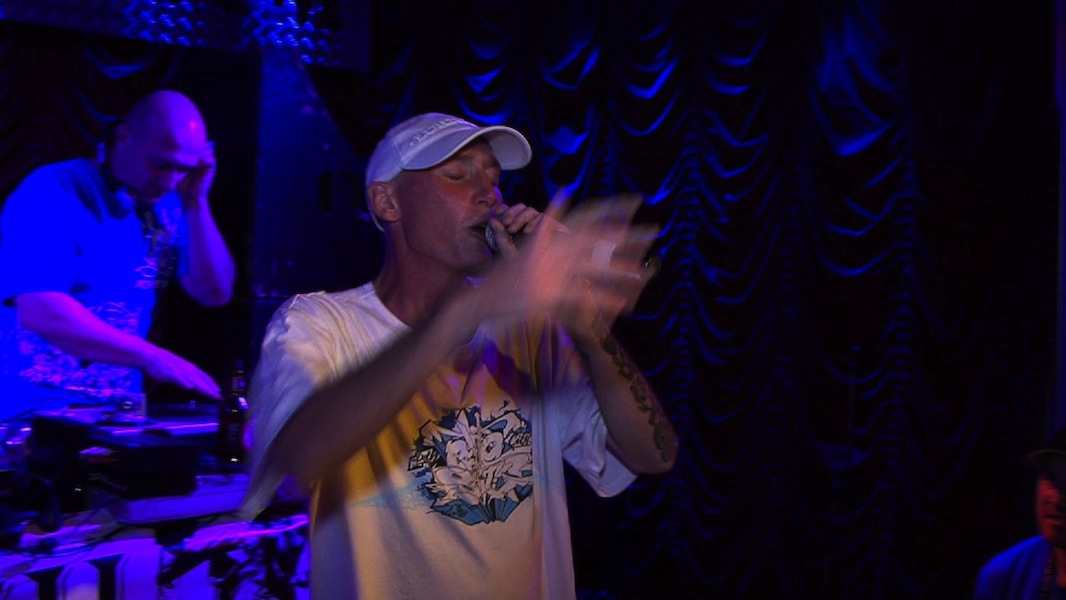
I really can’t recommend this film to you enough. Not just for hip-hop fans, the film is a real portrait of life and what it is all about. Not an easy watch, I wept a number of times during this, my second viewing. But despite what it depicts, the life affirming nature of how Robert Hunter lived his last 12 months does give the film a hint of the uplifting.
Verdict: Longneck of Melbourne Bitter
Like what you read? Then please like Not Now I’m Drinking a Beer and Watching a Movie on facebook here and follow me on twitter @beer_movie.
If you are keen to get your hands on the film, you can do so (DVD, Blu-ray & digital download) through the official website here.
 Beermovie.net