Trailer for your Weekend: World War Z

I’ve not read the book that World War Z is based on, but I have heard very good things. Given the popularity of the book and zombie narratives in general, a film adaptation was pretty inevitable. Featuring Mr Brad Pitt means that this has gotten even more hype. It has been in production for a while and here is the first official trailer.
What do you all think? Looks rather massive in budget and scope to me. Has the potential to be something really quite special. Or a bit meh. We will find out either way next year.
Bondfest is coming
I have been on holidays recently, hence not as many posts over the last few days. However after I return from Sydney, whilst I will still be on holidays you can expect a whole lot more posts coming your way. Why? Cause Bondfest is coming.

A week from today, the 23rd official James Bond film Skyfall opens in Australia. To celebrate I will be watching and reviewing all 22 existing films over a 4 day marathon effort, before reviewing Skyfall next Thursday. I am a huge fan of James Bond films, but not only that, the series was responsible for planting some of the earliest seeds of my love of film. Way before I would consider watching any other films more than a couple of years old, I was scrounging through the beat up VHS of my local video store to track down all the Bond films.
I hope you will come along and check out these reviews, starting from this Sunday. It is going to be a mammoth effort, I did not entirely think through the commitment it was. But the commitment has been made, and it is going to be quite the ride.
Like what you read? Then please like Not Now I’m Drinking a Beer and Watching a Movie on facebook here.
The Bergman Files: To Joy
“One wants to be a real person and an artist” – the character of Stig early in the film.
For me, Bergman had been in a bit of a funk through his last couple of films. But thankfully he blows it out of the water, with the excellent To Joy (1950). There is a refreshing originality to this film when compared to the tired Thirst (1949) which makes this one of the more enjoyable early Bergman watches.
Many of the same plot points feature here – a love story, surprise pregnancy, abortion. However here the whole thing is set against the backdrop of an orchestra which revitalises these themes and makes them as engaging as they should be. The couple at the centre of the relationship, Marta and Stig are the new musicians in the orchestra, although they have met in the past. Much of the early part of the film takes part in the rehearsals of the orchestra and Bergman clearly has fun with those sequences. I did too, even though I have minimal interest in or knowledge of classical music, I appreciated the skill of the musicians and also of Bergman in presenting their work. His camera flits from musician to musician allowing the viewer to see the individual cogs and also the orchestra as a whole. In addition to the freshness that the orchestra adds to the film, the structure also strays from Bergman’s formula. The film starts with a horrific accident and then goes back seven years to build back up toward it.
The relationship between Marta and Stig is one with a lot of complexity and depth. It begins in a scene by the beach where they almost negotiate the terms of their agreement. But from this beginning, Bergman is able to paint a love story, though one with a number of hurdles to clear. Stig has some demons himself, especially the disconnect between his ambition and his skill as a musician. For a long time throughout the film he is yearning yet falling short of what the quote at the top of the page describes. Like many of Bergman’s characters, Stig is enigmatic, talented and struggling to find to his place in the world. Marta comes into this world and both supports and challenges him, building him to great heights and standing by him through great lows when she could be forgiven for cutting him adrift. A pet gripe of mine, film at times seems to have an obsession with adultery. In this film there is an adultery subplot that for me took all of the steam out of the narrative. Luckily the script recovered and the reconnection of Marta and Stig was an effecting one. Actually their reconciliation is really nicely done, especially as the whole thing is presented by the two of them reading love letters from the other. This reconciliation is reflected in the really nice ending which whilst sentimental, is effecting, completing the release of one of the main characters from their grief.

Once again Bergman gets a very good performance from his female lead, this time Maj-Britt Nilsson as Marta who carries the film. Also featuring here is the father of Swedish film and Bergman’s mentor, iconic director Victor Sjostrom as Stig’s mentor, and the conductor of the orchestra. Sjostrom gives a really good performance and his character is effective in that it expands the world of the film out from the two central players. The film looks excellent with clean cinematography and looks very sharp. Bergman employs a lot of close-ups as well, focusing in on the couple early in their relationship at the exclusion of the wider world. Much like how a new relationship feels, with only the other person mattering, rather than any outside distractions. Another really clever use of close-up is in the scene when Stig and Marta are married. As they are exchanging vows, the camera lingers on a close-up of Marta’s face, even when Stig is talking, showing the impact of this moment on one of the parties involved. Bergman also utilises darkness visually really well. Much like a silent director, he intentionally shrouds various parts of the screen in darkness, obscuring what he wants to remain hidden.
The presence of long swathes of music and the flashback structure means that this is the most original that Bergman has felt for a number of films. Expanding on his usual love story and themes by incorporating orchestral music and an illuminating structure to elevate the film.
Verdict: Pint of Kilkenny
‘The Bergman Files’ Leaderboard
- It Rains on our Love (1946)
- To Joy (1950)
- Crisis (1946)
- Port of Call (1948)
- Music in Darkness (1948)
- A Ship Bound for India (1947)
- Prison (1949)
- Thirst (1949)
Like what you read? Then please like Not Now I’m Drinking a Beer and Watching a Movie on facebook here.
Trailer for your Weekend: Anna Karenina

As I mentioned last week, there is a dearth of trailers that have me excited out there at the moment. So I thought this week I would feature a trailer that has been out there for a while, that for Joe Wright’s take on Anna Karenina.
I haven’t read Tolstoy’s classic novel, and probably won’t get around to it before the film opens. I really like the look of this film and it has a lot of really interesting people involved – Wright, writer Tom Stoppard and a pretty intriguing cast. I’ll be keeping an eye out for this one when it opens, especially as the small scale sets suggest that this is going to be an interesting take on a classic narrative. What do you guys think?
Like what you read? Then please like Not Now I’m Drinking a Beer and Watching a Movie on facebook here.
Sabotage
When you think Joseph Conrad cinema adaptations, you generally think of Apocalypse Now (1979) Francis Ford Coppolla’s Vietnam War set take on Heart of Darkness. Sabotage (1936) is a not as famous film based on a not as famous book. It is a British era Alfred Hitchcock film, based on Conrad’s novel The Secret Agent, a book I absolutely love, and personally prefer to Heart of Darkness. The book is an amazing, tense account of a terrorist and the results of his actions, especially those wrought upon his family. The book is strange in that it is not overly cinematic, but immediately upon reading it I thought it would make a great adaptation if taken on by one of today’s more original directors. I had visions in my head of a contemporary reimagining with Paul Greengrass at the helm, or even more intriguingly for some reason a Tarantino helmed period piece. Either would be scripted by me, so no stealing my ideas.
Before I get into my thoughts, I think it is hard to talk too much about the film without giving away spoilers. Luckily the film is in the public domain, so check it out here (it is well worth a look, and is only an hour and a quarter long):
First a small note on the name change. It was necessitated because Hitchcock’s previous film was titled Secret Agent (1936). That picture was unrelated to Conrad’s novel, and was in fact based on a W. Somerset Maugham short story. From the very start Hitchcock’s originality and ability to utilise technique to enhance the style of his films is on display in this effort. A pre-credits shot sees the camera zoom in on the word sabotage in an open dictionary; whilst the first shot of the film proper shows a canted close up of a light bulb whilst Mr Verloc plunges the city into darkness with his first act of sabotage. The film has an edge of innovation throughout it, such as when a deceased character’s face repeatedly flashes up onscreen, haunting his older sister. What the film does well narratively, is achieves the all-important balance any adaptation must. Namely it strips away the fat from the book, in the form of a number of sub-plots which are not necessary to the central thrust of the film as envisaged by Hitchcock. Verloc is a saboteur, an agent for an unnamed foreign government who runs a cinema in London as a cover for his operations. The film has fun with this metaphor, with the shady goings on all taking place behind the facade of the screen. The appearance writ large for the audience in the movie’s cinema masks the reality of the city’s underbelly unfolding behind it.

The film is in parts, searing. It was actually banned in Brazil because it upset public order, whilst Hitchcock says the scene where a young boy is killed was the biggest mistake he made on film. This scene is the film’s highpoint and I think it is equal to any sequence Hitch ever filmed, at the very least in terms of tension. I do not write that last sentence lightly. Stevie, thinking he is just delivering a film canister, gets distracted on the way to dropping it off. The audience knows he is really carrying a bomb for Verloc, a fact Hitchcock reminds us of with repeated close-ups of the package, often intercut with a shot of a cute puppy or the young, innocent Stevie. As the scene builds to its shocking conclusion, Hitchcock continues to amp up the tension to almost unbearable levels. The outcome is a crushing one, smouldering bus wreckage and all. The book is extremely psychological, primarily concerned with mental anguish and torture. Whilst the film is not able to maintain all of this, it does elicit a lot of tension from the situations that it depicts and it is able to maintain the cerebral quality of the book. Hitch truly is a master of this genre of film. Specifically I am talking about short, taut, classical mystery films dripping with intrigue; in this case all aided no end by a very clever script. The setup, with enemy spies and undercover cops, is classic crime film. But the layer of psychological manipulation and the relationships between the characters allow it to rise above the generic standard. And whilst his Hollywood work is undoubtedly more ambitious, big in scope and ‘great’, these earlier British films of his really are genre classics.

Sylvia Sidney who is so excellent in the film
Occasionally the acting in these earlier, British works of Hitchcock’s left a little to be desired, especially in comparison with the turns delivered by some of the stars of his later Hollywood work. That is definitely not the case here though. Oskar Homolka gets the difficult role of Verloc, a pretty unlikeable dude. He is a bad husband, and a small amount of initial idealism swiftly makes way to a much larger unfeeling, vicious streak. He is a coward who will do anything to placate his superiors and Homolka’s portrayal maintains the small mindedness and bumbling tendencies of Conrad’s Verloc. Homolka is a bit of an Edward G. Robinson lookalike who initially appears to be rocking a Dracula accent, but this settles and is not distracting after a while. Continuing the lookalike theme (for me at least) is the undercover cop Ted Spencer, played by John Loder who looks a whole lot like Laurence Olivier. Spencer is (along with Stevie) the moral core of the film, obviously representing good and the law in opposition to Verloc’s evil and illegality. Stevie, Sylvia’s younger brother who features in the film’s emotional highpoint is effectively portrayed by Desmond Tester. This is a difficult role as Stevie is a character with mental issues, but the performance resists the temptation to overplay this, instead making it clear but not distracting. His innocence that Verloc takes advantage of is also made plain. The standout performance by far of the film comes from Sylvia Sidney as Verloc’s wife Sylvia (this has been changed from the name of Winnie in the book). Sidney is truly excellent in this film, managing to convey the right amount of innocence without coming across as weak. Actually her character is far from weak, as evidenced by some of the actions she takes late in the film. The scene where she discovers that her younger brother has been killed is heart wrenching, mainly because of Sidney’s performance. Upon hearing the news, she collapses to the ground, overwhelmed by grief yet not needing to resort to histrionics. It is a masterful piece of acting.
Like the best literary adaptations, this film changes a lot but remains true to its source. The film has a happier ending than the book. Not in a saccharine way, but it is a measure of Hitchcock’s skill that this change, just like all those he makes from the book, feels ‘right’ and like it fits perfectly. Whether or not you have read the book, definitely take a look at this one. I wish they still made em like this.
Verdict: Pint of Kilkenny
Progress: 64/1001
Sleeper
Note: This is a slightly expanded version of a review that first featured in Film Blerg’s Wednesday’s With Woody series here.
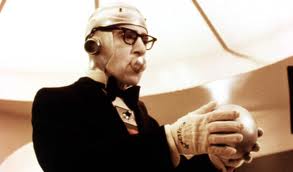
In Sleeper (1973)Woody Allen plays Miles Monroe, a Brooklyn health food shop owner who goes into hospital for a routine operation in 1973, and wakes from a cryogenic freeze 200 years later. It’s a plot you’ve seen countless times before, from 50’s B-movies, to Matt Groening’s television series Futurama. Chances are, you have not seen it done quite like this though – this is a dystopic vision rendered with the lightest touch imaginable. It’s also rendered with a low budget touch as well, with aluminum foil seeming to abound on this future earth. When he awakes in 2173, Monroe is confronted by a strange world where self expression is severely frowned upon and which has seemingly inverted much of 1970s society. Before too long Monroe and love interest Luna Schlosser, played excellently by Diane Keaton, are on the run trying to reach an underground revolutionary movement.
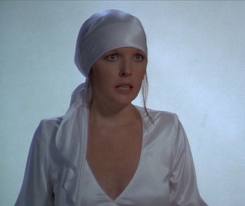
Diane Keaton’s performance is the best thing about Sleeper
Heralded as Allen’s breakout ‘classic’ by many, Sleeper is in fact an extremely uneven experience. Whilst that is a criticism that can be leveled at many films of a slapstick bent, more falls flat here than succeeds. The social and political jabs, generally very specific to 1970s America, are too obvious and contain none of the inspired nuance of the best dystopian science-fiction. That said, my knowledge of classic sci-fi film (which Sleeper apparently references frequently) is pretty sparse, so that may be part of the issue. Almost all of the key slapstick sequences are shot sped up, with ultra-intrusive vaudevillian music, techniques which can work at heightening the silliness. But here they just make it seem tired, almost like Allen had to do it this way to signal to the audience it was a joke sequence and they should be laughing. It is strange that the film is in many ways so uninspired, when the sci-fi farce concept is so fundamentally inspired and should be much funnier. Whilst what is on display here, from the technical aspects of filming through to the script, is much more refined then something like Take the Money and Run (1969), the spark that made a film such as that so endearing is gone. The only hint of real spirit comes in the form of the inspired performance by Diane Keaton, who is freed from the constraints of this future society by her run-ins with Allen’s Miles.
All that said, you will get a couple of good laughs out of the film. It features a banana peel joke for example that is so hilarious, gleefully weaving in the sci-fi and slapstick elements of the film perfectly, that you will lament how flat much of the rest of the film is. Unfortunately though in Sleeper, his fifth directorial effort, Allen’s shtick is already starting to feel a bit stale. Nothing illustrates this more clearly than the tokenistic insertion of one of his beloved riffs on Judaism toward the close of the film, which achieves nothing, except to remind you that this is a Woody Allen film. Not a terribly good one unfortunately.
Verdict: Schooner of Carlton Draught
Progress: 63/1001
Like what you read? Then please like Not Now I’m Drinking a Beer and Watching a Movie on facebook here.
Worth Watching October 2012
Worth Watching:
- Port of Call (1948), Ingmar Bergman – This film was reviewed by Jon from The Film Brief as part of The Bergman Files here. I thought this had a cracking start with an attempted suicide. A very sharp script and yet again Bergman is honing his favoured themes – familial relationships and young love are at the fore here. The major strength of this is Bergman’s critiques of broader Swedish society, especially through an intense abortion subplot.
- Bait 3D (2012), Kimble Rendall – A poor script woefully acted. But its frickin killer sharks loose in a flooded supermarket in awesomely rendered 3D and a whole lot of fun. A really cool little Aussie high concept genre flick. Picks up where last year’s excellent The Reef and Sanctum left off.
- Catching Hell (2011), Alex Gibney – Fantastic ESPN baseball documentary. Taps into all of the mystique in the game by connecting the ’03 Cubs with the ’86 Red Sox. Also a horrible story of bullying. Really sad and sows the warped place of sport in many people’s lives.
- The Tempest (1908), Percy Stowe – This very early silent Shakespeare short is really quite visually arresting for a film of its vintage. The set design, painted backgrounds and costuming all indicate the effort that has gone in to it. And it is a genuine film, not merely a filmed play as many early efforts were. There is a really nice performance by the unknown actress who plays Ariel, and the filmmakers manage to cram a lot of Shakespeare’s tale into a short with no dialogue and minimal intertitles. Here it is for you to check out.
- Margin Call (2011), J.C. Chandor – One of the best ensemble casts of recent years and an excellent cast drives this very taut GFC film. Script has to be good to make what is essentially a bunch of people sitting around in a room talking such riveting viewing. A great window into a vile world which illustrates the disconnect between the world of high finance and the real world.
- Mirror Mirror (2012), Tarsem Singh – Like all Tarsem films, this is visually electric. The script is witty and takes off fairy tale shtick without being derivative but rather by subverting their pretentions Costumes from the late Eiko Ishioka are lavish. I really liked a lot of this, and the few instances it falls down a little are when trying to pander to too wide an audience. Lily Collins as Snow White has sass and spirit whilst Julia Roberts is excellent as a truly cruel evil queen. Tarsem is a visionary.

A taste of some of the incredible costumes on offer in Mirror Mirror
- Lawless (2012), John Hillcoat – Cave and Hillcoat really are quite the team. This has gotten middling reviews, but I think it features prob the script of the year so far with some nice notes of humour arriving unexpectedly. Guy Pierce’s preening villain will become a classic if there is justice, as he manages to avoid it becoming a caricature. Jessica Chastain, Tom Hardy and Mia Wasikowska also excel. A great bluegrass infused soundtrack set the tone for a tale set in one of America’s most interesting historical periods, that of prohibition.

- Argo (2012), Ben Affleck – This is a borderline classic. If you didn’t already know Affleck was the young director to watch before this, you do now. The manner in which he balances tone – tense start, borderline comedy Hollywood middle section, white knuckle ending – is masterful. Tate Donovan, Affleck himself, Alan Arkin and John Goodman all put in really good performances. Really craftily shot too, the low-res to make it look like a period piece and a smart animated intro are highlights. One not to be missed.
Not Worth Watching:
- The Five Year Engagement (2012), Nicholas Stoller – One of the very worst of the year. Jacki Weaver and Annie from Community are good in supporting roles… and that’s all the positives I got. A woeful, unbelievable, unromantic and unfunny script cripples the film as does Jason Segal’s absurd character. A miserable film populated by miserable characters.
If you only have time to watch one Argo
Avoid at all costs The Five Year Engagement
Like what you read? Then please like Not Now I’m Drinking a Beer and Watching a Movie on facebook here.
Trailer for your Weekend: Silver Linings Playbook

I was kicking around on Apple Trailers trying to find a trailer to share and really struggling to find anything appealing that I had not shared. Getting exasperated, I chose Silver Linings Playbook solely because of the presence of Jennifer Lawrence and Bradley Cooper, two engaging actors if unleashed in the right material.
The trailer for Silver Linings Playbook looks like it could go both ways, but there is hope that this could be engaging. Cooper’s character looks interesting and it is awesome to see Jacki Weaver in a decently substantial role as his mum. I’m not going to lie, I wrote that sentence after the first 30 secs of the trailer. The rest of it gives me less hope. It is hard to do the two people with mental illness falling in love thing sensitively and without falling into overt tweeness, and I fear this will fail that test. But, I’ll reserve judgement, and hopefully the people involved in this one bring intelligence to the humour.
What do you guys think of this one?
Like what you read? Then please like Not Now I’m Drinking a Beer and Watching a Movie on facebook here.
The Bergman Files: Thirst
“It is the politics of relationships and the sociology of the psyche that is really Bergman’s concern. Marriage and the perils of domestic life”. – Michiko Kakutani on the concerns of Bergman’s films.
Ingmar Bergman’s 7th directorial effort Thirst (1949) continues in a similar thematic vein to a number of his early efforts, focusing on relationships, unwanted pregnancy and abortion. Here he also shines a light on the sexes and what defines them.

Eva Henning, who gives a fantastic performance in Thirst.
Just as the quote above from Kakutani suggests, this film from Bergman is deeply concerned with relationships and the politics that can affect them. The film opens with a mistress who does not know she is a mistress. Her lover is a military man. Eventually the affair is discovered and the main character is confronted by the military man’s wife. All of this is wrought with the politics and ethics of relationships and lust. Once again there is an unwanted pregnancy and once again it ends with an abortion. The abortion in this film is a real focal point and it deeply affects the character of Rut who undergoes the procedure. This is probably the most effective aspect of the film and Bergman makes this fallout feel a lot more real than in the other couple of films that have had abortions take place. Rut struggles through and verbalises her post-abortion struggle, how it makes her feel inside both emotionally and physically. The crushing pain of the procedure that she did not want. In these parts of the film, Eva Henning who plays Rut, gives a really fantastic performance.
The film is jarring in that it relatively late in the piece brings in an entirely new plotline featuring a borderline evil psychiatrist and lesbian seduction. It is pretty inexplicable how all this is brought in and really quite befuddling for the viewer, even one paying careful attention. This film is not as interestingly shot as Bergman’s previous film Prison. But it is really nicely edited with some creative fades and match shots. If it was not so confusing what was going on, the film would have been a whole lot more interesting. Especially with the continual emphasising of the distinction between the sexes, which is a nice thematic addition from Bergman. But unfortunately one that is buried by the film’s shortcomings.
As you have probably gathered, Thirst left me monumentally underwhelmed, a second pretty major disappointment in a row. But at least the earlier Prison had started off really quite ambitious and intriguing – no such sort of saving grace for Thirst. This is rambling and Bergman’s thematic concerns are starting to get quite wearisome.
Verdict: Schooner of Carlton Draught
‘The Bergman Files’ Leaderboard
- It Rains on our Love (1946)
- Crisis (1946)
- Port of Call (1948)
- Music in Darkness (1948)
- A Ship Bound for India (1947)
- Prison (1949)
- Thirst (1949)
Like what you read? Then please like Not Now I’m Drinking a Beer and Watching a Movie on facebook here.
 Beermovie.net