Broken City
Broken City has flown under the radar a little. But the trailer suggested that it could be a bit of a sleeper, with police and political machinations perhaps resulting in a taut thriller to blow our minds.
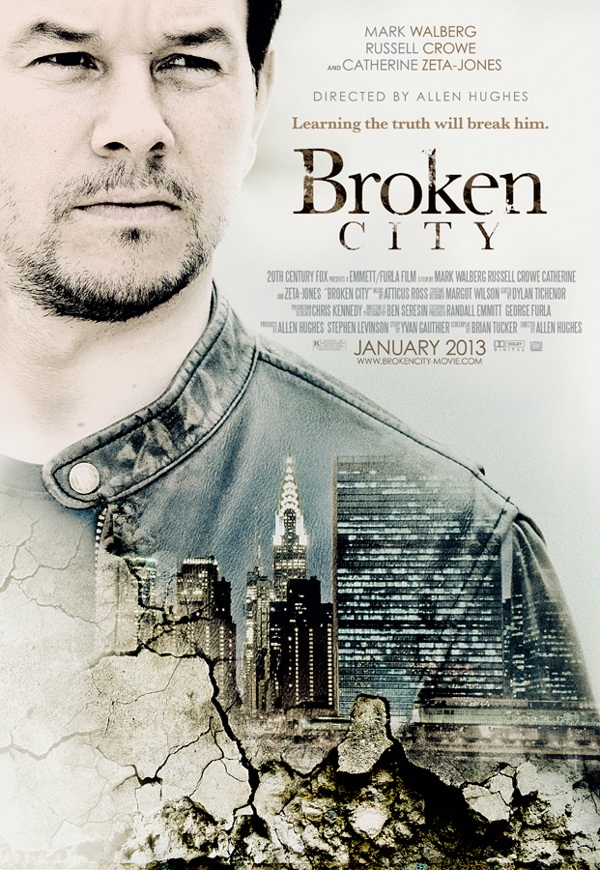
Unfortunately though, the action never reaches the desired level of tautness. It is all pretty ok though. Mark Wahlberg plays Billy Taggart, a New York cop who finds himself off the force due to a shooting incident. Some years later, a mysterious call from the mayor of the city, Russel Crowe, plunges him into some deep, dark, money laden places. The film is definitely attempting to play into some noir sensibilities, with a pretty feeble attempt to position the mayor’s missus as a femme fatale. Whilst this aspect fails, somewhat more successful are the more blurry ethical conundrums faced by numerous characters. Though the film is ultimately not willing to go dark enough in this regard to come up with something genuinely hard hitting. Exploring themes of manipulation of power, the contemporary political environment, alcoholism and vigilante justice, there is a fair bit here. Ultimately though it only manages to fall into the helping to hold your interest realm, rather than being all that thought provoking.
 The opening title graphics are somewhat reminiscent of a mid 90s TV cop show. Which is kind of apt, because in its plot and much of its execution Broken City often struggles to rise above the contrivances of that standard. What is definitely not mid 90s cop show standard are a number of the performances. Russell Crowe really is one of the best actors of this, or any generation. Even with this middling material, he reminds you that it is between him and Denzel for this generation’s acting King of the Universe. No one else can match them. Matching him here though is Jeffrey Wright, who brings a real intensity to his performance as the conniving Police Chief. The film is far and away at its best when the two of them share the screen and I would have loved to have seen more of them. Especially Wright. Damn he looks fuckin badarse with a shaved head and goatee. I guess unfortunately everything else in comparison to these two is a touch average. Marky Mark and Catherine Zeta-Jones give good performances. But they are not on the same level as the aforementioned two. While the script starts off particularly sharp, especially in its dialogue, the plot spends too much time concerned with disinteresting subplots that do not bring anything to the core narrative – the romance of Mark Wahlberg’s character by far the worst offender. And no mind blowing twist is forthcoming. Actually those that do arrive fall really rather flat, delivering no real sting.
Broken City is good, however always being far too mild to ever approach being great. It is worth a watch if you see it playing somewhere. Though to be honest, there will probably be something else on the cinematic menu that looks a little more enticing.
Verdict: Stubby of Reschs
Like what you read? Then please like Not Now I’m Drinking a Beer and Watching a Movie on facebook here
Trailer for your Weekend: It’s A Disaster

Apocalypse comedies are all of a sudden a dime a dozen. This one has flown under the radar a little, not being pushed by names such as Carrell, Rogen and Penn/Frost. The trailer is promising though, nicely captruing the awkwardness of being the new boyriend at a dinner party. It may not be as over the top as some of the other entries in this subgenre, but I think this has a fair bit of promise. Always good to see Julia Stiles onscreen as well. What do you guys think of this?
Like what you read? Then please like Not Now I’m Drinking a Beer and Watching a Movie on facebook here
Dead Europe

Christos Tsiolkas has in recent years become one of the most lauded ‘literary’ Australian authors. His novel The Slap published in 2008 was a runaway success and a book I studied at uni. Also a book I hated. But that is neither here nor there. This review is of Dead Europe (2012), an adaptation of an earlier Tsiolkas novel I have not read.
The film follows Isaac, a Greek-Australian, who returns to Greece to scatter his father’s ashes. This literal journey becomes a metaphorical one as Isaac finds out plenty of secrets about his family, most ones he would prefer not to have discovered. Isaac is also a photographer, and this is an interesting lens that the film is seen through. The incorporation of photography is one of the real strengths of the film as ideas of representation and presentation are explored and played with through this device. I think the film is strongest early on, when it chooses to deliver things relatively straight. The death of Isaac’s father and the resulting discussions concerning his burial and the familial squabbles that follow are the most effective parts of the film. When Isaac reaches Europe, there is no doubt that the intrigue picks up, but for me, it was not in an entirely successful manner. There are hints of ghost story, of road movie and a blurring of the lines between dream and reality. But ultimately there is a central journey that is far too oblique and distant from the audience. I think that when you take this approach, suggesting different genre and taking a really bold thematic approach, the film needs to be taut. However this film is just a bit too slipshod to make it work.
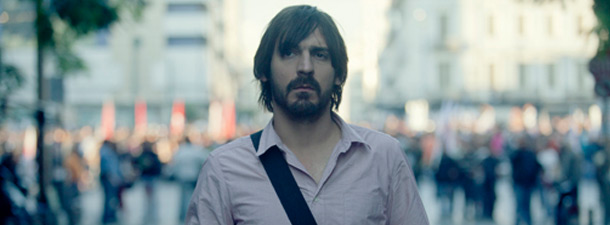
Dead Europe is a pretty unrelenting film. It has an intense start and does not really let up. Abuse, incest, sexuality, violence, paedophilia are all dealt with at one time or another. Narratively, this is definitely not a straight point A to point B excursion, rather revelling in etherealness. Unfortunately the script, which starts so strongly, really fades over the second half of the film. Alongside the extremely troubling issues listed above, the film also deals with faith, identity (both Australian & European), the notion of curses and legacy. And whilst this is all interesting enough, the film does not manage to draw them all together into an interesting or satisfying whole. The performances are excellent, in really quite challenging roles. As the protagonist Isaac, Ewen Leslie delivers, balancing a realistic performance with definite charisma. As his deplorable brother Nico, Martin Csokas delivers a troubling firecracker of a supporting turn which almost single-handedly makes the film worth checking out.
Overall, whilst the film has some intriguing ideas that are presented in some intriguing ways, it is an altogether too distant experience. Which is disappointing, because as a revealing of family secrets tale, this had a ton of potential.
Verdict: Schooner of Carlton Draught
Like what you read? Then please like Not Now I’m Drinking a Beer and Watching a Movie on facebook here
The Black Cat
The Black Cat (1934) saw the first team up of Bela Lugosi and Boris Karloff onscreen. Unfortunately it is a pretty tired affair, for me never managing to scale the heights of some of the two’s more iconic efforts. For much of its running time, the film seems pretty content to coast by, hoping the audience will be wowed by the fact that the world’s two greatest horror stars of the time were finally onscreen together.
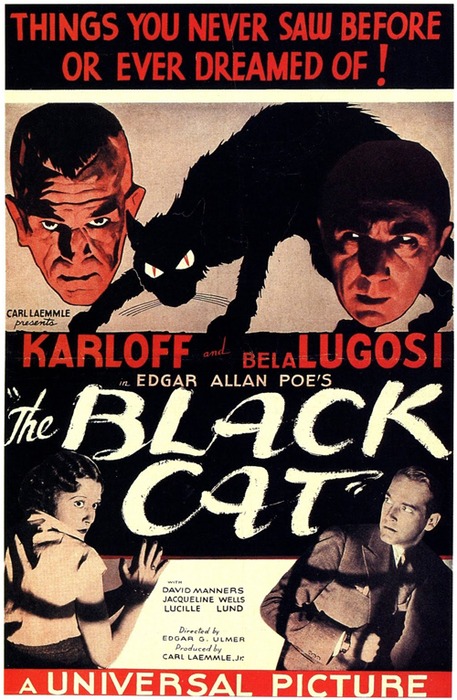
Lugosi stars as the creepy, suspicious engineer Dr Vitus Werdegast, whilst Karloff is a Satanist or something. There are plenty of references to the war littered through what is a pretty poor script, however if it was aiming to be some sort of comment on post-war life or the effects that such a transformative historical event could have on two people, it did not work for me. Into the sphere of these two comes newlyweds Peter and Joan Alison. Before too long Karloff has his sights set on incorporating Joan into one of his freaky Satanist ceremonies. This naturally leads to a chess game to see who has rights to the couple… That is the kind of plot that is at play here. Unfortunately there is no real strong narrative core to the film whatsoever or even proper attempts at character creation. The placing of iconic stars into the roles is what passes for character development here. Aspects of the film are decidedly unnerving, though not as in the way a horror film can successfully unnerve the audience. Necrophilia overtones are just plain unsettling in any context. The quality of the film does swing up in the last half hour. However because what has preceded it is so dire, the audience is totally uninvested in caring about what happens to the characters onscreen. It is a shame then that the atmospheric satanic ritual scene toward the end, nicely shot with a bunch of close-ups, is essentially wasted because you won’t care what happens. Ditto an extremely dark scene involving a character being skinned.
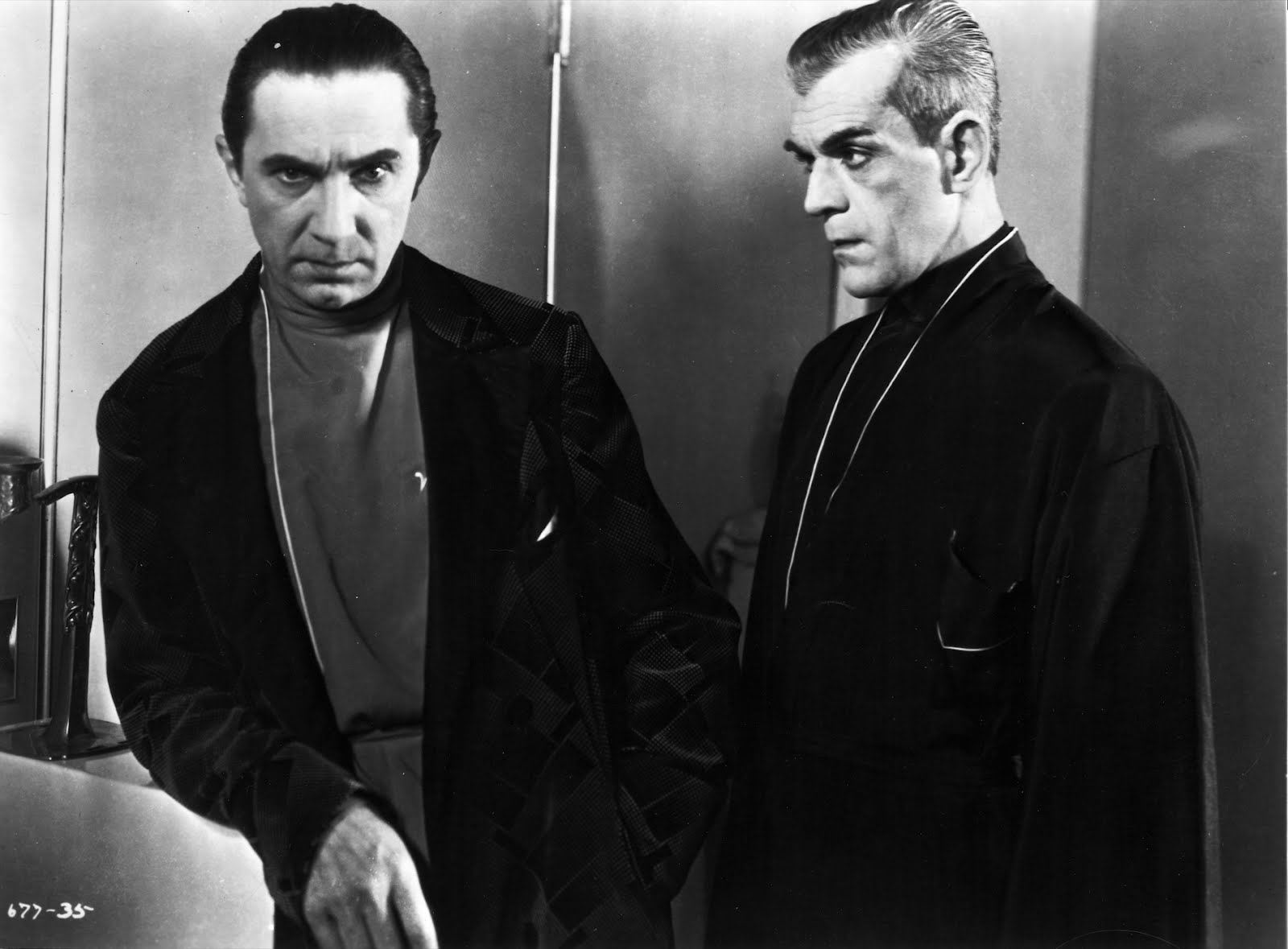 As for the all star cast (if two people can constitute ‘all star’), Karloff fares a fair bit better than Lugosi. The former is introduced in a clever but perhaps too self-referential manner. He awakens from sleep and the audience sees his very Frankenstein’s Monster esque profile sit up in a very Frankenstein’s Monster esque way. The makeup that Karloff is forced to wear is totally distracting too, which is saying a lot given this is a man whose makeup in The Mummy (1932) and Frankenstein (1931) did not detract from his performance (if anything it boosted his work in both films). Despite the material and his performance, Karloff does show his acting talent in this film. Lugosi it must be said, does not fair so well. In comparison to his rightfully iconic performance in Dracula (1931), he is pretty weak here. Coming from the Universal stable, The Black Cat unsurprisingly showcases some pretty incredible set design. The mansion at the centre of a majority of the plot must be one of the studio’s greatest achievements in that regard. Massive, labyrinthine and simultaneously gothic and ultra modern, the house manages to bring an atmosphere to proceedings that is decidedly lacking elsewhere in the film.
Unfortunately The Black Cat lacks the snap and panache that make the best Universal horror films classics that remain essential viewing today. It just totally failed to hold my interest whatsoever. Outside of a pretty incredible set and a decent last half hour, the first superstar team up from Lugosi and Karloff is a pretty inconspicuous one.
Verdict: Schooner of Carlton Draught
Progress: 76/1001
Like what you read? Then please like Not Now I’m Drinking a Beer and Watching a Movie on facebook here
Worth Watching February 2013
Here is the round up of all the films that I did not feature in depth elsewhere on the site for the month of February. Cracking month actually, including a couple of really fun short films that are included. Be sure to share your thoughts in the comments section below.
Worth Watching:
- Flight (2012), Robert Zemeckis – Despite his reputation, I actually think Zemeckis is one of the most underrated directors. Here, Denzel shows he is pretty much peerless in his generation of actors. This is a powerful film, an examination of the wretched toll that addiction in all its forms wreaks. Similar to Shame in that way. An incredibly script (had me tearing up on multiple occasions) and a cracking supporting cast ensure this is one of the best of 2013 so far.
- Kaboom! (2004), PES – This short is pretty incredible in its execution. Wonderfully creative use of kids’ toys. The use of these toys in a war film setting can be read as some sort of anti-war statement. Or just a really fucking cool looking idea. Take a look below.
- Fresh Guacamole (2012), PES – I know I am prone to hyperbole (I’m a film critic, what do you expect?) but this is one of the best looking films I’ve ever seen. Great animation and I am just massively blown away by how clever it looks. An exceptionally clever film. Check it out below.
- Safety Not Guaranteed (2012), Colin Trevorrow – This indie has a really dry script, but never feels like it is labouring its ‘indieness’ like so many post-Juno efforts do. A charming film filled with charming performances, especially from Aubrey Plaza. It does threaten to get a little too cute at times, but manages to rein it in. Surprisingly, the second half packs a real emotion punch. If I haven’t sold you on it yet, how bout the best zitar performance in a film since The Third Man and an incredible ending.
- Community Season 3 (2012), Dan Harmon – This season really ramps up the absurdist tendencies, being utterly random much of the time. And this is the source of a lot of the hilarity, as opposed to some of the more tightly scripted brilliance of earlier seasons. Continues the show’s tradition of brilliant riffing on pop-culture and genre.
- The Sweeney (2012), Nick Love – As far as contemporary cops & robbers flicks go, this is a bloody good one. Winstone is excellent as expected as the grizzled ‘don’t fuck with me’ cop, but it is the searing Ben Drew as his protégé who is the most impressive. Rare is the crime film these days which is content to focus on a single crime. But this one is and the narrative is good enough to hold interest.
- Zero Dark Thirty (2012), Kathryn Bigelow – There is just far too much going on here to even remotely process in a single viewing. It is possibly a great film. But also possibly not. It functions on all levels. From an individual quest to the fate of the world. Much of the film is troubling. Some questionable. But it is a film that needs to be seen a couple of times before opinions are formed.

- Madagascar 3: Europe’s Most Wanted (2012), Eric Darnell, Conrad Vernon & Tom McGrath – This film, with these characters, is pretty difficult not to like. The animation is sharp, the script is exceptionally witty and it comes at you are a really fast pace. No need to pay attention to plot, there is not much of one here. This is just eccentric fun, to the point of slipshod surrealism. Borderline nonsensical in parts, with surely no joke rejected for being too silly or peripheral to the peripheral plot.
Not Worth Watching:
- Lincoln (2012), Steven Spielberg – Daniel Day-Lewis’ performance is phenomenal and will rightly become iconic. It rises above mimicry and he inhabits the role. Aside from that though I find very little to recommend in this staid film. A poor script, full of overlong anecdotes from the President and too many obvious moments. Blandly shot by Spielberg too. Overall, a film with no sharpness or edge.
If you only have time to watch one Flight
Avoid at all costs Lincoln
Like what you read? Then please like Not Now I’m Drinking a Beer and Watching a Movie on facebook here
Trailer for your Weekend: The Frankenstein Theory

Pretty tasty poster if you are asking me.
I stumbled across this the other day without having heard anything about the film. Tis a fantastic premise – that Frankenstein was actually based on true events. The trailer depicts a somewhat bizarre mix of B movie and homage to the imagery of Shelley’s book. Doesn’t quite convince, but I think I will be keen to check this one out when hit hits cinemas (or more likely DVD). Thoughts people?
Like what you read? Then please like Not Now I’m Drinking a Beer and Watching a Movie on facebook here
Comic-Con Episode IV: A Fans Hope

The pretty fantastic poster for Comic-Con Episode IV: A Fan’s Hope poster for
Morgan Spurlock burst on to the scene with Super Size Me (2004), but his profile has faded somewhat since then, despite working pretty regularly. Most of his feature efforts, including Comic-Con Episode IV: A Fans Hope (2011) have gone straight to DVD, here in Australia at least.

Some of the famous geeks who are interviewed in the film
That is a shame though, because I think Spurlock is one of the more interesting documentary makers going round, both in terms of his choice of subjects and the way he brings them to the screen. Comic-Con Episode IV: A Fans Hope sheds a little light on the cultural phenomenon that is Comic-Con. It does so by telling the individual tales of a number of attendees. From those wishing to get their artwork noticed, grizzled vets who have been attending since the early days, a dude that wants to propose to his girlfriend at the event and a bunch more. Sprinkled throughout this are interviews with some Comic-Con geeks that have gone onto massive things, led by Joss Whedon and Kevin Smith. It is an interesting structure and for the most part works well. Though occasionally some of the subjects do seem to go missing for longer then would have been ideal. The film is excellent at really making you feel like you are right there at the Con. It is also interesting to hear much of the cynicism emanating from those that have been attending for many years, directed at the perceived ‘selling out’ of Comic-Con that has occurred as its popularity has skyrocketed. The film gets stronger as it goes along. There are a couple of fantastic high points in the second half and Spurlock manages to create some tension out of these really high stakes times, the culmination of dreams.
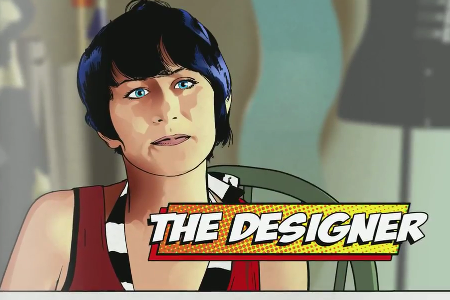
An example of some of the fantastic comic inspired graphics in the film
My criticisms of the film, if any, are that the people it presents are so interesting, that I wanted to know more about them. I couldn’t get enough of each of their stories in this 80 minute format. Perhaps a TV series, where 30 or 60 minutes could be devoted to each of them may have been a more satisfying way to really tell their stories rather than just present a sketch of these people. The film does a good job of overcoming the inherent awkwardness of many of the subjects and manages to get the audience invested in their various hopes and dreams though. It also shows the obsession of some people involved in geek culture and manages to do so in an interesting way. Not afraid to show that sometimes this obsession can verge too far and become unhealthy with people losing sight of the reason they got into this stuff in the first place. Like all of Spurlock’s work, this is well shot. It has some cool little touches too like the comic style intertitles when each subject is introduced and labelling on screen. The film as a whole also benefits from the sterling choice of talking head interviews and the punters that are being showcased who bring their passion to the film.
As an examination of geek culture through its most famous manifestation, Comic-Con Episode IV: A Fans Hope is pretty successful. If you have absolutely no interest in geek culture whatsoever, then there probably is not a whole lot for you here. But if you have even the slightest curiosity about what happens at Comic-Con, then this is definitely recommended.
Verdict: Stubby of Reschs
Like what you read? Then please like Not Now I’m Drinking a Beer and Watching a Movie on facebook here
Tomorrow When the War Began
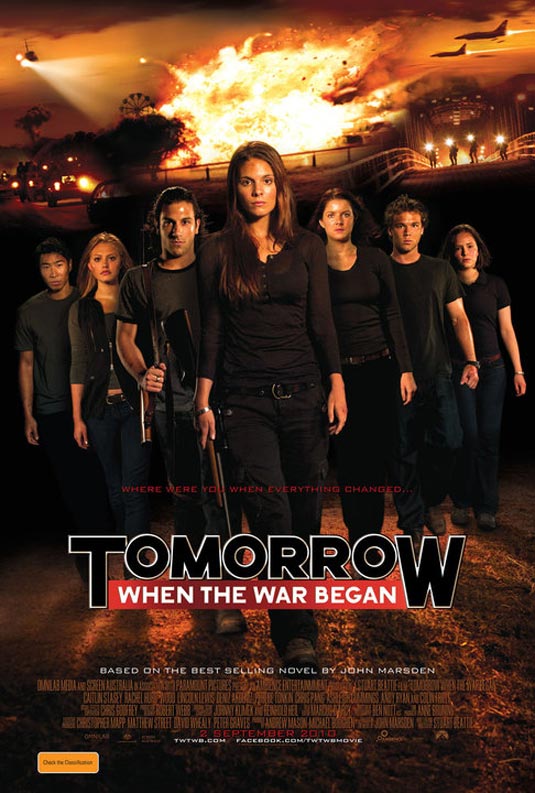
Tomorrow When the War Began (2010) is an adaptation of the first novel in the most popular Australian Young Adult series of my generation, written by John Marsden. Highly anticipated, the film was moderately successful, albeit I do not think it reached studio expectations. Intended as the start of a series of at least three films (and possibly a TV series subsequent to that), work on a sequel seems to have stalled of late, though as far as I can tell one is still planned.
I watched this film at the cinema and whilst I guess I liked it, the flaws really bothered me. Re-watching it, my opinion has definitely changed because I think it is a pretty fantastic piece of entertainment. The very Red Dawn (1984) esque plot sees a group of teens go away camping in the bush for a weekend. They return to find that Australia has been invaded, their home town completely taken over. Eventually they decide to fight back and form a troupe of very inexperienced guerrilla warriors. The second half of the film tracks their first major assault on the enemy. One of the notable aspects of the book is that it never identified who it was that invaded. A film adaptation does not have this choice as it has to show the enemy armies. So in this iteration of the story, it is an unknown Asian country that has invaded Australia because of its vast swathes of underpopulated land and its resources. This is actually a pretty standard xenophobic fear in Australia. That one day hordes from the north (generally in this xenophobic worldview it is the Indonesians that will do it) will invade Australia for our land. I don’t think that the film is intentionally playing on this fear. I just think it is unfortunate that the nature of film forces the identity of the invaders to be, at least somewhat, revealed.

Tomorrow When the War Began is the kind of film not often generated out of Australia. An ambitious budget spent on populist and fun pure entertainment. Thankfully, despite its unashamed mainstream intentions, the movie pulls no punches. Unafraid to make interesting statements about militarism and depict cowardice, it’s high action galore, unabashedly showing the reality of modern warfare and at times (though only when necessary) doing so with explicit violence. There’s no doubting that some of the set up of the plot and characters is clumsy, but it is never uncharming. My major issue with the film the first time I watched it was the script. Upon this viewing though, whilst some lines jarred for me, I actually think I was too harsh on that aspect of the film first time around. I think much of the dialogue that I perhaps had issues with previously is just written to be spoken by teenage characters. On that front, it predominately works. In fact the film captures what I recall of being a teenager quite well. There is an undercurrent of teen angst in the film, without it being an actual focus of the movie which is refreshing. The notion of discovering or making one’s way in the world as well as the, at times crippling, unstable sense of self-worth is really well done.
As is so often the case with films aimed at teens, the quality of acting is what really elevates or sinks the film. Thankfully the cast of Tomorrow When the War Began, mostly young veterans of Australian soaps, are really great. It is also a testament to the script that even though there are 8 main characters, the characterisation of all of them is lean and successful. Leading the way is former Ramsay Street resident Caitlin Stasey as main protagonist Ellie. She is effectively and believably able to convey what it must be like to be in such a horrific situation. Moreover, her character is a fantastically cool, all action heroine. She is the leader of the pack, the one who (whilst not entirely on her own) drives the group forward in all that they do. Hopefully more films do come to pass, because hers is a strong female character arc desperately needed. Another character who goes on a great ‘journey’ throughout this film is the ultra-religious Robyn, played by Phoebe Tonkin (most recently seen being utterly awesome as Dot in the ABC series Miss Fisher’s Murder Mysteries). She is fantastic in the role and is able to really embody someone going through a great moral and spiritual torment as well as all the other horrors that are swirling around her. Of the male leads, it is Deniz Akdeniz as Homer who is the undoubted pick of the bunch. His character has a really interesting, though refreshingly totally platonic, relationship with Ellie and Akdeniz is able to bring the spirit of this popular and loveable renegade to the forefront of his performance. Unfortunately, the only letdown in the acting stakes was Lincoln Lewis as the smarmy Kevin. He simply does not convince and this is the second film, after Bait 3D (2012), where I have felt that way about him.
Overflowing with interesting characters and loads of action, Tomorrow When the War Began definitely did not disappoint for me this time around. There are so many interesting places to take this series, so here’s hoping that the rest of John Marsden’s brilliant books can find their way onto the screen sooner rather than later.
Verdict: Pint of Kilkenny
Like what you read? Then please like Not Now I’m Drinking a Beer and Watching a Movie on facebook here
Trailer for your Weekend: Room 237
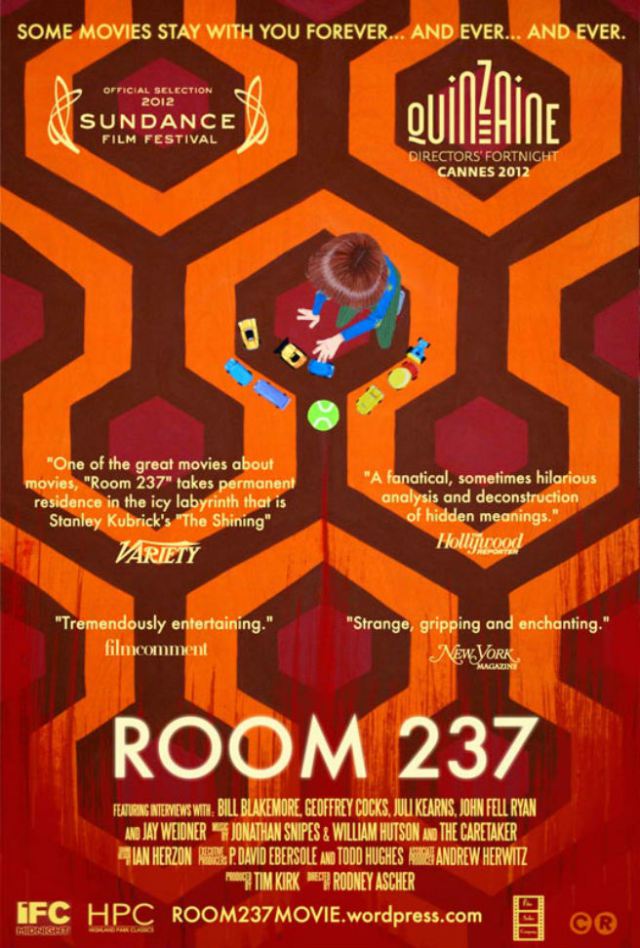
I’m not featuring this trailer for the movie so much (though I am very keen to see it), but rather the bold and artistic trailer. So great to see people take a really different approach to a trailer and this one really grabbed me. Simple, but very clever and effective. Great music, a great shot and a great payoff in under 2 minutes. What do you guys think of it?
Like what you read? Then please like Not Now I’m Drinking a Beer and Watching a Movie on facebook here
Dracula (1931)
Bram Stoker’s brilliant classic of English literature Dracula, first published in 1897, has produced numerous film adaptations – from the sublime, like Nosferatu in both its 1922 and 1979 iterations; to the garbage, Francis Ford Coppola’s Bram Stoker’s Dracula (1992) for example. Though I acknowledge my views on the latter are not universal.
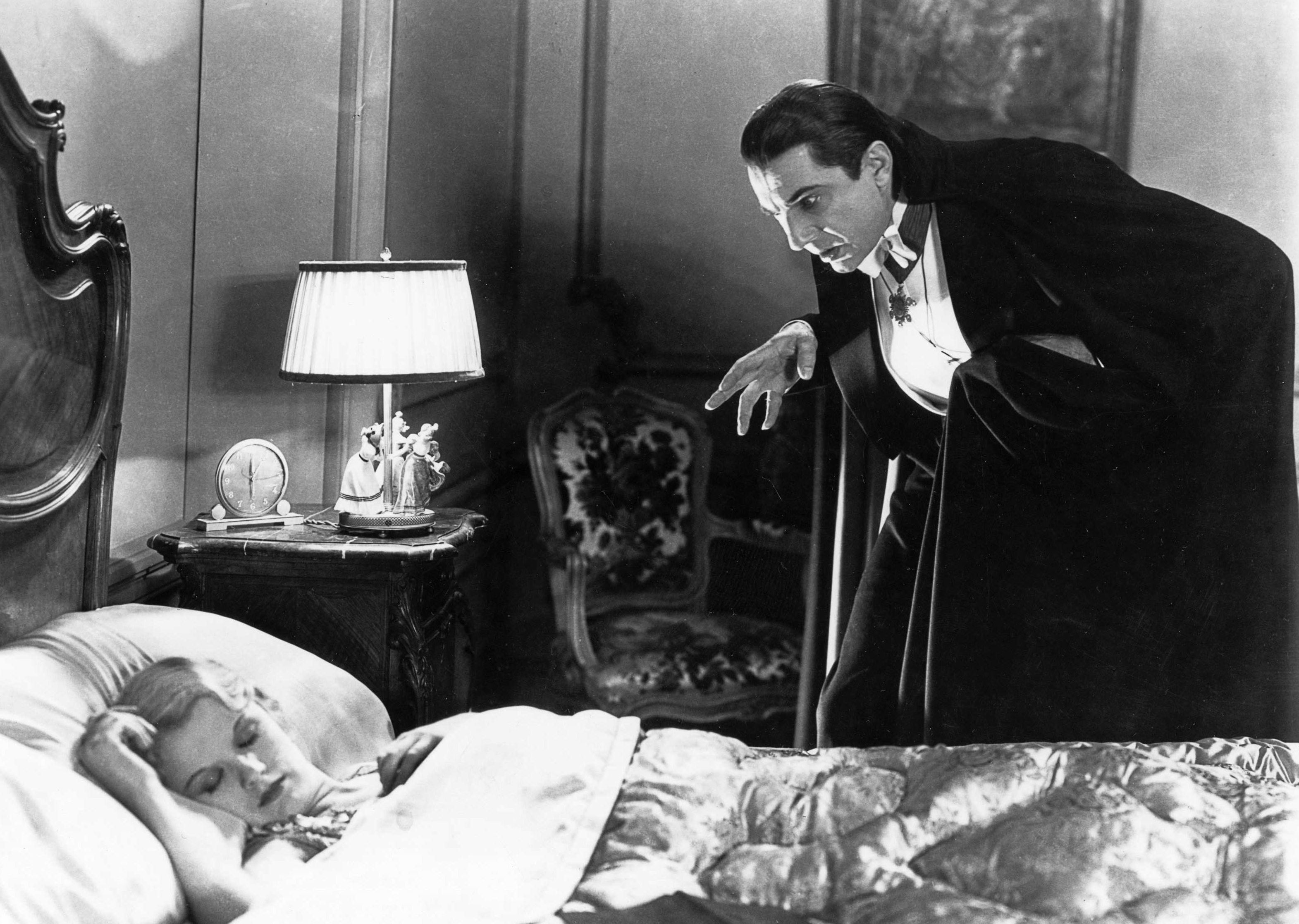
Dracula. Lurking.
Arguably no film adaptation of the novel has produced a more iconic interpretation of the novel’s central character though than Tod Browning’s Bela Lugosi starring Dracula (1931). Browning’s is a Dracula tale full of towering castles crawling with terrifying life forms (including somewhat absurdly an armadillo), an incredible orchestral score, those iconic Universal Horror sets (which intriguingly hosted the shooting of a Spanish Language version of Dracula at night at the same time this film was being shot) and plenty more that brings the atmosphere. The film is just so wonderfully staged. Apparently it is based heavily on a play based on the book and that sort of shows in the construction of the film as a whole, especially the way in which characters are introduced and plotlines set up. In comparison to most adaptations of Stoker’s novel, Dracula spends very little time in Transylvania, rather getting rather more quickly into the London set part of the story. The Transylvania set part still contains some of the most fun parts of the film. The scene where Dracula first sees his houseguest’s blood is pretty fantastic, with a dynamic camera zooming in to emphasise Dracula’s bloodlust. Before Lugosi comes out with the zinger “I never drink… wine”. It is undeniable that this 80 odd year old film does clunk at times. There seems to be a particular obsession with close-ups of Lugosi’s face shrouded in darkness, with only a strip of light over his eyes.

Dwight Frye who is so good as Renfield
It is impossible to talk about this film without discussing in depth Lugosi’s turn as Dracula. Indeed when most people think of Dracula, the image they have is not Stoker’s Dracula, it is Lugosi as Dracula. Look no further than last year’s fun animation Hotel Transylvania (2012), a film where Dracula as voiced by Adam Sandler looked a whole lot like Lugosi. Initially when watching the film this time around (I had seen it about 10 years ago), I was wondering if Lugosi’s performance was so iconic because of the actual performance itself, or just because of how his character looks. But it is immediately clear that Lugosi’s actual performance is really ace too. He has this shtick which he works throughout the film that just makes him seem to truly inhabit the role of Count Dracula. His Dracula is the bogeyman, both literally and figuratively, the dark force lurking in the shadows outside of a woman’s house in the darkness of night. It is easy to see why when so many people think Dracula, they think Lugosi. There is somewhat of a paradox at work here though. Because whilst Lugosi’s performance is stellar, he is not given the chance to show off his chops too much. Indeed Browning seems content to predominately focus on his (admittedly awesome) iconic look. Lugosi has some excellent support from other actors in the film too. In particular Dwight Frye as Renfield is really something else. Initially he hams it up wonderfully as the stranger in Transylvania who finds himself the houseguest of Dracula. Once he is sent mad by whatever occurs in that castle though, Frye’s performance becomes even better, as he is transformed into a Peter Lorre-esque force of nature. His performance is probably the most horrifying aspect of the film, at least it was for me.
Dracula is a very clever version of this ubiquitous tale that has stood the test of time and definitely deserves to be watched. It has to be seen to witness what is the most famous interpretation of the character of Dracula. But rest assured there is plenty else here to hold your interest as well.
Verdict: Pint of Kilkenny
Progress: 75/1001
Like what you read? Then please like Not Now I’m Drinking a Beer and Watching a Movie on facebook here
 Beermovie.net