Shadow of a Doubt
After emerging from the wasteland of essay hell, I journeyed to the incomparable Electric Shadows Bookshop (www.electricshadowsbookshop.com.au) intent on renting some DVDs for a reason other than writing an essay about them. Finding myself in the Hitchcock section, I thought I would grab something not on the 1001 list so I would not feel obliged to write about it. However, with Hitch having 18 titles on the list, its not always easy to avoid one that’s on there. Attracted by the presence of Joseph Cotten in the leading role I thought Shadow of a Doubt (1943) was my film. But, lo and behold its on the list, so here are my thoughts.
Cotten is best known as running with Orson Welles’ RKO crew, and is fantastic in quite a substantial role in Citizen Kane (1941). Here he plays Uncle Charlie, a suave Philadelphia based mass-murderer who flees to suburban Santa Rosa to escape the law. He is welcomed heartily by his sister’s family, especially her teenage daughter who also goes by the name Charlie. The two Charlies share a rapport and the relationship between the two of them drives most of the film. Young Charlie hopes her elder namesake will bring some light into the mundane family life she feels so trapped in, and which she is clearly rebelling against. Early in the film she squeals “Money, how can you talk about money when I’m talking about souls.” However her uncle brings more than a spark. I’m not sure if this was intentional by Hitchcock, me misreading the film or times changing but I was seriously creeped out by an apparent sexual tension between uncle and niece for the first half of the film. Luckily this passes and the film feels much more comfortable as a result. Eventually Young Charlie begins to suspect him of being a murderer, and even manages to wrangle a confession out of him. This comes with still quite a large amount of the action to come, and the third act deals with the moral conundrum faced by Young Charlie in relation to protecting her family and ensuring justice is served. Keep an eye out for the scene involving Young Charlie’s research in the town library, it illustrates Hitchcock genius for suspense and ability to wow you with a little stylistic flourish without taking away from the narrative.
Film historian (and director) Peter Bogdanovich views this as Hitchcock’s first real ‘American’ film. However the European influences on his style can still be seen throughout this film. To showcase an early chase on foot, he shifts to a high overhead shot, just as Fritz Lang does repeatedly in M (1931). The film seems to grow more and more assured as it goes on. For example the music initially grates and feels like an over the top, cheap attempt to ratchet up suspense. Later however it is more controlled and does contribute to the tension in an excellent way. All of the performances are good. Cotton excels in a role that could have descended into a pure-evil, sneering type character. He’s understated, but still makes you dislike him terribly and believe he is capable of murder. Plus he looks rather good in a double breasted suit with a couple of cigars poking out the breast pocket. All the other performances are similarly good, notable the supporting duo of Henry Travers as Joe, Young Charlie’s father and his best mate Herb played by Hume Cronyn. These two share a couple of exceptionally well-scripted and hilarious set pieces where they discuss suspense stories, and the best manner in which to kill someone without being detected. The manner in which Hitchcock intersperses these with the rather more serious and deadly going ons provides an expert twist of humour and irony.
The major upside of this film is its central conceit – two character who share a name and a rapport despite being different genders & ages end up being part of a suspenseful cat and mouse game. It is this that carries the film through its first two thirds, but it is in the third act where Shadow of a Doubt really explodes; delivering probably the most satisfying conclusion to a film I’ve watched. Hitchcock throws a twist or two into the mix, but they do not feel cheap or showy. He maintains, and even ramps up the suspense, leaving the viewer in real doubt as to how things will end. It is also perfectly paced, there is no rushed deus ex machina, nor does it go on and on a-la Return of the King (2003) and many others, tarnishing the memories of the whole film by leaving us begging for the end. I’m loathe to go into too much more detail in case it ruins this film for you. And despite the fact that it looks like I have given a way a lot of spoilers such as the fact Cotten plays a murderer (this was actually given away on the DVD case of my version), there are still heaps of surprises for you in this film if you go and check it out. Which you most definitely should. And if you don’t trust my opinion, then you should trust Hitchcock (one of the greatest cinematic geniuses ever to live), who said this was his favourite of all the films he made.
Verdict: Longneck of Melbourne Bitter
Progress: 12/1001
Stop Your Rambling
If I have any positive attributes as a writer, brevity is not one of them. I tend to write very long reviews which attempt to examine every aspect of a film. So with this in mind I thought I would set myself a challenge. The aim was three films in 1000 words. So you get my thoughts on three films in the number of words I generally write about one film (if you’re lucky). Could I get my views across in a much shorter space, and get my positive or negative thoughts across. No real thought went into the film choices. They were just a few I had to watch for uni that are on the list. Here we go. Wish me luck.
Fritz Lang’s M (1931) chronicles a city’s hunt for a heinous child murderer. The police are looking for him in force and are joined by the city’s gangsters annoyed at the increased police presence being generated. We are treated to masterful intercut scenes of both the cops and the crims formulating plans, with the editing making it hard to discern who are the law-enforcers and who the law-breakers. One of many pertinent and timeless social comments made by Lang throughout the film.
M features the greatest introductory shot for a villain I have ever seen. The murderer’s shadow ominously moving over a poster a young girl is throwing her ball against. It comes early in the film, but we instinctively know it’s our murderer, and that knowledge made my blood run cold. Lang continues to reveal aspects of him bit by bit, only revealing what he wants. Indeed we view him as a cold, ruthless, calculating supervillain until the film’s final scenes. Complimenting this approach by Lang is Peter Lorre’s performance. Quite simply it belongs in the top few performances ever. Only on screen for a short time, he makes it count. His childlike face invokes in the viewer a range of emotions, most of them very uncomfortable ones. Some find a measure of sympathy for him in the film’s final sequences. I personally didn’t. But it is a testament to Lang’s genius that sympathetic and non-sympathetic readings are equally valid.
Lang is a master of evoking emotion. The paced, waiting of a mother as she waits for her daughter’s return as the fear of the inevitable rises is felt by all. And the manner in which the murder of young Elsie is shown (or not) will make your jaw drop. Lang can compose a shot as beautiful as anyone, and he proves that in this film. But his genius as a filmmaker is proven by this one exercise of restraint.
I couldn’t do this film justice in 3,000 words let alone 300. Its a serial killer flick, a police-procedural, a heist flick, a social commentary and more. In short this is a masterpiece. If you or anyone you know doubt that film is an artform the equal of any other, watch this. In fact watch it right here:
Verdict: Longneck of Melbourne Bitter
Some Like it Hot (1959) is the grandfather (mother???) of cross-dressing comedies extending through to such classics as Tootsie (1982) and Mrs Doubtfire (1993), and not-so-classics such as White Chicks (2004).
It kicks off with two broke and down on their luck musicians, played by Tony Curtis and Jack Lemmon, witnessing a shooting in prohibition era America. After dismissing their first idea of “growing beards” they go on the run with an all girl band, disguising themselves as female. Before long they both fall for the charms of Sugar played by Marilyn Monroe. Here I was expecting the film to go into familiar, two guys chasing the one girl territory. But whilst it flirts with this briefly it is too clever to go down that predictable path.
Whilst some of the jokes, like pretty much any comedy, have dated somewhat, the situational aspects of the comedy still provide oodles of hilarity for a modern audience. See Curtis trying to bluff his way around Osgood’s boat that he has commandeered for a hot date with Sugar. For all the jokes however, the real treat in this film is the three wonderful central performances. Monroe despite starting slow oozes sex-appeal and surprisingly good comic timing. Curtis is similarly excellent as the smarmy brains behind the operation. But it is Jack Lemmon for me who is truly something awe-inspiring, delivering an all time great comedy performance. Anyone in need of proof of this man’s genius needs only check out the ‘maraca’ sequence where the audience can’t help lose themselves in the moment just as Lemmon has.
Some Like it Hot proves the benefit of having a talented director such as Wilder at the helm of a comedy. Its all tied together so beautifully. The gangster back-story that you can’t help feel would work in its own right, a cracking score and slick black & white photography all provide a wonderful canvas for the three leads and a humorous script to weave their magic.
Verdict: Pint of Kilkenny
The Blue Angel (1930) is generally considered to be an all-time great film. I struggle to see why. The film revolves around respectable college professor Immanuel Rath who falls in love with, and marries the (solely due to her profession) unrespectable cabaret artist Lola Lola. Following this he descends into destitution and a form of madness, ending up performing as a clown in Lola’s travelling company.
The issue is that the central romance the film depends wholly upon is rushed to the point of being unbelievable. Also, the wedding takes place over halfway through the film so the descent of this respectable man is barely chronicled at all. Instead director Josef Von Sternberg basically slaps a ‘Four Years Later’ sign on screen and everything has changed, without a whiff of satisfactory explanation. The formerly upstanding professor is now dishevelled whilst the once sweet Lola, who for some reason seemed to love the older man previously, now flirts overtly with others in front of him.
Marlene Dietrich who plays Lola Lola emerges from this the best. Hers is an excellent performance, and you can see why the professor falls for her character. She is also able to convey an excellent range of emotions, rising above material that provides no motivation for these shifts in character. The other performers are generally good, but not great and are clearly inhibited by the lopsided script.
Many much more insightful film commentators laud this film as a classic, so watch it for yourself and form your own opinion. But for me, despite a heart-wrenching final scene which illustrates what could have been, this was a bland and unbalanced experience.
Verdict: Schooner of Carlton Draught
That was an incredibly difficult exercise. And despite some doubts I would be able to do it, I scraped in with the three reviews amounting to 987 words. After watching M I was tempted not to include it here but devote a whole article to it, such is its brilliance. But I thought that defeated the purpose of this article and hopefully you get a sense of my wonder at this film, and my feelings on the other two as well.
Status: 11/1001
The Films of FILM1002 #1
In between watching endless games of football during the FIFA World Cup and getting a full time holiday job, I managed to fit in some study for my Intro to Film Studies uni exam. A bunch of the films on the course feature on the 1001 list, so I thought I would take the chance to share some thoughts. So here we go, in no specific order other than the order I re-watched them in, the first set of three.
The first film I checked out was Antonioni’s Blow Up (1966) which I missed in class so was watching for the first time. Like Rear Window (1954), another film on the course, this film features a photographer as its central character. Where Hitchcock’s film focuses on the voyeuristic aspects of the profession; Antonioni’s addresses philosophical ideas regarding photos themselves like the manner in which they capture a moment in time, if once this moment is committed to film it can be changed and whether they are inherently ‘true’. I think that given the symbolic nature of photos and the huge role that they play in everyday lives and society more generally it is unsurprising two of the period’s most prominent director’s chose to have photographers as their protagonists. Our main man in this film, is not a particularly likeable character for a lot of the film. He orders his assistant round, yells at models and generally just carries on like a bit of a tosser. He is a photographer after all. So as an audience our sympathies are not really geared toward him. In fact they are not really geared toward any character. This works in this film as it allows one to sit back and enjoy being transported back to another time and place with having to become particularly emotionally involved.
For a film that moves predominately in ‘arty’ circles, this is relatively simply shot. But it is also very well made. Even the photo shoot scenes that were so clearly mined by Mike Myers for Austin Powers (1997) material, are not completely overshadowed by their comic offspring that they themselves become comical. This is down to the fact that they are excellently filmed with some interesting editing that makes them a joy, and an interesting one to watch. The other area where Antonioni really shows his stuff is during the scenes in the park. Notably the first (and only) glimpse of nature we are treated to in the film making for a stark contrast with the London streets we have been journeying through. Our photographer friend obviously does not spend too much time getting in touch with nature, evidenced by his rather comical chasing of the local birdlife in an attempt to snap a good shot. The film probably hits his highpoint near it’s midpoint with a couple of consecutive sequences. One shows the photographer developing his photos from the park in much detail. In the age of digital photography, it is great to see the process and art of developing a film explored in such loving detail. This is followed up by him surrounding his studio with the images, stalking around them like a private detective looking for that one clue that will break the case and sweating profusely. The long takes, and the fact that we are not really let in on what it is the photographer thinks he has found makes these scenes really interesting as we the audience are gradually let in on the secret – that he appears to have caught a murder on film.
Blow Up is an exceedingly cool film. It shows a lot of very chic people swanning around and doing very cool things like marching for a cause, taking photographs, getting a little threesome action and drinking at all hours of the day, all whilst wearing some pretty darn hip clothes. And they do it all to a very very cool soundtrack contributed almost entirely by Herbie Hancock. Hancock became a bit of a cool buzzword musician amongst a certain style of hip music fan a few years ago so is still pretty popular. Despite some of my friends getting into him, I must admit he totally passed me by. But he is the right dude to provide this soundtrack, matching the ultra-hip aesthetic of the film perfectly. Pretty much the only non-Hancock music comes in the form of a late cameo from The Yardbirds playing in a club in one of the film’s stranger scenes. Aside from Hancock’s great tunes, the other notable feature of the soundtrack is it’s deployment of long periods of silence used to enhance tension. This is used to admirable effect when the photographer is stalking the couple in the park, when he is looking at fine detail in the photos of the murder and again when he returns to the park to search for the body. The lack of a soundtrack makes the viewer focus solely on the visuals, and imagine the possible ramifications our protagonist’s actions could have for himself.
With around half an hour to go I was thoroughly enjoying this film. It did take a long time to get into the meat of the plot, with a lot of dithering before our man becomes certain that he has captured a murder on film. But I felt that it was really picking up in this regard and was anticipating a satisfying conclusion to the central mystery. I definitely did not get a satisfying conclusion. No doubt there are some who would disagree, but I think the movie really loses its way here. You could say it loses the plot. It became to me nonsensical. I’m not the kind of viewer who demands that everything be explained and finished up in a nice neat package. But the succession of scenes the film ends with added nothing to my viewing of the film, except a sense of annoyance.
So overall a dynamite first two thirds is let down by a woeful ending. Maybe I have just missed the point of said ending, or it went over my head, but I was incredibly disappointed with it. Still a worthy watch, there is much fine detail to pore over such as the significance of colour or silence, but as a piece of entertaining art it fell a little short for me.
Verdict: Stubby of Reschs
Errol Morris’ The Thin Blue Line (1988) raises a number of controversial questions regarding the fundamental nature of the documentary film. The VHS case of the copy I watched praised Phillip Glass’ “hypnotic score.” They are right, the score does add a hell of a lot to this film and is indeed hypnotic. But if documentaries are just filmed presentations of facts, surely they do not need the help of a score to influence opinion. Similarly the dramatically filmed recreations, apparently rather revolutionary for the time, surely through the use of camera angles and lighting among others distort the presentation of the memory’s of those present. Herein lies the conflict of making a doco for the screen. Present an unadorned account of events, no music, no attempt to influence the opinion of the audience, or make something that is entertaining and risk losing some level of integrity along the way.
Essentially the film deals with the murder of a police officer in Dallas, Texas. Following evidence from a teen runaway called David Harris, an older man who had befriended him in the days preceding the crime, Randall Dale Adams, is sentenced to death for the deed. The suggestion by Adams’ lawyers that he was pursued instead of Harris simply because he would get the death penalty whereas the juvenile Harris could not, is a chilling one. The way in which a man’s life is something to be played with and bargained for is a sickening one, even if ‘justice’ is the motivation. As a person incredibly passionate about abolition of the death penalty, I think this film is as good an advertisement for these views as any. Despite the ethical eye for an eye arguments, the fact that the lives of people are put in the hands of people with seemingly zero regard for the truth, rather just looking for another notch on the belt, for me shows just how heinous the fundamental concept of the death penalty is. The film obviously presents a one-sided view of proceedings. Clearly the intention is to convince the audience that Adams was innocent and that it was in fact Harris who committed the crime. Spectacularly in the films final scene, featuring dialogue over a still of a tape recorder, Harris more or less confesses to the crime. This is possibly the most stunning scene in this, and pretty much all documentaries. I think it would be interesting if Morris had set out to make a film to prove Adams’ guilt. What evidence would he have focused on? How would the re-enactments have differed? It could be argued that a lot of this film’s notoriety comes from what it brought about rather than its actual artistic merit. Following the film’s release Randall Adams was eventually released from prison. Whilst David Harris was never convicted of the murder, he was executed in 2004 for an unrelated 1985 slaying.
And the stunning conclusion, featuring dialogue over a still of a tape recorder, alone makes the film worth a watch. Similarly Glass’ score is fascinating, interesting and nuanced; the type of score that one doesn’t really expect to be exposed to while watching a documentary. But despite being well made and enjoyable, the film is not hugely different, except from the score, to a lot of TV docos you may have seen over the years. Its inclusion on the list is probably due to it being revolutionary for the time and influencing these numerous docos rather than being an absolutely mind blowing experience in its own right.
Verdict: Stubby of Reschs
F.W. Murnau’s Nosferatu (1922) borrowed heavily from Bram Stoker’s iconic vampire novel Dracula (1897), so heavily in fact that Stoker’s estate successfully sued the filmmakers for plagiarism and all copies of the film were ordered to be destroyed. Fortunately for modern viewers, some copies managed to slip through this destruction order and the film remains available today. In my view borrowing from Stoker’s book can only be a good one, it is one of the undoubted classics of English literature. Story wise, Nosferatu is the Dracula tale stripped down to its bare bones – a real estate agent goes to Transylvania to finalise a deal with a count, in the film renamed Orlock, comes to realise that the count is a supernatural presence, realises the lives of his loved ones are in danger, and finally dashes home to try and save them from the count’s advances.
One of the issues with watching silent films in general in a modern setting is their quality. I saw two different copies of this film and they both differed quite substantially. For some reason DVD distributors feel it is their right to amend intertitles, credits (in this version both of these were a garish and distracting lime green) and sound at will. Even the tinting used, which has a great impact upon the effect of the film was very different between the two copies. The copy I saw for the purpose of this film used a lot of tinting, a bright yellow tint in the early love scenes (sunshine?) and blue tinting in the Transylvania night scenes (the supernatural?) to give just two examples. The frustrating thing for all of this is that it is impossible to know what the original director’s intention was in regards to this. Would he have approved this use of tinting? Was the other DVD copy that did not include tinting, closer or further away from his vision? In the end I just tried to put these questions to one side and focus on the cinematography and storytelling where the director’s original vision was able to be shown without later, outside interference. But at times this is difficult, and is hopefully something that distributors are aware of. For example the intertitles in this film look ultra-modern which snaps the viewer out of the age-old story every time they are shown.
The term melodramatic is generally a put-down in modern day parlance. The acting in this film is definitely melodramatic, but this is in no way a put down as it is both necessary and expertly done. Obviously without the benefit of dialogue, the need for actors to convey emotion physically is much higher in a silent film, meaning body language is dialled up to 11. The early scenes of this film which show the love between Hutter and Ellen show how well this can work. Their over the top facial expressions and embracing tell us everything we need to know, without words. Aside from these general thoughts, Nosferatu contains what must surely be one of the most iconic film depictions of a vampire, actually probably one of the more iconic performances in world cinema full stop. Max Schreck physically embodies the dreaded Count Orlock to perfection. His gaunt face, long bony fingers, massive hooked nose, sunken eyes and those teeth make him a spectacular incarnation of our greatest fears. Schreck does not simply rely on this physical image, but embodies the Count with an extreme creepiness that chills the bone. So good was this performance that it inspired the film Shadow of the Vampire (2000) which at its core the thesis that Schreck was in fact a vampire which is the reason he was able to give such a phenomenal performance. Technically, the acting is more than matched by this film’s cinematography. The landscape scenes in Transylvania with the craggy mountains looming ominously high above are beautiful on a basic and a symbolic level. In fact many scenes here are so beautiful they surpass even any modern day BBC doco you’re likely to see. The scenes of rafting down the river then the seafaring shots late in the film for example. These make wonderful viewing and these shots were not what I was expecting to see in a 1920s horror film.
With this film Murnau also proves himself a master of both modern and old school technique. What must have been cutting edge special effects are fused with a masterful use of shadow and silhouette. The best thing about the use of special effects in this film is that they do actually enhance the experience of watching it. A lesson many modern filmmakers could learn a lot from. The wagon racing along at incredible speed, the castle gates opening by themselves and the apparition of Orlock walking straight through a closed door enhance the atmosphere of the film greatly. And they look incredibly cool – my personal favourite sees Orlock loading his carriage high with coffins at great speed, climbing in the top one and then using his Jedi mind power to pick up the coffin lid from the ground and place it on top of him. Battling with some of these special effects shots for the film’s most iconic, is one that relies on a simpler technology. Toward the end of the film Orlock mounts the stairs to the room where Emily is. Instead of seeing him we see his giant, shadow puppet- esque silhouette with the use of shadow emphasises the long fingers and face of the villain. This is a wonderful image as Orlock creeps to what he thinks will be his triumph but what is in fact his demise.
The film is somewhat slow going for a modern audience. But the enjoyment comes from witnessing the technical mastery and nuance rather than being bombarded with plot and scared by scenes meant to shock. Indeed the horror in this film comes from Schreck’s performance and the dread felt so keenly by Hutter along with the fear of what will become of his beloved. And rats. If you have a phobia of rodents you will find parts of this shit scary as well. This is a pioneering and wonderful film. As someone who is an avowed non-fan of horror, and who has seen very little silent cinema I can recommend this even if you’re in the same boat. Schreck’s performance is an iconic one and the cinematography and special effects make this well worth a look-see.
Nosferatu due to its copyright status is available on Youtube for free. The quality of this one is really quite good. Take a look:
Verdict: Pint of Kilkenny
Progress: 7/1001
Goodbye Lenin!
Wolfgang Becker’s Goodbye Lenin! (2003) is one of numerous films that deal with the period surrounding the fall of the Berlin Wall in 1989. However unlike most of this bunch, this film chooses a humorous approach to subject matter that is anything but (not just the wall, but familial abandonment, terminal illness and death of loved ones).
The film follows Alex, a teenager in the last days of the GDR. When she sees him being dragged off by soldiers at an anti-socialist rally, Alex’s loyal to the cause mother collapses. She has had a heart attack and as a result spends eight months in a coma, missing the fall of the wall and the accompanying social changes and opening up of the East. Interestingly for a film chronicling this time period in German history, the fall of the Wall itself is actually dealt with very fleetingly. Rather than dwelling on it Becker instead briefly flashes up some news footage accompanied by a joke referring to a new “recycling campaign.” In a way this is unsurprising given that what is important is not the physical barrier that falls, but the ideology of the East that falls with it, an ideology Alex’s mother believes in passionately. As a result of her heart attack, doctors advise that Alex’s mother should not be subjected to any great shocks. So Alex takes it upon himself to build a microcosm of the GDR in their apartment and deceive his mother regarding what has taken place while she was in her coma. It is really a wonderful premise. I am sure similar ideas have been seen in films both before and since, but I think what this plot has going for it is the sheer magnitude of the event they are trying to hide. This is not just trying to cover up the massive party you had on the weekend when your parents were away. To attempt to cover up such a monumental societal shift takes a lot of commitment. This all unfolds as a series of amusing vignettes, with little coherent linkage besides the common purpose they serve. But these also provide some of the film’s loveliest scenes. In one of my favourites which illustrates the depth of though Alex has to go to, he goes about finding old jars for his mother’s favourite pre-fall brands, and fills them with the new imported produce which is all that are now on sale.
Any film that uses humour to address subject matter as serious as this risks making light of it. Fortunately Goodbye Lenin! Is able to tread this rather fine line well and never comes across as trivialising the human rights abuses perpetrated in the socialist state (although it must be said these are dealt with pretty sparingly). As Alex goes further and further into creating a socialist dream world for his mother, he does seem to become more sympathetic to the society he lived in before the fall of the wall. Whether the film has any pro-socialist sentiment, especially toward the end is a question for individual viewers. Whatever the view on that formed, I think the focus is on the strange sense of melancholy and displacement that must have been felt by those from the East when the Wall fell. Outside of a more competitive football team, all the West seems to bring to Alex’s life is Burger King, Coke and a more accessible source of whipped cream related pornography. This does simplify it somewhat in that the freedom now allowed the characters is welcomed, but again is not a central focus of the film. There is an inner conflict within Alex, which is not really developed through the film in that whilst he comes to yearn somewhat for the pre-fall past he also has a hope for the future with its increased freedom and new girlfriend. It would have been interesting to how he reconciled these two differing ideologies going forward. The film however takes an almost universal light touch, with the only two scenes being exceptions to this are one brief, early appearance by the Stasi at the family home, and also the briefly confronting riot scenes.
When I heard this was a humorous take on the fall of the Wall, I was expecting subtle humour. That is not really found here, I found the humour trades predominately in quippy one-liners and slapstick (for the latter, see a plastered up Alex trying to get out of the bath after helping Lara practice for an upcoming exam). Some subtlety is injected into proceedings when Alex is forced to create fake newscasts to continue to trick his mother. These Be Kind Rewind (2008) esque set pieces are not as overblown or obvious as many of the other attempts at humour in the film. Alex’s partner in crime in creating these fake television newscasts is his work colleague Denis with whom he builds up a strong friendship throughout the film. Denis also delivers the films biggest laugh out loud moment when referencing probably the most famous film cut of all time from Kubrick’s 2001: A Space Odyssey (1968). Or maybe I just perceived this as the film’s biggest laugh out loud moment because I watched the film at uni with a bunch of like-minded film nerds who gave the joke a rather rapturous reception. The relationship between these two young men making their way in the new unified Germany is really interesting, especially given Denis hails from the West. Along with these the other aspects of humour which really worked for me were the scenes of Alex’s mother helping her friends draft complaint letters to the appropriate authorities regarding the quality and appropriateness of toasters, maternity wear and most memorably underwear. This humorous highlighting of East/West tension was both funny and illuminated this tension, whereas many of the other attempts were happy to settle for lowest common denominator belly laughs.
Another disappointment I did have with the film is that the supporting cast of characters are somewhat under drawn, with very little back-story. Apparently Lara is a trainee nurse from the U.S.S.R. But this is just mentioned and never delved into. I really wanted to no more about this fantastic woman who woos Alex and enjoys both death metal clubs and romantic sleep-outs under the stars. I wanted to know whereabouts in the U.S.S.R she was from, what she thought of the place, why she was in Germany and where she saw herself in five years. But unfortunately I got none of that. Obviously a film cannot be all back-story and there is a limit to how much delving can be done, but I would have been a lot more satisfied with a bit more. Technically I found the film rather run of the mill. Not every film needs to dazzle with technical flourishes but whilst reasonably done, its just all a bit average. This is strange seeing that Becker shows himself to have some real style when he opens up a couple of times toward the end of the film. This is best illustrated in the scene where Alex’s mother’s condition deteriorates and she is rushed back to hospital. The shots of the ambulance rushing through the streets and tracking shots of Alex’s ailing mother being rushed down hospital corridors; are intercut with ones of Alex’s sister frantically searching for the letters from her father that have been hidden from her all these years in a wonderfully affecting scene. I just wish that Becker had have trusted himself and been more willing to loosen up the filming style a little more throughout.
The ending of the film suggests that the whole charade has become much more important to Alex than to his mother. In filming a fitting farewell for the GDR he does do it out of love for his mother, but also ignores the effect that the whole exercise has on the other women he loves in his life. Both Lara and his sister warn Alex repeatedly against his ongoing crusade to deceive his mother. And it does appear that no one else is as passionate about it, or as desperate to make it work as him. The ending is also somewhat strange in the fact that it is a feel good one, whilst definitely not being a conventional ‘happy’ ending (I can’t really say more than that without giving away a big spoiler). However the reappearance of Alex’s father and the revelations it brings with it adds some intrigue and emotion into the last third of the film. I suspect that overall I have taken a rather shallow reading of this film. And no doubt there is deeper meaning here. I am not sure if it was too subtle, or my cultural background too lacking for me to quite grasp it. And I don’t mean to be too critical of the film throughout this review. This is still a very competently made film, and if you are looking for a fall of the Wall film to watch with your mates and some beers on a Saturday night this is probably your best choice. But if you want to be challenged, confronted and effected by similar events then give Florian Henckel von Donnersmarck’s Oscar winning cinematic tour-de-force (I’m pretty sure I once made a commitment never to use that term) The Lives of Others (2006) a shot.
Verdict: Stubby of Reschs
Progress: 8/1001
I Live, and Orson Welles’ The Stranger
My myriad of readers will no doubt be reassured to know that I am still alive. Having left a number of massive uni essays til the last moment (as is the way of the uni student) I have been so caught up in the issues of Jain religious identity and representations of technology in Bret Easton Ellis’s Less Than Zero & Richard Yates’ Revolutionary Road that I haven’t had the chance to view many films let alone write about them. Also recent leisure time has been dominated by trips to Melbourne for Socceroos games and reading some of the awesome new books I scored for my birthday. Anyways I decided enough was enough and it was time to get back into it at least momentarily. So I took a little time out from the English essay (that I couldn’t really afford) and checked out a movie I have watched and loved before, Orson Welles’ The Stranger (1946).
Orson Welles is best known generally for making what is often called the greatest film ever Citizen Kane (1941). The Stranger is not conceived on as grand a scale. What it is though is fantastically enjoyable to watch. As I put the DVD on this afternoon, I was really excited to be watching this film again, remembering how much I had enjoyed it the first time I saw it. Usually when I watch a film I liked a second time there is trepidation that it won’t hold up to a second viewing, but I had no such qualms with this one. If you were to assign a genre to this film I guess it is somewhat of a detective film, with the plot essentially involving the tracking of a heinous criminal. It sees a war criminal being intentionally set free, in the hope that he will lead authorities (without his knowledge) to his dastardly Nazi commander Franz Kindler. The focus in on Wilson, the man charged with the responsibility of uncovering and unmasking Kindler in the small American town he has taken refuge in under a new identity. The plot reaches its tense climax atop a clock tower late at night after Wilson has befriended many of the town’s residents and discovered which one is really the fiendish Kindler. I will leave the plot description at that instead of going on my usual spoiler-laden rampage, because I would guess a lot of people would not have seen this film, and I don’t want to give it all away. But aplogies if a few more spoilers slip in later on.
Most of the action takes place in a small town in the United States. We know it is a small town in the United States cause it has a diner with a nosy know-it-all owner, a tendency for either autumn leaves or snowflakes to be falling, people on bikes dinging their bells in a friendly manner and a clock tower which becomes a focus for much of the action. The scenes in the clock tower were for me very reminiscent of Vertigo (1958) and I wonder if Hitchcock didn’t take at least a little inspiration from the high camera angles and dizzying depiction of height that Wells manages here. The town is brilliantly created and provides a sense of community and place for the film to fit into. Just as important to the success of this film is a range of really interesting characters conveyed by some excellent performances. Orson Welles, rocking an excellent moustache, has fashioned a truly memorably villain in his role as Rankin/Kindler. He is chillingly smug when outlining his fervent belief that there will be another Nazi uprising to the escaped Shayne. He then coldheartedly chokes Shayne to death whilst he is attempting to get him to repent from his sins in what is a scene of pretty brutal violence. The way in which he is able to delude the town’s residents, especially the young men he teaches, into thinking he is an ace guy makes his true nature all the more chilling. Indeed the performances in this film are almost universally good. Konrad Meinike in his small role as the escaped war criminal turned evangelist Shayne renders an incredibly sinister character. The innocent but brave Noah is expertly crafted by Richard Long and the tender relationship depicted between him and his sister in danger Mary played by Loretta Young is lovely. But the standout performance is undoubtedly Edward G Robinson as the investigator Wilson. According to the notes I made whilst watching the film, Robinson is “the fucking dude.” To add a little nuance to these sentiments (which I stand by wholeheartedly), Robinson’s performance is an incredible one and he portrays a very smart and incredibly likable character. Not exactly an archetypal hero (Robinson is a short, squat man), Wilson wins over the townsfolk with his charm and nature just as Robinson’s performance won me over as a viewer.
Despite the film well over 60 years old, it has aged remarkably well. A lot of this is due to the themes it explores. Some of which – how to deal with war criminals, how valid a defense is “I was only following orders – can be applied to conflicts which have continued to rage since the film’s release. Other more specific to WWII retain their resonance because of just how despicable the war was, most especially the holocaust which is often referred to in this film. This point is rammed home, when in an attempt to make Mary see sense, Wilson and her father show her some graphic footage from the concentration camps. I, like most others have seen similar holocaust images before. However they never fail to stop and make one think and make one want to weep. There is a wonderful scene of chatter around the dinner table with dialogue such as “No German in his right mind can still have a taste for war.” This scene encapsulates both of these points, obviously they are talking about WWII, but change a couple of country and villian names, and it could be a discussion happening in a pub right now. The other reason this film this film has aged so well is because it was made by Orson Welles so it looks absolutely amazing. The black and white photography is ultra crisp, this is one of those films you suspect would not look as good in colour. There is some wonderful use of shadow early in the film, prominently when portraying our war criminal on the run. In contrast the bright and sunny outdoor scenes such as Wilson and Noah’s fishing expedition are radiant and inviting.
I love this film. I am so glad it held up to another viewing for me. On a basic level it is an enjoyable romp of a chase film, but one which addresses some of what were undoubtedly the key concerns of an immediate post WWII world. Throw in two wonderful central performances from Wells and Robinson and you get a big winner. Here it is:
Verdict: Longneck of Melbourne Bitter
Progress: 4/1001
Two Very Different Animations
It is clear that animation has undergone a great shift over the past 10-20 years. Before this animation was synonymous with one word – Disney. Now I would say it is synonymous with two words – Anime and Pixar. I decided to check out two films which represent these two periods.
Disney’s The Jungle Book (1967) is loosely based on the Rudyard Kipling novel of the same name. For a film which takes as its source a work by such a renowned novelist, it is quite slight on plot. Not a lot really happens in this movie. It is more a collection of set pieces with the slight linkage being the attempts to make the young boy Mowgli see sense and return to the man-village. As good as some of these set pieces are (and some of them are very good, the chase sequence between King Louee and Baloo & Bagheera springs to mind) the linking is so slight there is very little impetus to the story and at times it does stumble along a little without fully absorbing the viewer (or at least this viewer).
What it lacks in story, The Jungle Book compensates for in other areas. It features a succession of memorable characters including Mowgli’s guardian angel panther Bagheera, a troupe of military like elephants, the hypnotic snake Kaa and a ‘fab four’ of vultures. But the scene-stealer is Mowgli’s bear friend Baloo. Reminiscent of Timon and Pumbaa from the much later Disney feature The Lion King (1994) Baloo teaches Mowgli not to take life too seriously, after all you only need the “Bear Necessities” (as he outlines in the film’s standout song). Not just there for light relief, Baloo is also the compassionate heart of the film. For some reason the film’s villain Shere-Khan only appears with around 30 minutes left. He is so oft talked about by the film’s other characters that he is somewhat of a legendary character. And when he finally appears he does not disappoint. The tiger is not a stereotypical over the top violent and stupid villain. He is a cerebral, scheming figure who wants to kill Mowgli as he represents “man’s gun and man’s fire” which are the only things that our villain fears. As for the animation, The Jungle Book is somewhat of a mixed bag. Backgrounds are beautifully realised with lush jungles and ancient ruins a constant source of wonderment. On the other hand I found the characters to be a bit blandly animated. They were very plain and overshadowed visually by the landscapes they were placed in. The one exception to this for me was the villainous tiger Shere-Khan whose depiction really enhances the impact of the character.
This film does have things to say if you want to look for it. When Baloo hears that Mowgli is to be taken to the man-village he expresses his fear that “they’ll ruin him, they’ll make a man out of him.” Thematically there is a lot of compassion in this film. Baloo’s repeated attempts to enable Mowgli to stay in the jungle are touching, as is his dedication to the man-cub he has only just met. The stubborn Bagheera is also never able to leave Mowgli to his own devices as he threatens to on many occasions. And the final act of self-sacrifice by Baloo in single handedly taking on the vicious Shere-Khan shows that even this light relief character is prepared to do anything to save his young friend. There is also the question of where Mowgli belongs. This can be adapted universally to a range of real-world conundrums. He does not belong in the jungle – not with the bears, the monkeys or the vultures. But surely he will struggle to fit in at the man-village having grown up in the jungle. I also found his snap decision to go to the village, after resisting pretty much the entire movie unconvincing. I don’t think that a boy of 8 (approximately) would really be that easily swayed by the vision of a pretty young girl.
The positives and negatives of this film in the end pretty much even each other out. The average story is elevated by a number of great characters. Similarly some excellent songs (“Bear Necessities”) are cancelled out by some bad ones (Kaa’s creepy “Trust in Me”). This is not a bad film, but it is a much too short one that is maybe a little dated now.
Verdict: Stubby of Reschs
I have not seen a whole lot of anime, but after watching Akira (1988) I will be searching out a whole lot more. Obviously this film operates on a whole other plane to that of The Jungle Book which I looked at above. The film is set in a dystopic Neo Tokyo 31 years after WWIII in which Tokyo was destroyed. Initially a number of wonderful tracking shots take us through the spectacularly rendered cityscapes, depicting an urban jungle equal in beauty to the jungle brought to life in The Jungle Book. There is a noirish feel at street level enhanced by the flickering of the many broken streetlights, the dark alleyways that abound, graffiti and numerous broken down, burning cars. By the time this early setting had been established I was pretty much hooked, excited and unsure what the film was going to do with this world.
In this city, which is on edge due to the government’s attempt at tax reform, we are introduced to a teenage bike gang led by alpha male Kaneda. A series of wonderful bike chases ensue between our protagonists and the villainous clown gang. These scenes have a fantastic sense of speed and tension; and are topped with some brutal violence. I wanted to watch them over and over to re-experience the excitement. It is at the conclusion of one of these chases that the film changes completely. Tetsuo, a member of Kaneda’s gang crashes his motorbike into an apparition that appears to be an elderly man trapped in a perpetual childhood. The apparition is unharmed, but Tetsuo is and is taken away by the military. Here we see numerous experiments being performed on Tetsuo. It is clear that he has fantastic mental capabilities and these experiments unleash the power of his mind. The first moment when Tetsuo learns to harness his power is a shocking one, leaving a pile of guards quickly dead in his wake. Soon, Tetsuo escapes from the facility where the military is holding him but is haunted by visions featuring Akira, who is also spoken about by other characters. An air of mystery surrounds who or what Akira is. But Tetsuo wants to confront and challenge Akira because he feels no one is as strong as him and by taking down Akira he will prove it. This is the nuts and bolts of what is a fantastically complex (but generally easy to follow) plot.
Tetsuo is a wonderfully contradictory character. For much of the film it is unclear whether he is fundamentally good or evil and whether or not we should be sympathising with him. He does some horrible things such as his slaying of the bartender, but how much of this is him and how much of it is the experiments that were performed on him. It is clear that the angst he felt especially toward Kaneda for his occasionally being patronising has been multiplied. It is unnerving to see Tetsuo attack Kaneda, who just wants to help his friend. But the attempts of Kaneda to help Tetsuo just enrage him more. He feels the need to graphically illustrate that no longer is Kaneda the alpha-male and that he is now the strong one. It is during the scenes of him lashing out at those around him that I felt the least sympathy with Tetsuo. But as someone who has never had the power to fight back it is perhaps unsurprising that he channels this newfound superiority in such a manner. But this core relationship of the film is redeemed in its conclusion. When Tetsuo thinks he has been responsible for the death of Kaneda he is inconsolable, realising what he has done and that he has (he thinks) killed his greatest protector. Likewise when it comes to the crunch Kaneda realises he cannot kill Tetsuo, who he has essentially raised and protected since they were both very young. You know that what happened to Tetsuo will haunt Kaneda for the rest of his like (due to the emotional impact, not just cause its freaky as shit). There are very few films which have made me feel so much about a central pairing, let alone an animated one.
I thought that there was a chance that Akira would expand what I thought animation was possible of achieving. And in many ways it did. But the real shocker for me is that it actually expanded what I thought a soundtrack was possible of. I think it is probably the greatest soundtrack I have ever come across. The way it adds intensity to the early chase sequences or the silence as Akira ascends into space toward the films conclusion. But its greatest addition is the way it emphasises Tetsuo’s mental prowess. In these most shocking of moments throughout the film when Tetsuo unleashes his power, all of the impact comes from the soundtrack. If I were to watch these scenes on mute I seriously think they would be lucky to have 10% of the impact they do. I was really surprised that the soundtrack to an 80’s animation could astound me the way it did.
There is so much here to enjoy and explore in this film and I could bore you with thousands of more words on different aspects of it. It is hard for me to recommend this film enough. It succeeds as a spectacle, as a piece of sci-fi, as an exploration of a dystopia, as a relationship drama, as a love story. For me, this is simply the first truly unmissable film I have written about on this blog and an experience that has stayed with me since I saw it and that I think will continue to stay with me. Go watch it.
Verdict: Longneck of Melbourne Bitter
Progress: 3/1001
Vertigo
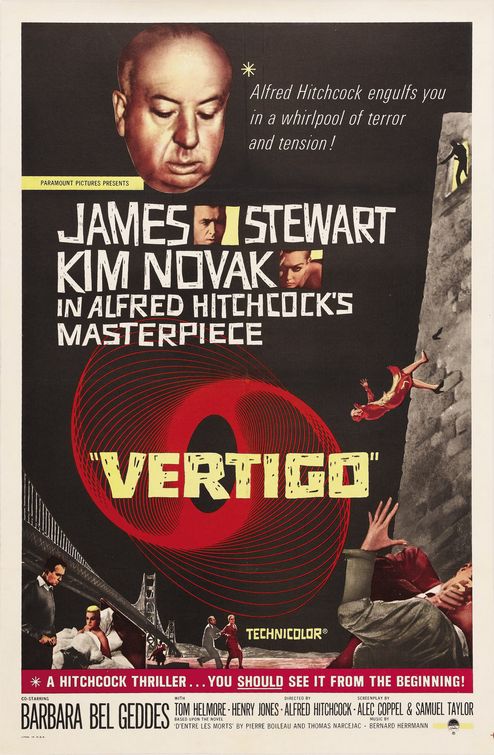 For no real reason other than the fact it was lying in the huge pile of library DVDs besides my TV, the first film I have decided to check out is Alfred Hitchcock’s Vertigo (1958). Hitchcock is probably the most iconic director in cinema history but my personal experience with Hitchcock only extends to two films. I watched the first, Psycho (1960) for a high school English class quite a few years ago now. Whilst I haven’t seen it since then I remember being shocked (in my school boy innocence) that I could like an old film so much. I was also struck by the technical skill of Hitchcock and the manner in which each shot had something to say. Not to mention one of the most famous twists in all of cinema history. I saw my second Hitchcock film a month or two ago as part of a first year uni course. It was Rear Window (1954) and whilst again I was astounded by Hitchcock technical proficiency, I was somewhat underwhelmed by the film overall. For some reason the story just did not grab me and whilst the set was incredibly constructed, I felt the film at times constrained by its setting. It will be interesting to see if these sentiments hold up with a second viewing of these films (Hitchcock has a massive 18 films including these 2 on the 1001 list).
So now, after that rather longwinded intro, on to Vertigo. My film studies lecturer described this film as probably Hitchcock’s best and most well realised film. My knowledge of the director’s work is not sufficient to make any such claims but it is certainly an exceptional work. It opens with a long and beguiling credit sequence featuring extreme close ups of a face and whirling graphics. It really is a treat to watch in an age where credit sequences generally consist of a bunch of names over some average graphics that someone has slapped together at the last moment (Zack Snyder’s Watchmen (2009) is one recent film which bucks this trend). From here the film jumps straight into a chase scene across rooftops, accompanied by unrelenting music. The tension is high and we see a police officer plunge to his death whilst attempting to save the life of his colleague.
 Finally the audience is able to draw breath. We are introduced to the police officer that watched the other one plunge to his death. His name is John ‘Scottie’ Ferguson and we learn that as a result of the incident he now suffers from extreme vertigo and has retired from the force. He has been told that only another shock to the system like the initial one he suffered will overturn the condition. My ears pricked on hearing this. I was certain at some stage we would see this second shock to his system. In this sequence Ferguson is chatting to his lifelong friend Midge. The relationship between the two is lovingly portrayed throughout the film. They have a believable rapport and inject some humour into the film. Personally my enjoyment of the film was at its greatest when these two characters were on screen together.
The major plotline of the film kicks off when Ferguson receives a call from an old college acquaintance who asks him to follow his wife. In the opinion of this college friend his wife has been possessed by a dead women. Scottie initially scoffs at this suggestion but reluctantly agrees to trail the wife. After saving the wife Madeline’s life when she jumps into San Francisco Bay, Scottie and her fall in love. It is an affair that seemed somewhat uncomfortable to me as a viewer. Not just cause she was a married woman but also because she was clearly mentally unstable and Scottie seems to have no qualms taking advantage of this. I was not sure why Scottie falls for Madeline, why he initially chooses to make a move on her. This initial plotline ends with Scottie’s vertigo coming back to haunt him as he watches his love plunge to her death from the roof of a church.
It is here that the film takes an unexpected tonal shift. Prior to this it has been a reasonably conventional (but brilliantly shot) thriller. The audience is subjected to a scary nightmare sequence into which Hitchcock inserts pieces of animation. This is a bold sequence which could easily have backfired and come off looking twee, or just downright laughable. But it works exceptionally well and it is on this sequence that the whole film turns. From here it is Scottie’s sanity that it in question. He tracks down and seduces a woman who he thinks looks somewhat like Madeline. He forces this woman Judy to buy clothes that match those Madeline wore and colour her hair the same striking blonde colour. These scenes, with Scottie forcing the increasingly uncomfortable Judy to do his bidding are exceptionally unsettling even to the modern viewer and really complicate ones feelings toward Scottie. These scenes reminded me a lot of a similarly unsettling scene late in James Ellroy’s classic crime novel The Black Dahlia which I have no doubt were heavily inspired by Vertigo. The film concludes with Scottie uncovering the film’s big twist, that he has been played and with Judy accidentally plunging to her death. The end of the film left me unsure as to how I was meant to view Scottie. His actions toward Judy in forcing her to dress like Madeline were clearly those of someone not of sane mind and this unnerving chronicle of his obsession really coloured my opinion of the film’s supposed ‘hero’.
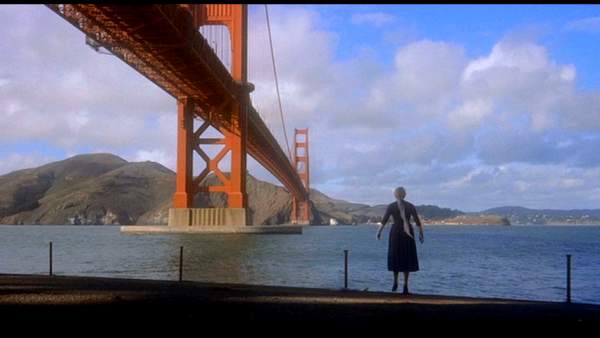
The use of music by Hitchcock dominates much of this film in much the same way that the setting dominates Rear Window in my opinion. And the film is majestically shot and composed, with many scenes of the film being artworks in themselves. The high camera angle shot of Madeline’s body being discovered whilst Scottie flees the church springs to mind as a picture that would look pretty cool hanging on my wall. Like any film, this is an imperfect one. But to examine the films flaws – such as the character’s occasionally underdeveloped motives and the unsatisfactory tying up of the initial thriller plotline – in any great detail is really to quibble unnecessarily. It is a brilliantly made and at times exceptionally unsettling film.
Verdict: Pint of Kilkenny
Progress: 1/1001
Ratings System
I agonised for quite some time over whether I should use a ratings system for each film that I view. I didn’t feel particularly qualified to denote the ‘star’ value of films, but in the end decided it was important to grade them in some way. So in the end I came up with my own, more personal five-tiered system:
- Melbourne Bitter Longneck – The King of Beers. A title reserved for what are in my opinion the kings of movies. In a nutshell, this is a movie I think everyone should go out and watch straight away, no excuses (accompanied by a MB longneck of course)
- Pint of Kilkenny – There is very little better than one of these by the fire in a pub on a freezing Canberra evening. And there is very little better than these films. Denotes an excellent film which comes highly recommended and should be seen by everyone.
- Stubby of Reschs – A very good film. An enjoyable film which maybe didn’t entirely grab me. Reschs never fails to grab me and merely names this rating cause it’s a beer I enjoy a little less than a Pint of Kilkenny.
- Schooner of Carlton Draught – An average beer but one you will drink if there is nothing else going. Films earning this rating are ones that I am surprised were deemed worthy to be on this list, because in reality they do not stand out in any good way and more importantly are not particularly enjoyable.
- Schooner of Tooheys New – This movie, like this beer may induce vomiting on impact and should be avoided at all costs. I’m not really sure if any movies will ‘earn’ this rating, but if they do then you wouldn’t wish for your worst enemy to sit through it.
I would expect, seeing as these are supposedly all great or excellent films that I would tend to dish out more high ratings then generally seen. However time will tell.
Not Now, I’m Drinking a Beer and Watching A Movie
I am aware that this is in no way an original idea for a blog. Its purpose is to chronicle my attempts to track down and watch the 1001 films I should apparently see before I kick the bucket. * I’m sure others have undertaken and chronicled similar quests. I also make no claim of being a film critic. Rather I will use this forum to share my views on what I liked and did not like in individual films. I will not be making any claims regarding the ‘greatness’ of films; rather I will be making comments on what amongst them are my ‘favourites.’ Two very distinct things. At the time of beginning this blog I have already seen somewhere around 70 – 80 of the films on this list. I will re-view them for the purposes of commenting on them here as I go along.
I was motivated to take the time to start commenting on these films for a few different reasons. Already in tracking down and viewing some of these films I have been exposed to filmmakers whose work I would never have seen otherwise. Orson Welles and Werner Herzog are two who spring to mind. Maybe by writing about these filmmakers others will be inspired to search out the films of directors such as these. Secondly is that hopefully by maintaining this blog I will be more motivated to keep up at watching these films and keep tracking down some of the more obscure works on the list. And lastly is that I, like many people I am sure have quite a poor memory. So hopefully by recording my feelings about these films I will have something to look back on when my memory of them fades somewhat.
Sourcing the films on this list, especially the earlier ones is not always easy. The main place that I source them from is the local library system here in Canberra which operates an excellent service. Other places I find them are in my own personal DVD collection, local video shop, university and through mates. I am sure that as I make my way through this list I will come across a number of films which elude me. So I will occasionally share with you my attempts to track down these hard to find films.
I would love to hear your comments and opinions on my posts. Let me know if you agree or (politely) disagree with my sentiments. But please also bear in mind that these are my personal opinions and personal opinions can never be wrong (unless you like Nickelback or Dan Brown books, in which case they are).
Thats it for now. Time that I started watching a movie rather than continued sitting in front of my computer writing about it. Stay well.
* My list is sourced from the widely available book 1001 Movies You Must See Before You Die edited by Steven Jay Schneider and published in Australia by Harper Collins.
 Beermovie.net